Gustav Klimt:
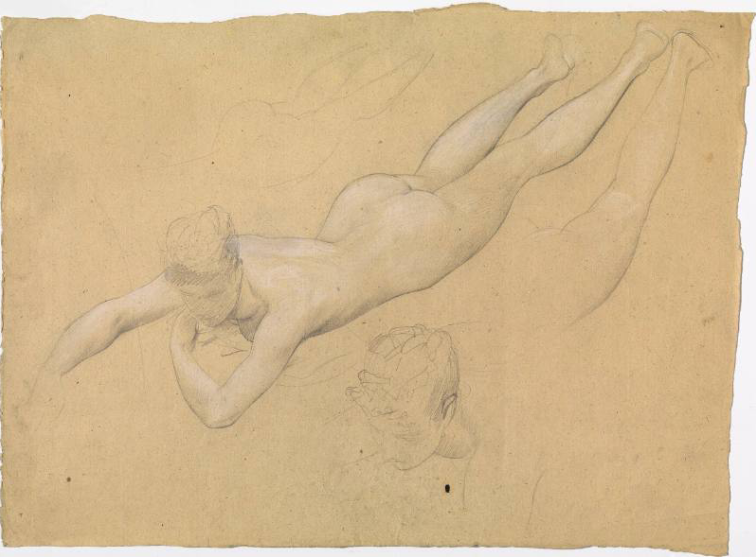
Floating Nude (Schwebender Akt), 1885–1886
Pencil heightened with white on wrapping paper
32 × 43.5 cm
University of Applied Arts Vienna, Art Collection and Archive
source: ©ALBERTINA Digitale Publikationen)
(Strobl s3282)
In 1885, a twenty-three-year-old Gustav Klimt sketched this hovering figure on ordinary brown wrapping paper to solve a practical staging problem. He needed an airborne muse for the upper left corner of a massive theater curtain in the spa town of Karlsbad. Placing the rough studio sketch alongside the finished theater curtain reveals how a bare life study turned into theatrical spectacle.
Spotting the Figure on the Karlsbad Curtain
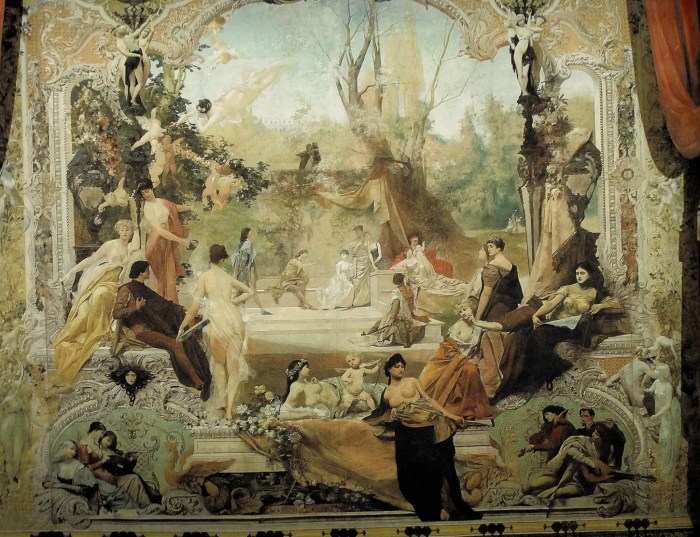
During the 1880s, Gustav Klimt ran a busy decorative studio with his brother Ernst Klimt and their fellow student Franz Matsch. Known as the Künstler-Compagnie, the trio received steady commissions from the Viennese architects Ferdinand Fellner and Hermann Helmer, who built theaters across the Austro-Hungarian Empire. In 1885, the partners began painting Homage to the Art of the Stage, a monumental 6.7-by-8.5-meter oil curtain for the new Municipal Theater in Karlsbad (now Karlovy Vary in the Czech Republic).
Look at the upper left section of the finished curtain, just above the dark green treetops and directly beneath the white rococo arch. There she is: dressed in flowing translucent white fabric and surrounded by small winged putti, gliding downward along the exact diagonal Klimt tested on paper. The theater opened on May 15, 1886, and following a major restoration between 1995 and 1999, the original canvas still hangs on its stage today.
Working Methods on Brown Wrapping Paper
Klimt drew this figure on inexpensive wrapping paper with rough, torn edges, a standard working surface in his studio when preparing large architectural decorations. Seen from behind on a steep diagonal, the short-haired model extends one arm forward while tucking the other beneath the chest. Klimt added white highlights along the back, shoulders, and legs to establish how light falls across the body, then sketched a separate detail study of the downward-tilted head and a raised leg in the lower right corner alongside faint contour lines near the top.
This practical working method appears in other decorative studies from the mid-1880s, including Study for the Dancing Little Girl from the ceiling painting “Der Tanz”. Before dressing the figure in theatrical drapery for the curtain, he worked out the exact weight and tilt of the body from life.
A Misdated Note and Bertold Löffler’s Estate
An undated pencil note on the back of the sheet reads: “Diese Zeichnung ist von Gustav Klimt entstanden um 1888” (This drawing by Gustav Klimt was made around 1888), followed by an illegible signature. Whoever wrote that inscription likely confused this study with Klimt’s later ceiling paintings for Vienna’s Burgtheater, such as Male Head (Study for Theatre in Taormina, Vienna Burgtheater). Art historian Alice Strobl later matched the pose to the 1886 Karlsbad curtain, moving its date back to 1885–1886.
The sheet later entered the collection of Austrian painter and graphic designer Bertold Löffler, who studied and taught at Vienna’s School of Applied Arts, the very institution where Klimt had trained. Following Löffler’s death in 1960, the drawing remained in his estate until the University of Applied Arts Vienna acquired it in 1980.
Leave a Reply