Secessione Romana (1913–1916) – Roman Secession
Origins and Intent
Italian Secession art remains deeply compelling—fluid in its evolution, often grouped under the label stile Liberty, though that term never quite captures its full scope. Among its most nuanced expressions was the Roman Secession, active between 1912 and 1917: a moderate avant-garde that rejected both academic rigidity and Futurist provocation.
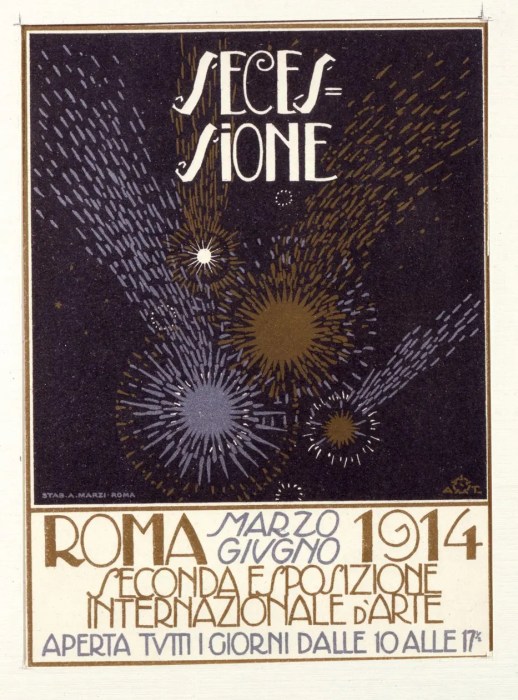
The movement began in 1912, initiated by artists from the Società degli Amatori e Cultori di Belle Arti. Their goal was not to form a school or impose a style, but to challenge the critical and aesthetic systems that had long shaped Italy’s art institutions. Many were already established, and each had followed a personal path—outside the academies, beyond the reach of political patronage.
It is no coincidence that this Secession emerged in Rome, shortly after the fiftieth anniversary of Italian unification. The timing was symbolic: a moment of national reflection gave way to artistic redefinition. Inspired by earlier Secessions in Vienna, Munich, and Berlin, the Roman iteration sought to open Italy to the ferment of international modernism—without abandoning its own traditions.
The Roman Secession distanced itself from Futurism’s radical rupture. While some artists sympathetic to Futurism exhibited individually, the movement as a whole remained apart. No manifestos were issued. No single style was imposed. The Secession allowed artists to speak in their own voices, and that freedom became its defining feature.
Exhibitions and Artists
Between 1913 and 1916, four major exhibitions were held at the Palazzo delle Esposizioni. These gatherings became spaces of dialogue—between Italian innovators and leading European contemporaries. The Roman Secession welcomed diversity, encouraged cross-pollination, and resisted the narrowing tendencies of both academic art and avant-garde dogma.
The exhibitions brought together painters from widely varied backgrounds: Gino Rossi, Felice Casorati, Armando Spadini, Plinio Nomellini, Lorenzo Viani, Laurenzio Laurenzi, Ferruccio Ferrazzi, Felice Carena, Giuseppe Carosi, and the Cremonese painter Emilio Rizzi. Their approaches ranged from lyrical figuration to tonal experimentation, unified not by technique but by independence.

Divisionist influences appeared in the work of Camillo Innocenti, Arturo Noci, and Nomellini. Gustav Klimt’s presence signaled rupture and modernity par excellence—his inclusion underscored the Secession’s openness to European avant-garde currents.
Alongside Belle Époque figures such as Innocenti—who served on the Secession’s executive board—and Giovanni Boldini, the exhibitions welcomed newcomers like Arturo Martini and renowned foreign artists including Paul Cézanne, Henri Matisse, and Pablo Picasso. Women were present too, notably the Turin illustrator Vittoria Cocito, whose participation marked a quiet but meaningful shift in visibility.
The stylistic range was wide: from Symbolist reverie to Post-Impressionist structure, from Divisionist light to early Expressionist tension. What united these artists was not a shared aesthetic, but a shared refusal to be confined.
Legacy and Reflection
Though the Roman Secession did not continue beyond 1916, its exhibitions left a lasting imprint on the trajectory of Italian modernism. Later overshadowed by the louder gestures of Futurism, the Secession’s quieter pluralism offered a vital alternative—one that would echo in the Biennali Romane, the early Quadriennali, and in the careers of artists who continued to explore modernity without rupture.

In its refusal to shout, the Roman Secession made space for something subtler: a modernity rooted in dialogue, memory, and the dignity of individual vision.