Egon Schiele:
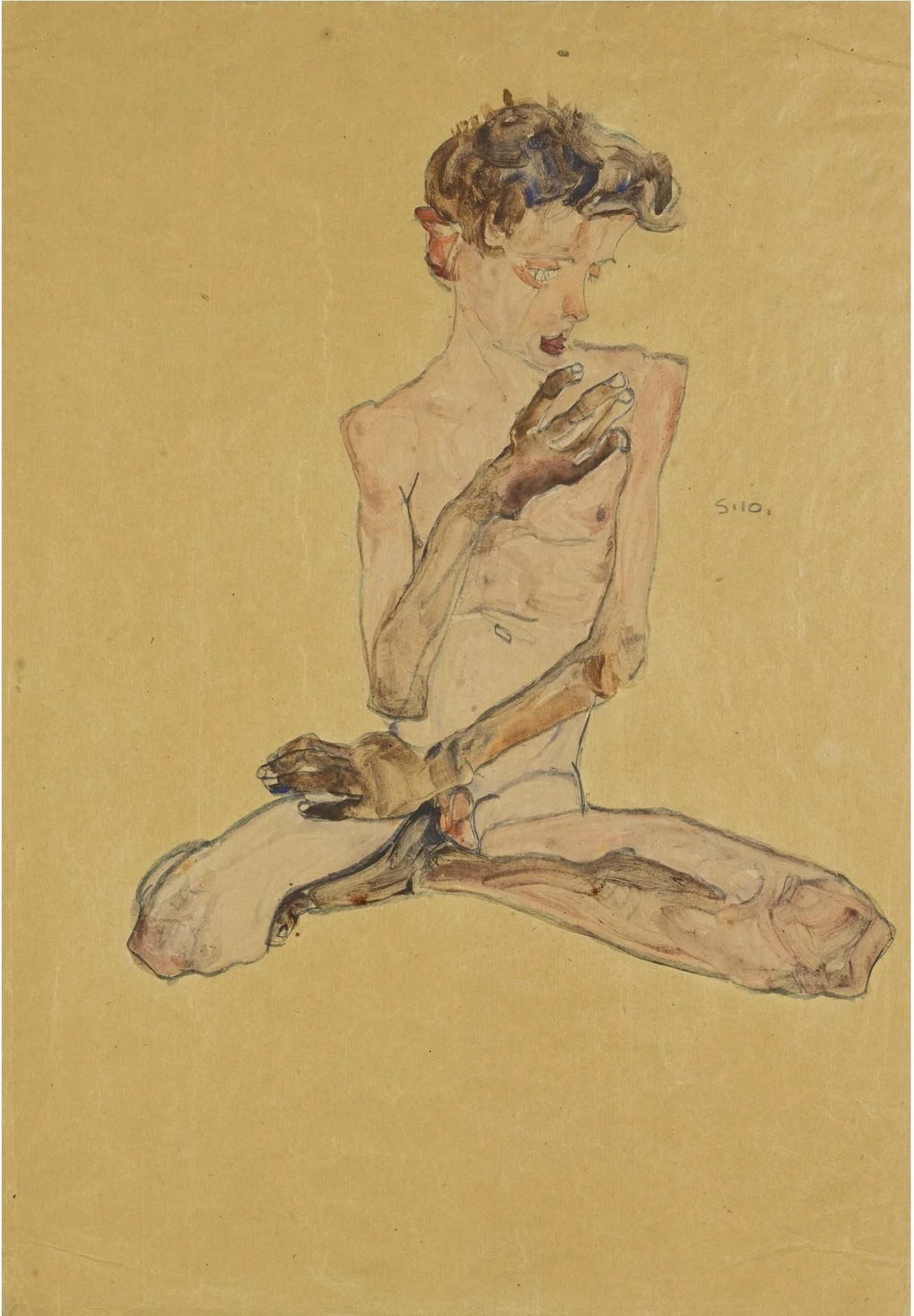
Seated Boy (Sitzender Junge), 1910
Gouache, watercolor, and black crayon on buff wove paper
45.1 × 31.9 cm
Private collection (Sold at Sotheby’s, New York, November 5, 2015)
(Kallir d675a)
In 1910, a twenty-year-old Egon Schiele was searching for a new way to draw the human figure. Seated on warm buff paper, this slender boy twists into a strained pose that no model could hold for long. Tiny pinholes in the top corners still mark where Schiele tacked the sheet straight onto his studio wall.
Sharp Contours and Earthy Gouache
During 1910, Egon Schiele stripped away decorative backgrounds to isolate bone, tendon, and posture. Black crayon carves the boy’s narrow shoulders and folded limbs against the empty buff sheet. He tucks his left leg inward, bends his right leg behind him, and drops his gaze downward to the right.
Look closely at the contrast in paint across his skin. Schiele left the chest and thighs translucent, letting the raw brownish paper act as flesh. Then he loaded dark brown gouache onto the forearms and oversized hands, turning his raised left hand near the chin into the physical anchor of the entire drawing. Touches of bright red on the lips, ear, and eyelids draw the eye back again and again to the boy’s presence.
Schiele’s 1910 Studies of Youth
Schiele frequently brought working-class boys and teenagers from Vienna’s outer districts into his studio during 1910. Those sessions produced urgent, unsentimental studies caught mid-breath rather than formal portraits.
This fierce physical honesty links the sheet directly to other 1910 works on paper, including Sitting Boy with Folded Hands and Boy with a Long Smock. Across all three sheets, jagged outlines hold the sitter in place while carefully placed touches of colour give each figure a distinct presence.
From Galerie Würthle to the Taubman Collection
The sheet’s documented path begins at Vienna’s Galerie Würthle, the pioneering gallery later run by Schiele’s early champion Otto Kallir. In the 1960s, Viennese collector C. J. Rittmannsberger bought the drawing there, keeping it in his family until it crossed the block at Sotheby’s London on June 26, 2008.
The winning bidder was A. Alfred Taubman, the American businessman and longtime chairman of Sotheby’s who built a major modern art collection. Following Taubman’s death in 2015, Seated Boy returned to the saleroom at Sotheby’s New York on November 5, 2015, entering another private collection.
Leave a Reply