Gustav Klimt
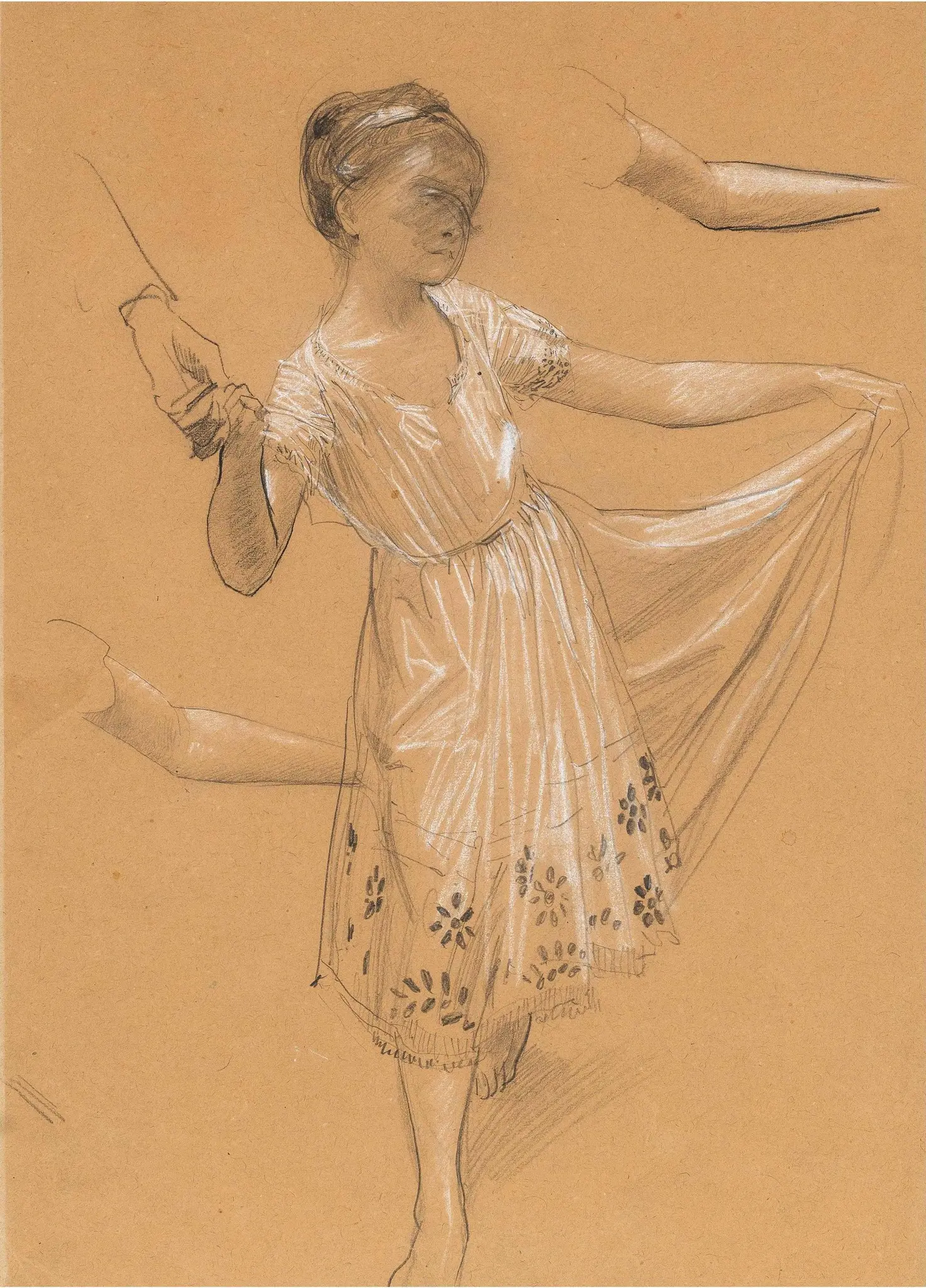
Study for the dancing little girl from the ceiling painting “Der Tanz” (Studie für das tanzende kleine Mädchen des Deckenbildes “Der Tanz”), 1885
Pencil, chalk, white heightening on paper
45 × 31.7 cm
Auctioned at Dorotheum, Vienna, 2023
(Strobl s134)
This preparatory drawing reveals Klimt’s early mastery of movement and ornamental grace. The central figure—a young girl lifting the hem of her dress with both hands—embodies a moment of poised exuberance. Her gesture is not merely anatomical but theatrical: the lifted skirt reveals floral motifs along the hem, suggesting Klimt’s sensitivity to decorative rhythm even in his studies.
Surrounding the figure are anatomical sketches of arms and feet, rendered with varying degrees of finish. These peripheral studies hint at Klimt’s iterative process, his search for the right articulation of limbs to match the ceiling’s curvature and the choreography of the larger ensemble. The white heightening across the folds of the dress adds volume and texture, anticipating the luminous surfaces of his later work.
Created in preparation for Der Tanz, the ceiling painting in the auditorium of the city theatre in Karlovy Vary, this sheet offers insight into Klimt’s early collaborative phase with Ernst Klimt and Franz Matsch. The trio was tasked with transforming theatrical architecture into a living tableau, and this study reflects Gustav’s particular gift for animating allegory with youthful vitality. The girl’s lifted pose, her floral hem, and the surrounding anatomical fragments all suggest a careful calibration between spontaneity and structure.
As a ceiling commission, the final composition demanded careful foreshortening and ornamental balance, ensuring the figure remained legible and graceful when viewed from the auditorium floor. Klimt’s line is confident yet tender, already hinting at the sensuality and surface play that would later define his Secessionist work.
Created before Klimt’s formal break with academic tradition and his founding role in the Vienna Secession, this study reflects the disciplined elegance of his early commissions. Her expression, though lightly sketched, conveys a quiet joy, as if caught mid-reverie rather than mid-performance—a moment of pure draftsmanship, where the joy of dance meets the rigour of architectural commission.


Leave a Reply