Egon Schiele:
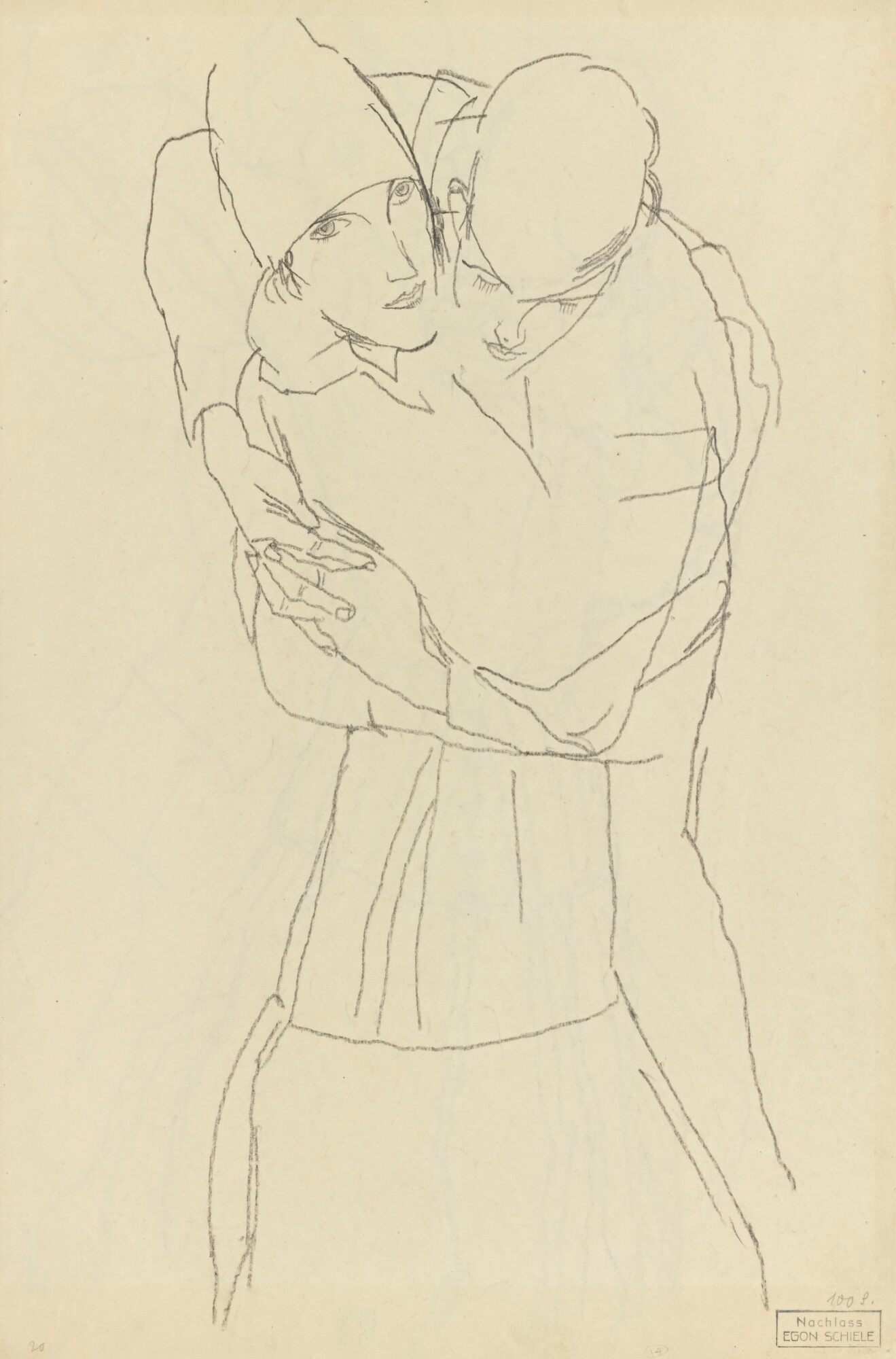
Embracing Couple (Egon and Edith Schiele) (Umarmendes Paar), 1915
Pencil on paper
48.2 × 32.2 cm (19 × 12 5/8 in.)
Leopold Private Collection, Vienna
(Kallir d1792)
Two people stand locked in an embrace. At first glance, it looks like a simple image of intimacy, but Schiele makes the moment more complicated than that. Edith buries her face against him, while he continues to look outward. The result is a drawing that feels both deeply connected and slightly distant at the same time.
Two Ways of Holding On
Look first at the hands. Wrapped tightly across the middle of the drawing, they pull two figures together with real force. At first glance, this 1915 pencil drawing by Egon Schiele looks like a straightforward portrait of love: the artist and his new wife, Edith Harms, standing in a close embrace. Yet the longer you look, the less the drawing seems to be about romance and the more it becomes a study of two people simply holding on to each other. Look a little longer, though, and you notice that the two people in the drawing are having very different experiences of the exact same moment.
Edith is seen almost entirely from behind, her face buried against his chest. Even without seeing her features, anyone familiar with Schiele’s work from 1915 recognizes her right away. She wears the fitted, narrow-waisted dress and the tall, peaked cap that show up in several portraits of her that year. Her body leans fully into him, and the long, straight lines of her skirt give the lower half of the drawing a solid, grounded weight.
Looking Out from Inside the Embrace
Above Edith’s shoulder, Schiele’s own head appears and changes the mood completely. While Edith turns inward, hiding her face in the embrace, Schiele looks straight out toward us. He draws his face as a sharp, angular wedge with short-cropped hair and tiny, pin-prick pupils. His expression is difficult to read. Rather than disappearing into the embrace, he continues to look directly out at us. While Edith disappears into the embrace, Schiele remains fully visible. His gaze meets ours directly, creating a striking contrast between the hidden face pressed into his shoulder and the face that looks back out from the drawing. The two figures are physically inseparable, yet they do not experience the moment in quite the same way.
What makes the drawing especially unusual is how little conflict it contains. Instead, the two bodies seem to merge into a single shape, united by the sweeping lines of the embrace. That tension between closeness and separateness appears again and again in Schiele’s work from these years. Even in moments of intimacy, his figures often seem locked in their own private worlds.
A Marriage Just Before War
What was happening in Schiele’s life in June 1915 explains a lot of that tension. Earlier that spring, he had ended his four-year relationship with his longtime model and partner, Wally Neuzil. In June, he married Edith Harms, a middle-class neighbor from across the street in Vienna’s Hietzing district, just days before he had to report for military service in the Austro-Hungarian army. Marriage, domestic life, and the prospect of military service arrived almost simultaneously.
Embracing Couple belongs to a group of drawings from that year in which Schiele repeatedly returned to Edith as a subject. The same distinctive cap and fitted silhouette appear in works such as D 1793 and D 1796, while the closely connected figures of D 1797 explore a similar sense of physical closeness. Again and again, he returned to the question of how two people can occupy the same space while still remaining themselves.
Less Line, More Empty Space
If you compare this sheet to Schiele’s earlier drawings, you can also see his hand changing. The nervous, broken lines of his early twenties are gone. Here, he uses long, clean pencil strokes that follow the curve of a shoulder or the fall of a sleeve without hesitation. Just as important is what he leaves out. Large areas of the cream-colored paper remain completely blank. The blank paper keeps all attention on the embrace itself.
In the bottom right corner sits a small rectangular stamp reading Nachlass EGON SCHIELE, a mark added after his death in 1918 to record works left behind in his studio. It reminds us that this was not created as a grand public statement, but as a quiet working drawing kept in Schiele’s studio.
What Lies on the Back
Like many of Schiele’s working sheets, this piece of paper was used twice. On the back (verso) is another pencil drawing from 1915, Semi-Nude with Raised Shirt (Halbakt mit hochgezogenem Hemd), showing how easily Schiele moved back and forth between clothed portraits of his wife and unguarded figure studies.
Because the drawing belongs to the Leopold Private Collection in Vienna, it is rarely put on public display. It resurfaced in 2025 for the Leopold Museum’s exhibition Changing Times: Egon Schiele’s Last Years 1914–1918, offering a rare, quiet glimpse into the personal life behind one of the most turbulent chapters of Schiele’s career.
Leave a Reply