
Gustav Klimt (born July 14, 1862 – died February 6, 1918) was an Austrian painter known for his unique style and bold ideas. He was one of the main artists in the Vienna Secession, a group that sought to break away from traditional academic art. Klimt was born near Vienna in a poor family. His father, Ernst Klimt, was a gold engraver, and his mother, Anna Klimt (née Finster), had a deep love for music and hoped one of her children would become a musician.
Gustav was the second of seven children. He had two brothers—Ernst and Georg. Ernst, like Gustav, became a painter and worked closely with him in their early years, while Georg pursued metalwork and developed into a skilled craftsman in the Secessionist style. Their four sisters were Klara, Hermine, Johanna, and Anna. The family often struggled financially, especially as their father’s health declined. One of the earliest losses came in 1874, when Gustav’s younger sister Anna died at the age of five.
Despite these hardships, Klimt showed artistic talent early on. In 1876, at the age of 14, he was accepted into the Vienna School of Arts and Crafts (Kunstgewerbeschule), where he trained in architectural painting alongside his younger brother Ernst and their friend Franz Matsch.
At age 14, he began formal training at the Vienna School of Arts and Crafts, where he studied to become an architectural painter. This academic education gave him strong technical skills and a solid foundation in classical art, which shaped his early career.
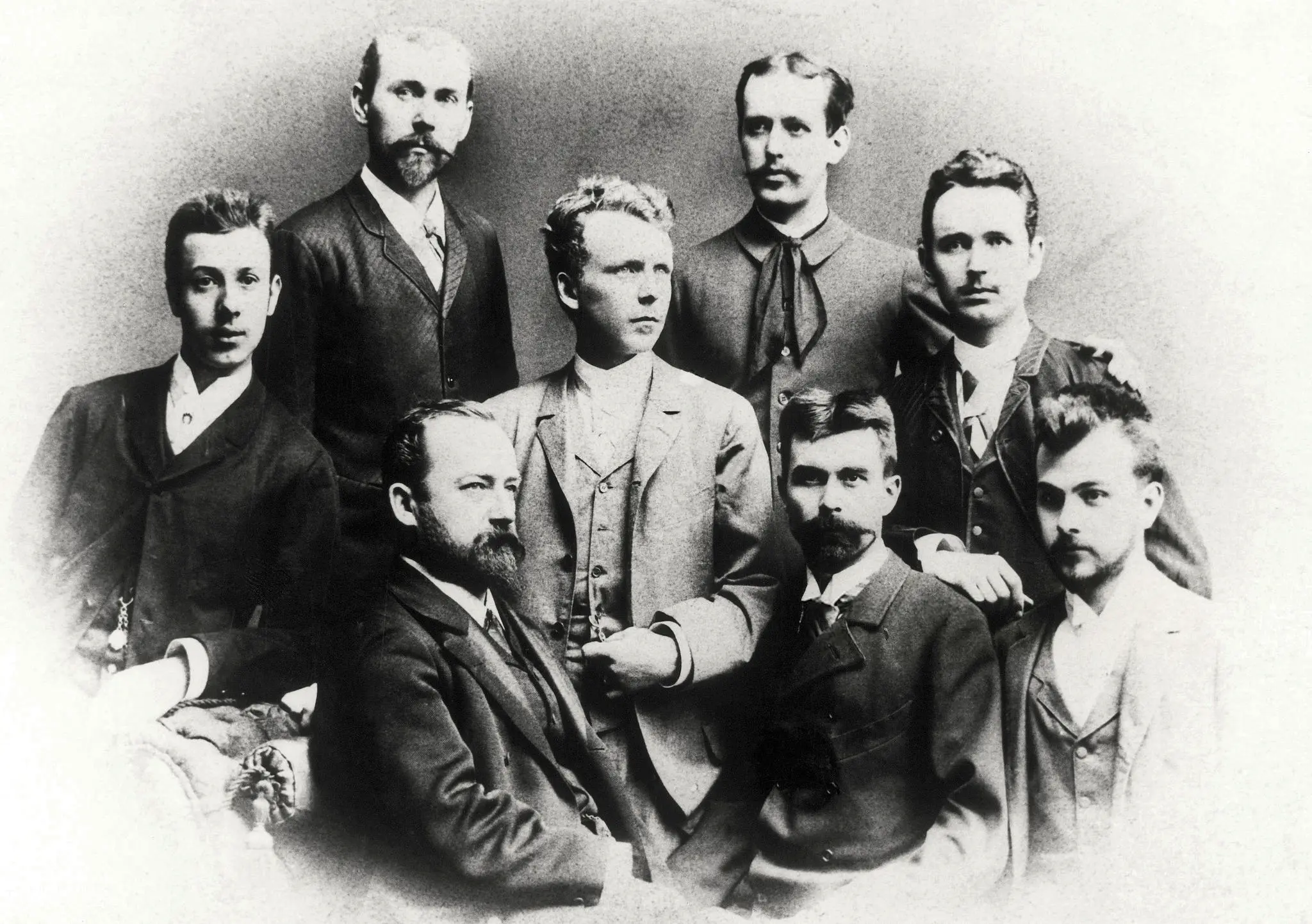
At first, Klimt painted in a more academic way. In the early 1880s, Gustav Klimt formed a close artistic partnership with his younger brother Ernst and fellow painter Franz Matsch. Together, they established the Künstler-Compagnie, a collaborative studio that specialized in large-scale decorative commissions. The trio quickly gained recognition for their academic style and technical precision, producing murals and ceiling paintings for prominent public buildings. Their work adorned theaters, museums, and other cultural institutions, reflecting a shared commitment to classical aesthetics. The partnership thrived for nearly a decade.
But in 1892, tragedy struck: his father, Ernst Klimt Sr., died in July, and just a few months later, in December, his younger brother Ernst died unexpectedly at the age of 28. These losses deeply affected Gustav and marked a turning point in his artistic direction.
After Ernst’s death, Gustav became the legal guardian of his niece Helene, the daughter of Ernst and his wife, Helene Flöge—who was also the sister of Emilie Flöge. With the family suddenly shaken by loss, Gustav stepped in to support them, taking on a significant share of responsibility for young Helene’s upbringing and remaining closely involved in her life.
Klimt was not only a founding member of the Vienna Secession in the late 1890s—he was its first president and one of the driving forces behind its vision. Together with a group of younger artists, he broke away from the conservative Künstlerhaus to create a space where modern art could flourish without academic restrictions. Under his leadership, the Secession championed international exchange, introduced Viennese audiences to new artistic movements, and established its own exhibition building, the iconic Secession Pavilion designed by Joseph Maria Olbrich.
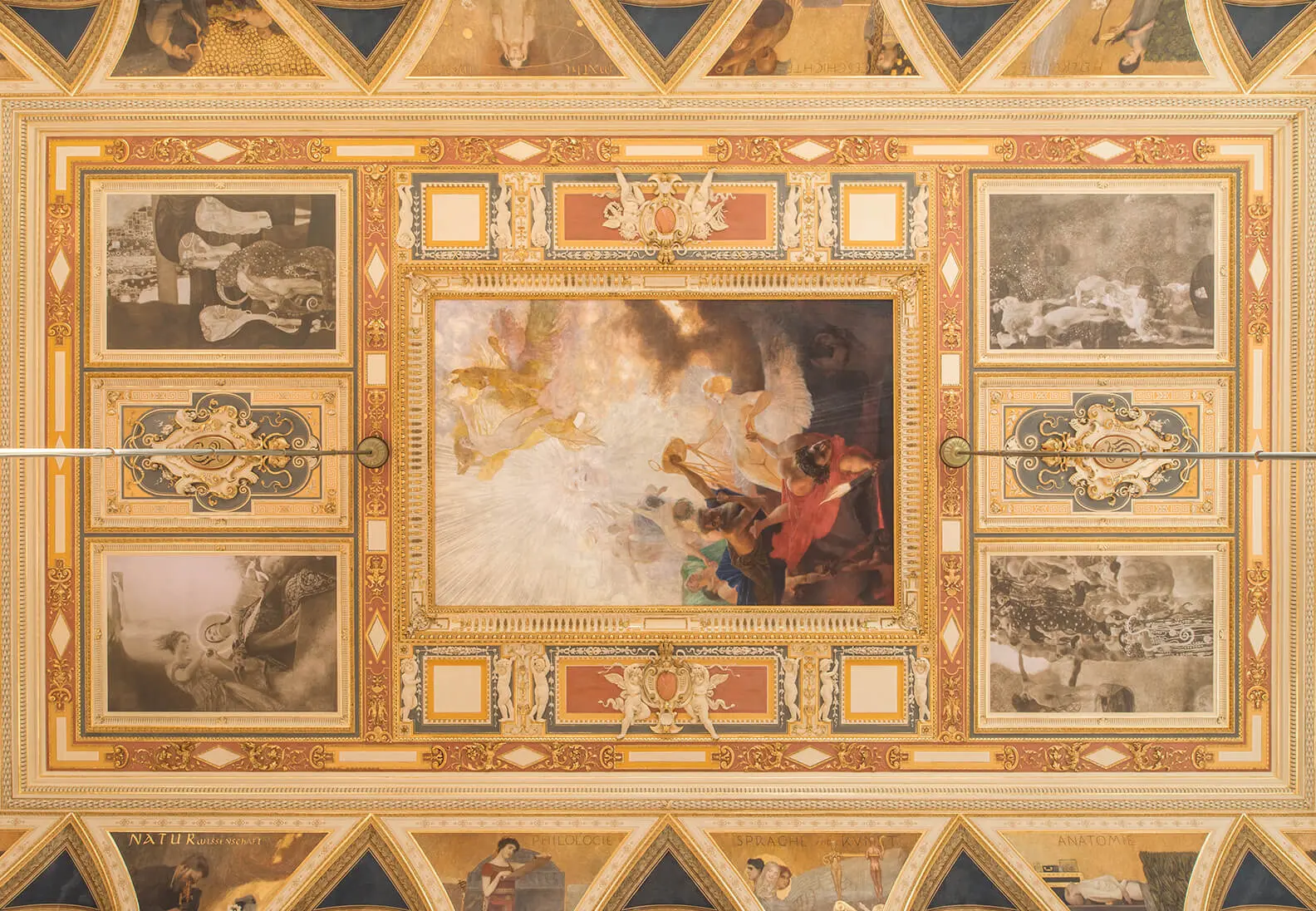
During this period, Klimt began painting in a more personal and daring style, often portraying women in dreamlike, symbolic, or unsettling ways. Some of his most controversial works were the Faculty Paintings for the University of Vienna—Philosophy, Medicine, and Jurisprudence. Intended as grand allegories, they were condemned for being too erotic, too dark, and too unconventional. The University board ultimately rejected them, refusing to install the paintings as planned.
The public backlash was intense, and Klimt was deeply frustrated by the accusations and moral outrage. In response, he withdrew from state commissions entirely, declaring that he would “not submit to any further interference.” From then on, he worked independently, relying on private patrons and exhibiting through the Secession, where he could pursue his artistic vision without compromise.
In the early 1900s, Klimt entered what’s called his “Golden Phase.” He used gold leaf and detailed patterns to make his paintings shine. Famous works from this time include The Kiss and Portrait of Adele Bloch-Bauer I. His art was inspired by things like Byzantine mosaics and Japanese prints, and it helped shape a style called Art Nouveau.
During this period, tensions within the Vienna Secession came to a head. In 1905, Klimt, along with Koloman Moser, Otto Wagner, and Josef Hoffmann, broke away from the Secession due to disagreements over its direction and increasing institutional control. They wanted greater artistic freedom and a stronger focus on fine art. The group that remained, led by Carl Moll and Josef Engelhart, included artists such as Max Kurzweil, Alfred Roller, and Ferdinand Andri. This faction leaned toward a more conservative and establishment‑friendly approach. The split marked a defining moment in Viennese modernism, with Klimt’s circle pushing the boundaries of personal, symbolic, and decorative expression.
In the wake of the split, Klimt and his allies sought new ways to present modern art on their own terms. Their most ambitious effort was the Kunstschau of 1908, a large independent exhibition organized by the Klimt group. Designed by Josef Hoffmann and staged in a temporary pavilion, the Kunstschau brought together painting, sculpture, architecture, and applied arts in a unified vision of modern Viennese culture. It was here that Klimt unveiled The Kiss, which quickly became one of his most celebrated works. Though financially unsuccessful, the Kunstschau became a landmark event—an assertion of artistic independence and a defining moment for the avant‑garde in Vienna.
Around 1909–1910, Klimt’s style began to shift. He moved away from gold and decoration, focusing more on natural colors, psychological depth, and looser brushwork. His later paintings often had a quieter, more reflective mood. This evolution was partly shaped by his travels—Klimt visited Paris and Spain, where he encountered the works of modern artists such as the Fauves and Toulouse-Lautrec. These influences can be seen in his bolder use of color, expressive line, and more spontaneous handling of paint. Yet Klimt always gave these inspirations his own stamp, blending them with his distinctive sense of intimacy and symbolism.

Klimt kept his personal life quiet. He was close to a woman named Emilie Flöge, who remained by his side throughout his life, and they may have been lifelong companions. Their connection ran deep: Emilie’s sister Helene was married to Klimt’s younger brother Ernst, which brought the families together. Klimt often spent summers with the Flöge family at the Attersee in Upper Austria, where he found both relaxation and inspiration. Emilie, a fashion designer and co-founder of the progressive salon Flöge, shared Klimt’s interest in aesthetics and modernity. Though they never married, their bond endured for decades—reflected in letters, photographs, and the quiet presence she maintained in his life.
Klimt kept his personal life quiet. He first met Emilie Flöge in the early 1890s, when his younger brother Ernst married her sister Helene. From that moment on, Emilie became a constant presence in his life, and their bond—whether romantic, platonic, or something in between—lasted until Klimt’s death in 1918. Klimt often spent summers with the Flöge family at the Attersee in Upper Austria, where he found both relaxation and inspiration. Emilie, a fashion designer and co‑founder of the progressive salon Flöge, shared Klimt’s interest in aesthetics and modernity. Though they never married, their connection endured for decades, reflected in letters, photographs, and the steady companionship she offered throughout his life.
At the same time, Klimt is known to have had several relationships and fathered children, though he rarely spoke about them publicly. He met Marie “Mizzi” Zimmermann around 1895, and their relationship developed somewhat later, resulting in two sons: Gustav, born in 1899, and Otto, born in 1902, who died at just three months old. He met Maria Ucicka in 1898, and their relationship led to the birth of Gustav Ucicky in 1899. He met Consuela Camilla “Ella” Huber around 1911, and between 1912 and 1915 they had three children together: Gustav, Charlotte (who died in infancy), and Wilhelm. Klimt supported the women and their children financially during his lifetime, and his estate continued that support after his death.

On January 11, 1918, Klimt suffered a stroke that left him weakened and unable to paint. He was hospitalized and never fully recovered. About a month later, on February 6, he died from pneumonia while still in care. Egon Schiele, who deeply admired Klimt and considered him a mentor, was one of the last people to see him alive. After Klimt’s death, Schiele made several drawings of him lying in state—intimate and haunting studies that captured the solemnity of the moment and the profound loss felt across the Viennese art world. These sketches stand as a final tribute from one generation of modernists to the next.
