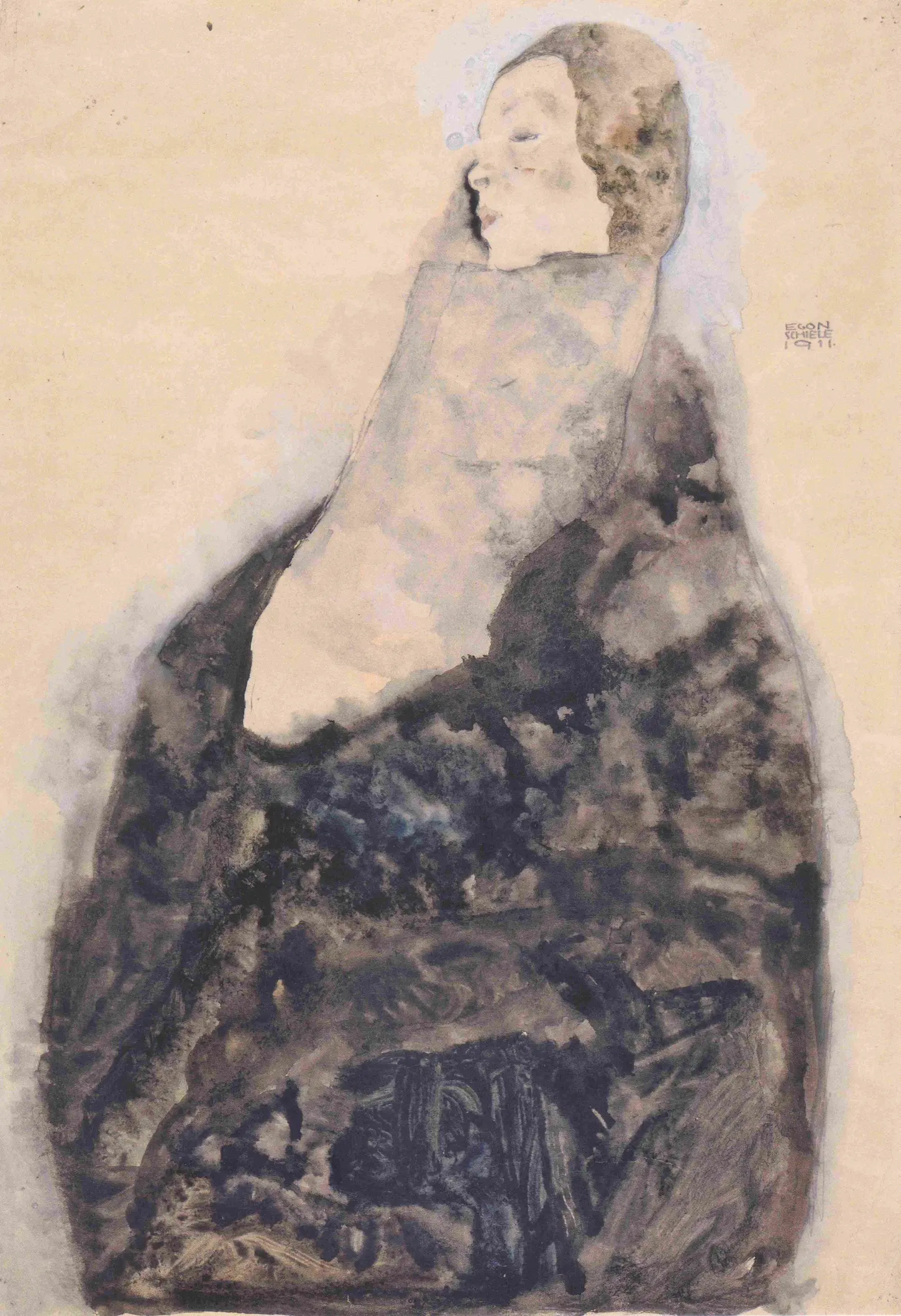
Egon Schiele:
Sleeping Child (Schlafende), 1911
Pencil, watercolor, opaque white on wrapping paper
44.8 cm × 31.5 cm
©Albertina, Vienna
(Kallir d867a)
Egon Schiele returned again and again to the theme of sleep during his intensely productive months in 1911. He increasingly moved away from costly artist’s boards, working instead on inexpensive wrapping paper (Packpapier). In this watercolor, the brown sheet becomes an active, visible element of the composition, not just a surface to paint on.
The Cocoon and the Wet-on-Wet Technique
Schiele painted this work in late summer 1911, focusing on a child asleep beneath a heavy blanket. Working directly on the rough paper, he allowed dark washes to mingle and gather around the figure, enclosing the child in what feels like a protective cocoon. The deep tones create a stark frame around the pale centre of the drawing.
For the face, Schiele treated it differently. He left the skin almost entirely unpainted, allowing the natural brown tone of the wrapping paper to function as the flesh tone. He then used a pencil to define the facial features and clothes. Instead of drawing long continuous outlines, Schiele interrupted his lines repeatedly and added clusters of short strokes to build up the sleeper’s volume and weight.
Parallels with the Sleeping Mother
This technique closely echoes another work from the same period. In his work on The Artist’s Sleeping Mother, 1911, Schiele handled the domestic subject with a similar combination of a heavy frame and exposed brown wrapping paper. In both sheets, sleep is not treated as a moment of physical exhaustion or a state of withdrawal, but as a deep retreat from the outside world. By using the same humble material for both his mother and this sleeping child, Schiele turned the limitations of his studio into a deliberate stylistic choice.
Surviving the War: The Fohn Collection
The drawing’s journey to the museum reflects the turbulent history of modern art in Europe. Under the Nazi regime of the 1930s and 1940s, modern art was confiscated, suppressed, and destroyed across Austria and Germany. During these years, a married couple, Sofie and Emanuel Fohn, continued to acquire works that the authorities condemned as “degenerate.”
The Fohn couple kept this specific Schiele watercolor carefully preserved in their private inventory throughout World War II. Decades later, the Austrian Ludwig Foundation acquired the historic collection and subsequently transferred the drawing to the Albertina Museum as a permanent loan. Today, this sheet offers a glimpse into how Schiele became a radical expressionist, revealing a style forged gradually at the drawing board through persistent experimentation with modest, everyday materials.
Leave a Reply