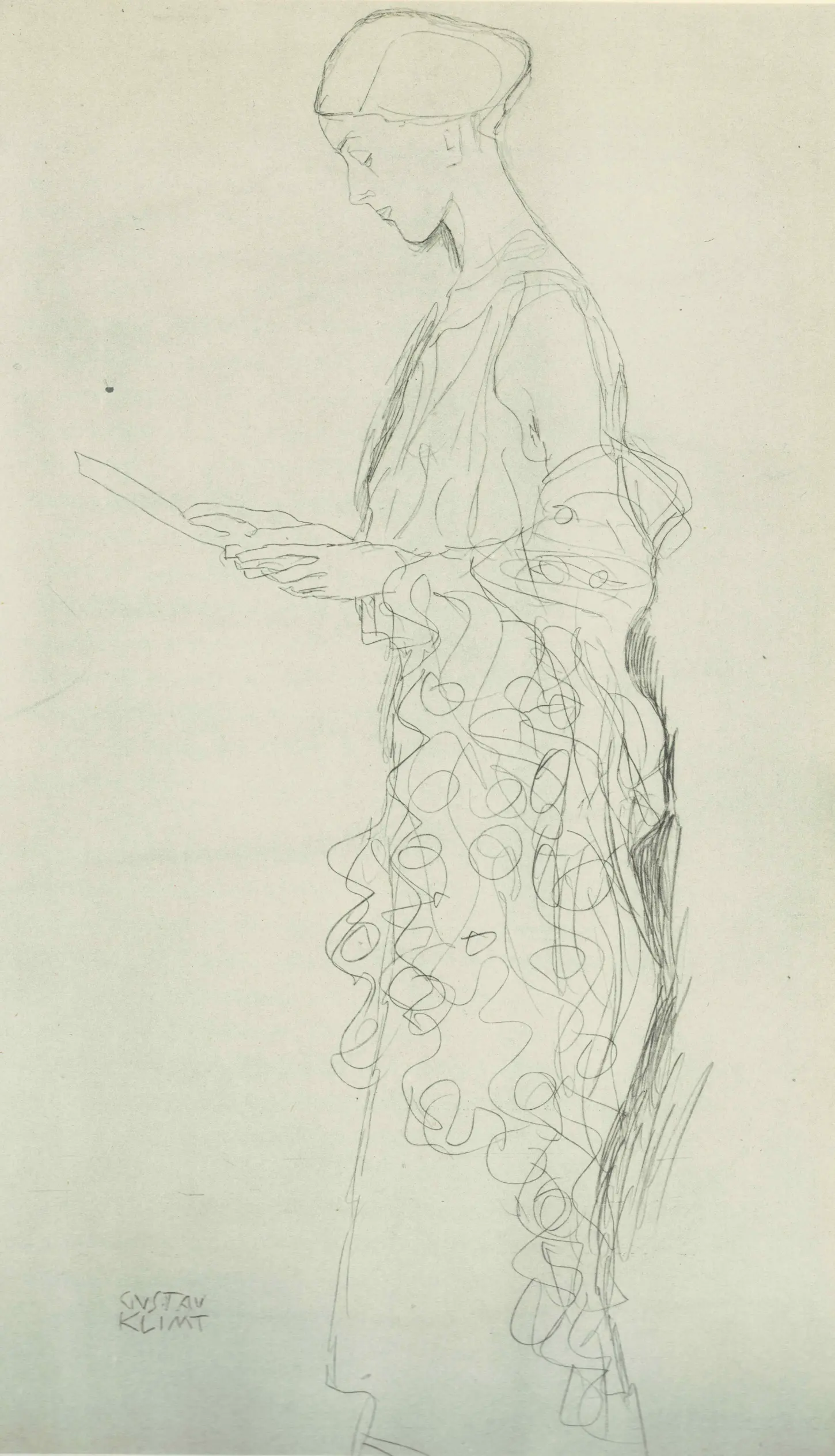
Gustav Klimt:
Woman Reading (Lesende), 1907-1908
Pencil on paper
54.5 cm × 32.2 cm
©Albertina, Vienna
(Strobl s1648)
During the peak of his famous Golden Period, Gustav Klimt proved that he did not need actual gold leaf to make a figure jump off the page. He spent thousands of hours at his drawing board practicing his lines until he could capture a person’s entire mood with just a few strokes of his pencil. This sketch gives us a fascinating look behind the scenes of one of his biggest international projects.
The Ideas That Klimt Threw Away
Klimt originally drew this reading woman while brainstorming ideas for a massive mosaic wall painting inside the Stoclet palace in Brussels. He spent weeks sketching ladies reading and singing to find the perfect look for the dining room walls, but eventually changed his mind completely.
He tossed these quiet, calm concepts aside and replaced them with a dynamic dancer instead, a choice that became the starting point for his famous masterpiece, Expectation. While this specific reading woman never made it onto the palace walls, the leftover drawing remains a quiet, powerful image on its own.
Sharp Focus and Wild Clothes
Klimt loved to play with contrast, even when he was just using a simple graphite pencil. If you look closely at the drawing, you can see how he beautifully combined two totally different styles on the exact same page.
While the woman’s face is drawn with a razor-sharp, steady hand that shows her completely lost in her book, his pencil goes wild as your eyes move down to her clothes. Those lines become fast, energetic, and packed together to form the intricate patterns of her dress. Klimt left the paper blank around her, so the reader completely occupies the page alone.
Safe in the Museum
Unlike many modern drawings from this era, this sheet never disappeared into private hands. Instead of getting lost in private collections or damaged during European conflicts, the sketch stayed safe in official Austrian archives. The gallery looked after the sheet until 1923, before handing it over to the permanent collection of the Albertina Museum.
This sheet is simply a leftover page from a busy workweek in Klimt’s studio. Yet, it remains fascinating to see how easily he captured a quiet moment, using nothing more than a simple pencil to create something that still looks very much Klimt.
Leave a Reply