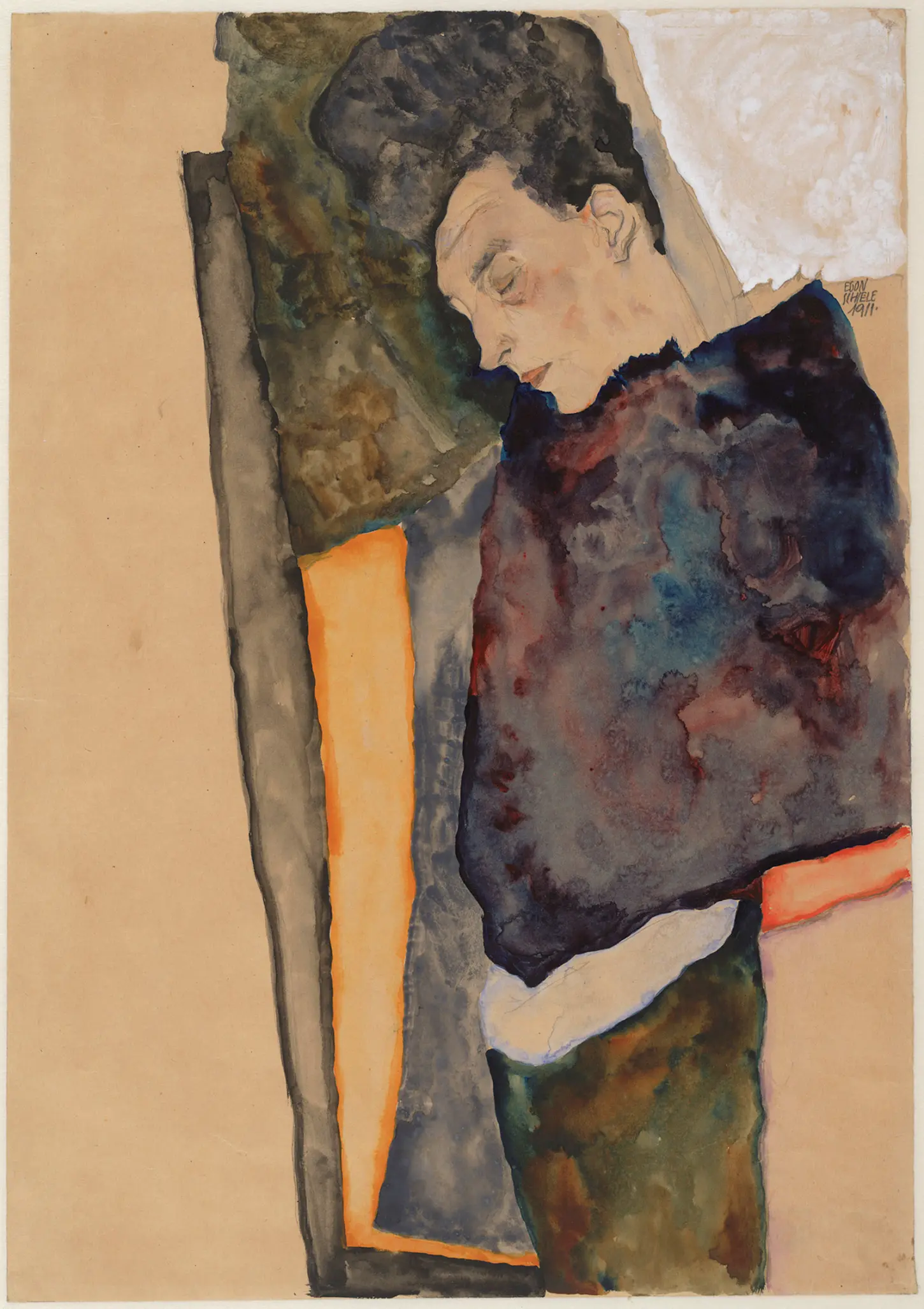
Egon Schiele:
The Artist’s Sleeping Mother (Die schlafende Mutter des Künstlers), 1911
Pencil, watercolor, and opaque white on brown wrapping paper
45 x 31,8 cm
©Albertina, Vienna
(Kallir d865)
By 1911, Egon Schiele had moved completely past his early academic training to develop a highly personal graphic language. This intimate portrait of his mother marks a moment where domestic friction and radical compositional changes intersect on a single sheet of wrapping paper.
A fractured domestic bond
Schiele maintained a deeply troubled relationship with his mother, Marie Schiele. Following his father’s death, he constantly accused her of failing to support his artistic ambitions both financially and emotionally. During the exact year he executed this drawing, Schiele sent her a bitter letter declaring that she lacked any understanding of his creative necessity. In this watercolor, he records her with tightly closed eyes, completely avoiding any visual interaction with her son or the viewer. This choice removes the traditional intimacy usually found in family portraits, turning his mother into a distant, unreadable subject who remains entirely locked inside her own world.
Rotating the paper
The mechanical execution of the drawing reveals how Schiele intentionally broke away from realistic observation. He originally sketched his mother horizontally, resting on a household couch with a patterned wall hanging behind her. However, when placing his signature in the upper right corner, Schiele deliberately turned the sheet ninety degrees into a vertical format. This single rotation instantly changes the meaning of the image. The realistic couch disappears, and the wall hanging becomes an unfixable, shifting pattern. By forcing a horizontal body into a vertical frame, Schiele lifts his mother out of a normal room and leaves her floating in an empty, gravity-free space.
The expert divide
This formal manipulation has caused a lasting disagreement among art historians regarding how the sheet is supposed to be viewed. The collector Rudolf Leopold argued that the signature was merely a decorative element and that the paper should be kept in its original horizontal position to show a sleeping woman. Conversely, researchers like Pia Müller-Tamm and the curators at the Albertina maintain that Schiele’s signature must dictate the orientation. By following the signature, the portrait shifts from a mundane sketch of a nap into a heavy statement on isolation. Schiele uses the cheap, coarse texture of brown wrapping paper to heighten this feeling of displacement.
Traces of ownership
The physical history of the object links directly back to Schiele’s inner circle in Vienna. The reverse side of the paper bears the collector stamp of Arthur Roessler, who purchased the drawing directly from the artist. Roessler kept this family document in his private rooms for decades before the Albertina Museum acquired it from him in 1950. Looking at the final composition, the turning of the page alters more than just the background. One is left to consider whether this floating, silent portrait was a genuine attempt to understand his mother’s grief, or if Schiele used this technical rotation as a final, material way to detach himself from her entirely.
Leave a Reply