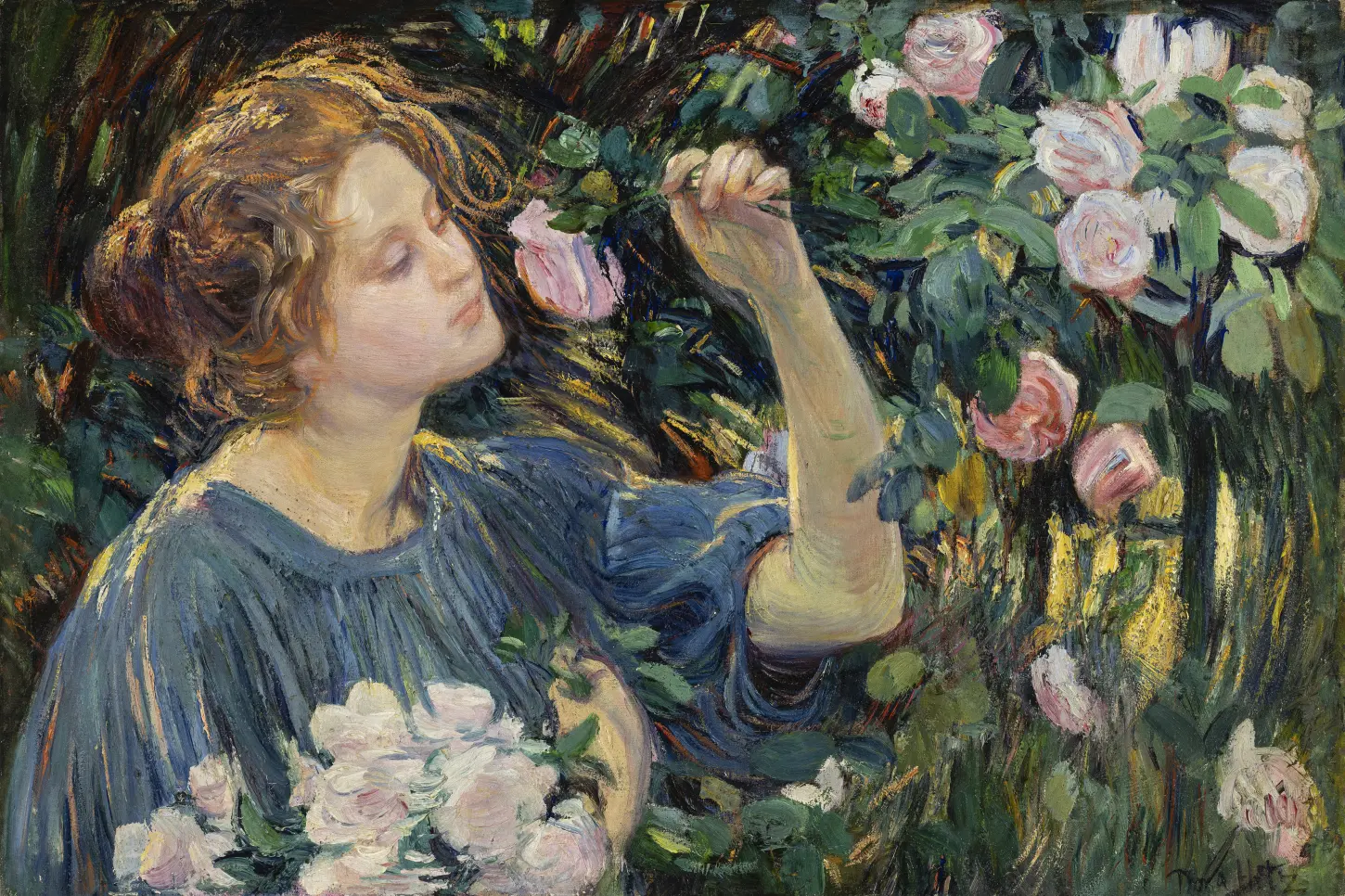
Women of Secession: Dora Hitz:
In the Roses (In den Rosen), before 1913
Oil on canvas
63 x 95 cm
©Museum Wiesbaden, Wiesbaden
Dora Hitz painted In the Roses before 1913. While earlier museum records dated the canvas to a later year, a paper label found on the reverse from the Moderne Kunsthandlung München corrects this timeline. Hitz was active in avant-garde circles, expanding her professional market beyond Berlin into the Munich Secession networks. This canvas marks a clear shift from her early portraits and the large-scale frescoes she executed between 1878 and 1882 as the official court painter for the Romanian royal family at Peleș Castle. Gustav Klimt worked at this exact same royal residence immediately after her departure, executing his first major architectural commissions there from 1883 to 1886. Though Hitz and Klimt missed each other in Sinaia, their paths crossed later through international exhibition networks. Both creators frequently showed their work within the overlapping circles of the Berlin and Vienna Secessions.
The Paris Studio Network
Around 1892, Hitz lived in Paris and studied at the Académie Colarossi. Because state academies barred women from official enrollment, private institutions in Montparnasse became essential hubs for international female artists. Hitz tracks to a large studio that served as a central meeting point for a radical group of young painters. This circle included Julie Wolfthorn, Adele von Finck, and Ida Gerhardi. Her close connections to these artists laid the groundwork for future political solidarity. When Hitz later moved to Berlin, she continued this cooperative approach. She co-founded the Berlin Secession alongside Wolfthorn in 1898 and later ran the Frauenkunstverband alongside Käthe Kollwitz to campaign for equal exhibition rights.
Survival of a Fragmented Archive
The history of this piece highlights the absolute precarity of Hitz’s artistic estate. Although she was one of the most productive and celebrated painters in Berlin, only about 50 of her paintings survive today. The vast majority of her lifework was destroyed during the world wars or lost during decades of institutional neglect. Museum Wiesbaden eventually bought this surviving canvas in 1942 through the Berlin art market. The tragic loss of her wider archive means that every single surviving canvas like this one has to carry the weight of her entire legacy. It makes one wonder what other stylistic breakthroughs disappeared in the ruins of the twentieth century, and how much of early German modernism remains completely hidden from history.
Leave a Reply