Egon Schiele:
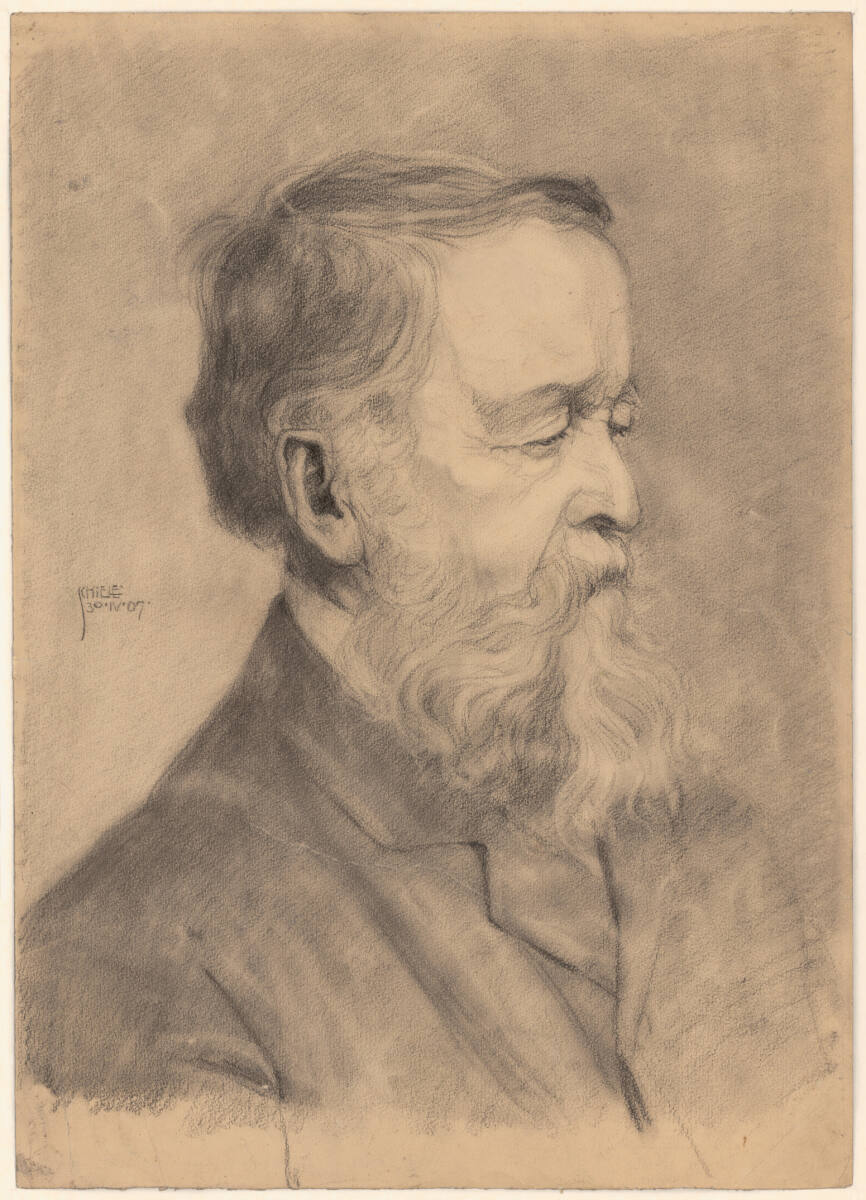
Bust Portrait of a Bearded Man (Brustbild eines bärtigen Mannes), 1907
Black chalk on drawing paper
53.3 x 37.8 cm
©Albertina, Vienna
(Kallir d130)
The early student years of Egon Schiele reveal a heavy struggle with traditional discipline long before the raw energy of his late expressionism emerged. This school assignment shows a teenager mastering the rules of the establishment, even as his internal artistic friction was reaching a boiling point.
The Academy cage
Schiele executed this drawing on April 30, 1907, as a sixteen-year-old student at the Vienna Academy of Fine Arts. His professor, Christian Griepenkerl, was a notoriously strict painter who despised modern art and demanded absolute obedience to the old masters. This portrait was a standard classroom test. Schiele had to prove he could accurately copy textures like a heavy wool coat, a soft beard, and wrinkled skin. The academy forced students into these rigid exercises for hours. It was a system designed to break individuality, but perhaps Schiele’s hand already hints at something less compliant. The heavy, dark line running down the man’s back pushes the figure to the edge of the paper, creating an uneasy asymmetry.
The breakdown of patience
This academic prison quickly turned into an open war. Griepenkerl told Schiele that the devil had defecated him into his classroom, furious at the boy’s restless talent and rapid drawing speed. By 1909, Schiele’s patience completely ran out. He could no longer tolerate the conservative rules, the dust of the plaster casts, and the suffocating atmosphere of the school. He dropped out of the academy, taking several radical classmates with him. Together, they formed the Neukunstgruppe to break away from the academic framework and exhibit on their own terms. This drawing of an old man was one of the very last dues Schiele paid to the old world.
A master’s validation
The exact month Schiele made this drawing coincides with a documented shift in his professional circle. Seeking validation outside the classroom, the seventeen-year-old student initiated contact with Gustav Klimt at his studio. Archival records confirm that Klimt recognized the teenager’s draftsmanship and extended immediate practical support. He purchased several student drawings, facilitated exchanges of work, and provided Schiele with access to his own models. Furthermore, Klimt actively integrated the young artist into his own network of patrons, introducing him to prominent Viennese collectors and securing commissions with the Wiener Werkstätte. While Schiele’s early biographer Arthur Roessler later fabricated dramatic conversations and theatrical praise to build the artist’s legendary status, the material, financial, and institutional assistance Klimt provided remains a matter of historical record.
Looking out the window
The drawing eventually left the studio and entered public memory. It belonged to Karl Hontschik, a government official from Villach, who donated the sheet to the ALBERTINA Museum in 1949. Today, it stands as a record of a young artist on the threshold of a revolution. It is fascinating to look closely at this heavy profile and trace the exact boundary where the rigid demands of the academy begin to dissolve into Schiele’s own restless line. We are left to contemplate how much of his later, explosive autonomy was actually fueled by the years spent under the crushing weight of this conservative discipline.
Leave a Reply