Egon Schiele:
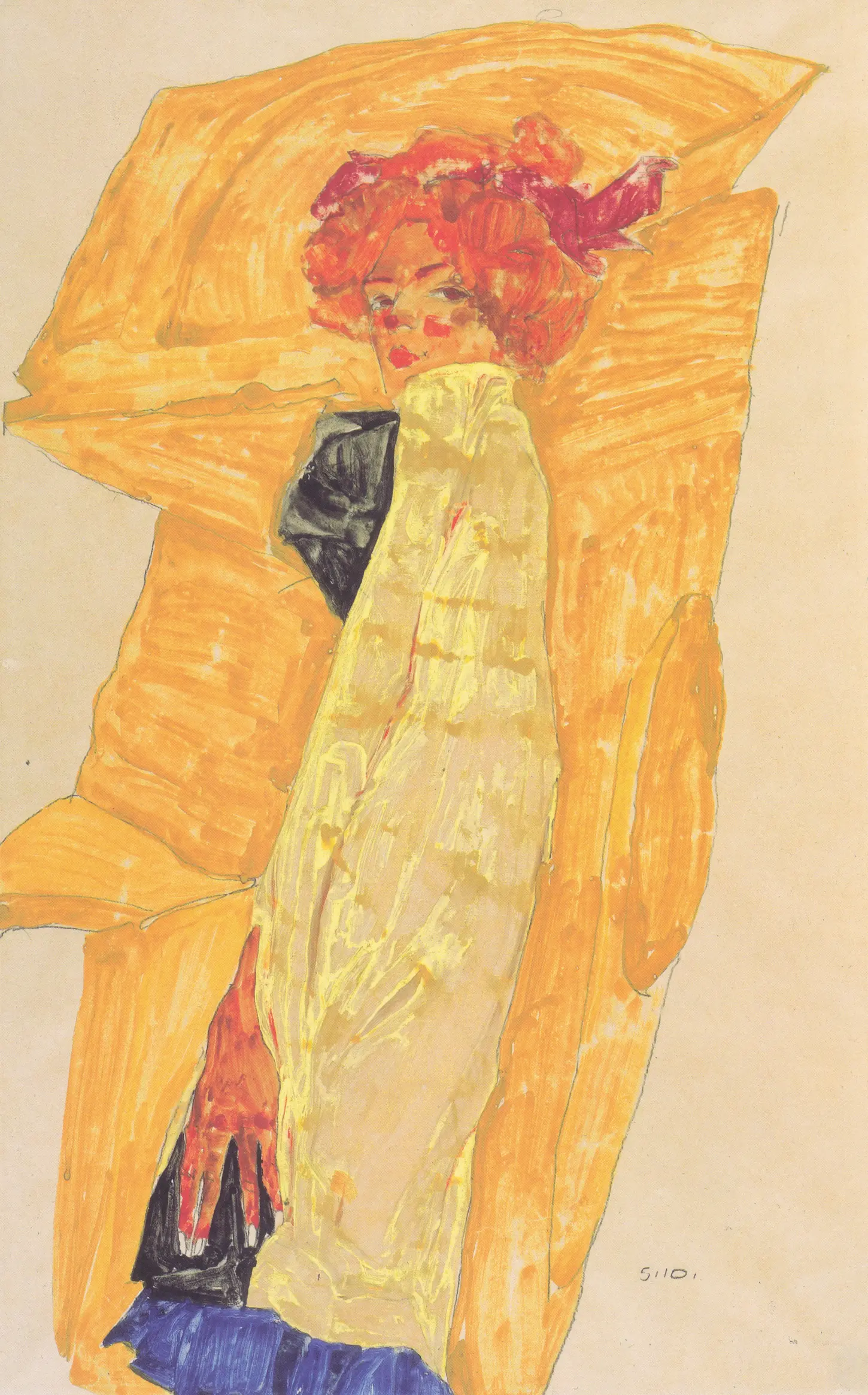
Gerti in Front of Ochre Drapery (Gerti vor ockerfarbener Draperie), 1910
Pencil and opaque colors on Japan paper
55.1 x 34.7 cm
©Albertina, Vienna
(Kallir d510)
Egon Schiele made this drawing of his sister Gertrud in 1910. Everyone called her Gerti. At the time, she was only sixteen years old. She spent endless hours posing for her brother in his small Vienna workspace. This specific sheet has a clean provenance record. A Viennese collector named Arthur Stemmer bought it early on. The Albertina Museum then acquired it from him in 1937. This transaction saved the paperwork just before political events altered the local art market.
Pencil and Opaque Paint
Schiele picked a vertical sheet of Japan paper for this portrait. He used a very sharp pencil to trace Gerti’s silhouette. Her posture looks almost stretched. Her left arm hangs down along her body in an exaggerated line. Schiele did not leave the drawing completely monochrome. He used a splash of opaque red paint to color the big bow in her hair. He used that same red for her lips. The bright background consists of a simple yellow-ochre cloth. This drapery frames her body and creates a shallow room.
Leaving Klimt Behind
The year 1910 was a difficult but crucial moment for Schiele. He broke away from the elegant style of Gustav Klimt. He wanted his lines to be raw and honest. Professional models cost money that Schiele simply did not have. He often could not even afford to heat his rented rooms. Gerti stepped in to solve this practical problem. She sat still for hours in the freezing cold. This family support gave Schiele the freedom to experiment with his new linear technique.
The drawing is the material proof of a simple family arrangement. Without a sister who was willing to spend her free winter days posing for free in a cold room, Schiele could not have made these drawings. His career started with this unpaid help from his sister Gerti.
Leave a Reply