Women of Secession: Dora Hitz
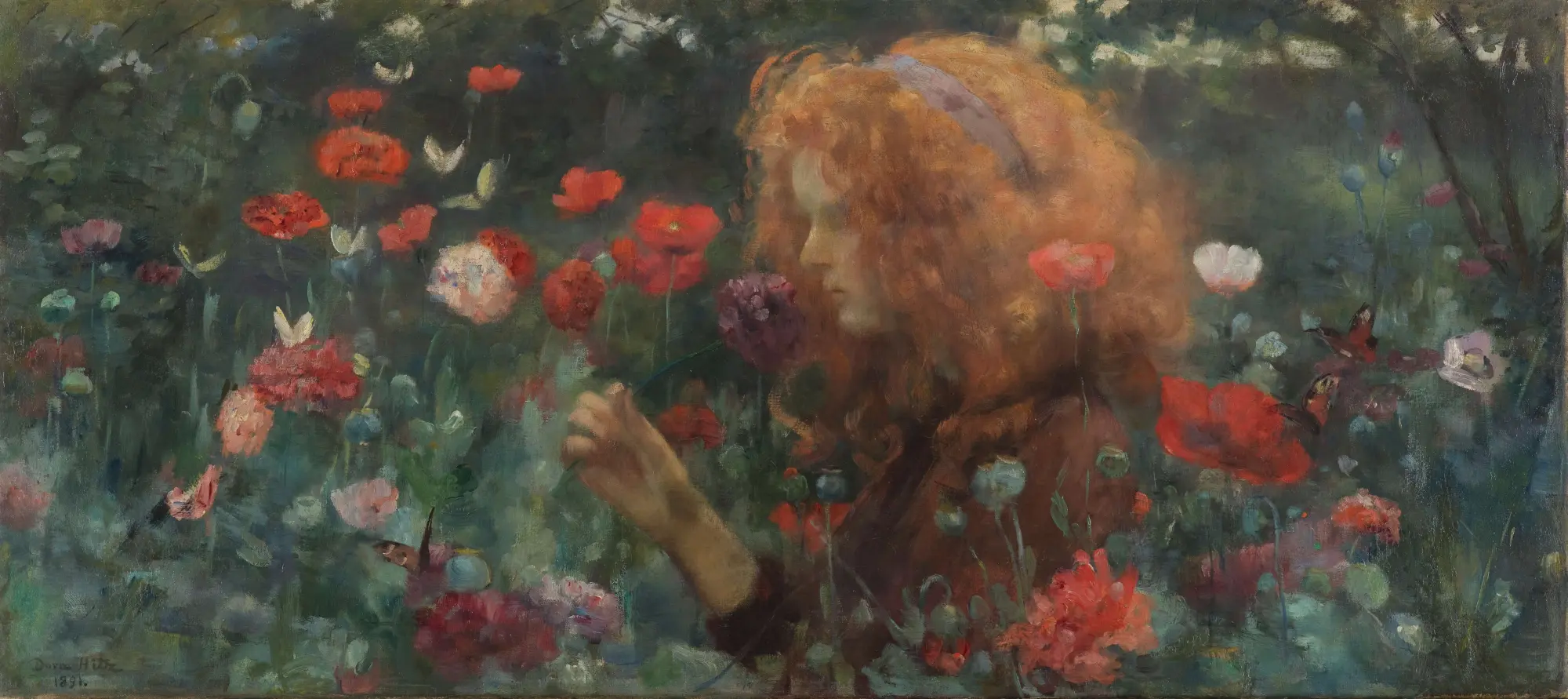
Girl in a Poppy Field (Mädchen im Mohnfeld), 1891
Oil on canvas
48.0 x 107.5 cm
©Museum der bildenden Künste, Leipzig
When you think of the flowing floral fields of the Secession movements, Gustav Klimt’s famous flower landscapes usually come to mind. However, a German painter named Dora Hitz was experimenting with these exact natural patterns years before the Vienna Secession even took off. Her 1891 canvas shows a young girl disappearing into nature, but the real story lies in how Hitz’s path crossed with Klimt’s long before they both broke the academic rules.
Drowning in Red Poppies
Hitz chose an unusual panorama format for this painting. Usually, a long canvas like this is used to show a wide, distant landscape. Hitz does the exact opposite. She zooms in close on a red-haired girl sitting right in the middle of a massive sea of poppies.
The individual red flowers on the bottom edge are drawn so large that they are almost life-sized compared to the small girl. Hitz used quick, loose brushstrokes to scatter the red paint across the canvas. The girl does not look at us; she looks sideways, completely lost in her surroundings. It creates a flat, decorative surface where the human figure and the plants blur into a single pattern.
Winning Gold at the Paris Salon
Hitz executed this canvas while living in Paris, where she submitted it to the 1891 Salon exhibition under the French title Pavots. She had spent years in the city studying under the symbolist painter Eugène Carrière, whose influence shows in the soft, dromerige focus around the girl’s silhouette.
The painting became an immediate success. The Paris jury awarded Hitz a Gold Medal for the work, a massive achievement for a foreign female painter at the time. This international triumph established her reputation across Europe just before she packed up her studio and moved to Berlin.
The Royal Connection to Klimt
Hitz’s earlier career connects her directly to Gustav Klimt through a very surprising location: Peleș Castle in Romania. Between 1878 and 1882, Hitz lived at the Romanian court as the official court painter, creating massive fresco murals for the royal summer residence.
As we explored in our previous post on Dora Hitz’s In the Roses, Klimt arrived at this exact same castle immediately after her departure. From 1883 to 1886, Klimt and his studio partners executed their first major architectural commissions there. Even though Hitz and Klimt just missed each other in the Carpathian Mountains, they spent their formative years working on the walls of the exact same palace.
Shaking up the Avant-Garde
This piece catches Hitz at a major stylistic turning point. While the girl’s face and arms still show the smooth, traditional technique of her early training, the exploding background is pure avant-garde. The background fields are constructed with the vibrating, loose brushstrokes that would soon become her trademark.
This shared background in grand, decorative palace painting gave both Hitz and Klimt the tools to do something radical later on. They both learned how to treat a canvas like a flat, ornamental pattern rather than a window with deep perspective. Hitz took these skills back to Germany, where she became a co-founder of the progressive Berlin Secession in 1899, leaving royal portraiture behind to let figures and nature melt together into a sea of color.
Leave a Reply