Gustav Klimt:
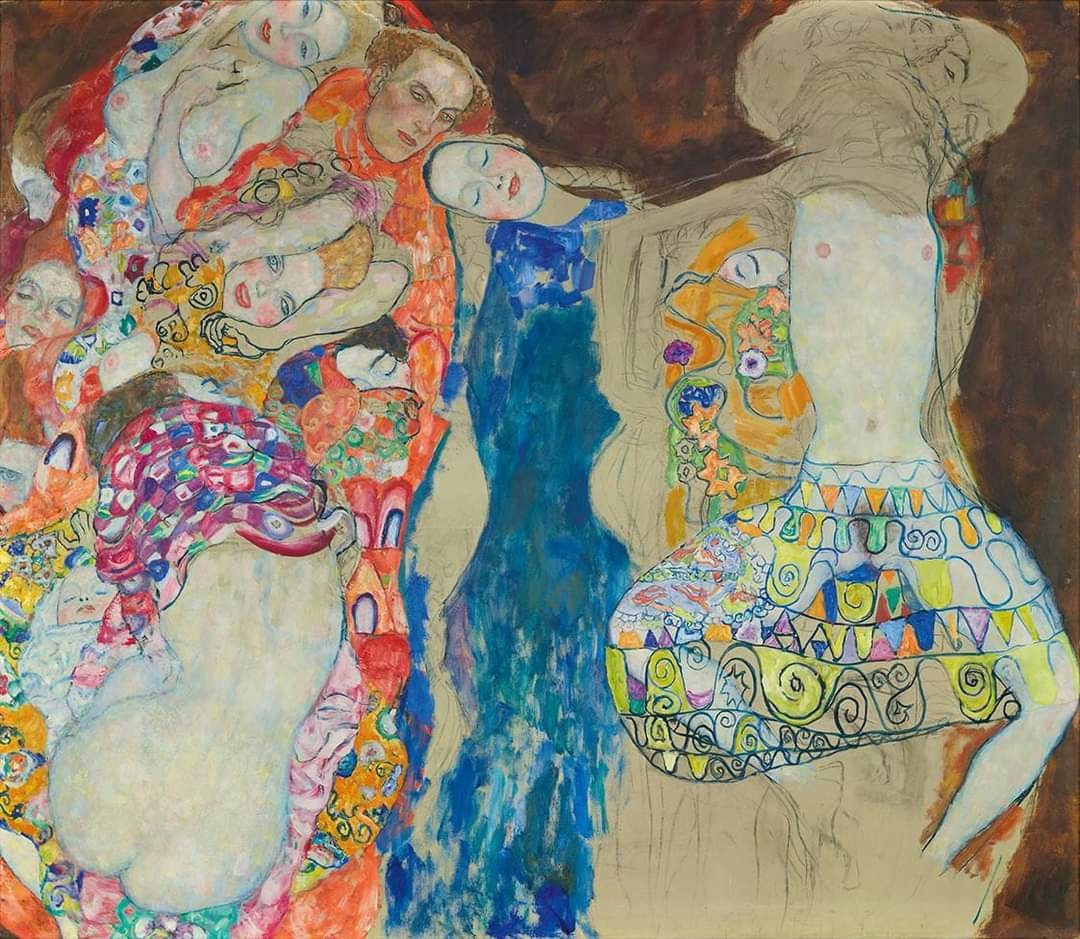
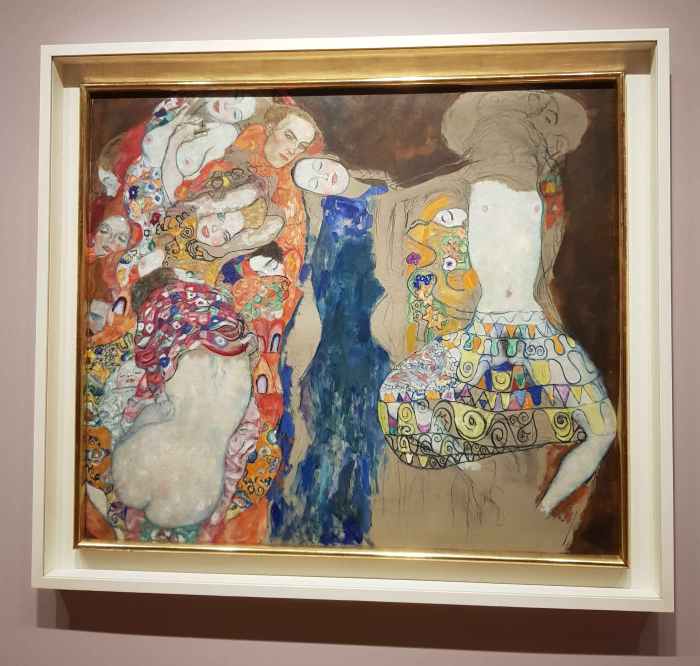
The Bride (Die Braut), 1917–1918 (unfinished)
oil on canvas
165 × 191 cm
©Klimt Foundation, Vienna, on permanent loan to the Belvedere, Vienna
(Natter no. 244)
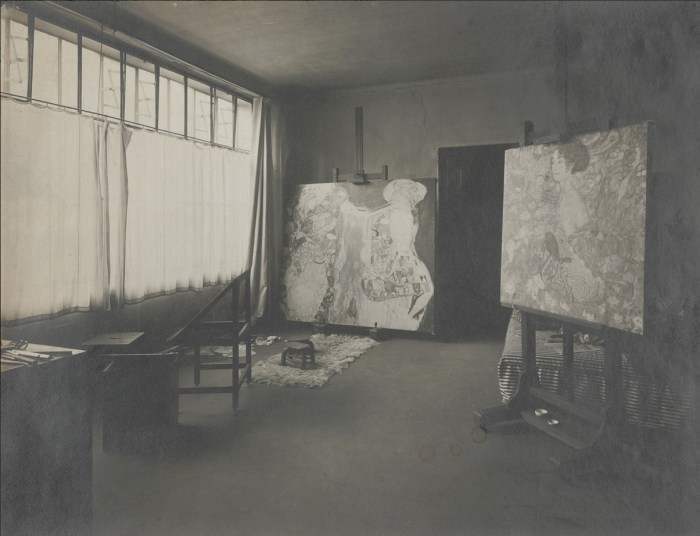
The Bride is one of those late works in which Klimt’s entire artistic vocabulary seems to gather for a final time. When he died on 6 February 1918, following a severe stroke in January and a subsequent fatal bout of pneumonia, the canvas was still standing on the large easel in his studio in Hietzing. Located in the garden building behind his home at Feldmühlgasse 11, the high, north‑facing windows of this space provided the steady, cool light he preferred. The painting stood among several other unfinished works, exactly as he had left them when he was suddenly taken ill. The building still exists today; it houses the Klimt Villa Wien, a quiet, intimate museum that preserves the unique atmosphere of the place where these final masterpieces were created.
The exact moment when Klimt began work on The Bride is difficult to determine. The surviving drawings suggest a long, exploratory process: more than a hundred studies survive, most of them catalogued in the definitive Strobl volumes of Klimt’s drawings. Each sheet tests a pose, a contour, or the emotional weight of a figure. These drawings trace the slow gathering of the composition, showing how Klimt circled around the core idea before committing it to canvas. Because he often worked on several paintings simultaneously, motifs migrated freely between works in his studio. The turning nude on the left recalls the earlier pose of Goldfish, while the interwoven bodies and the spiralling arrangement of figures develop alongside and echo concurrent works like The Baby and The Virgin. The Strobl volumes reveal how thoroughly he prepared this painting, with each drawing refining a gesture, a tilt of the head, or the fall of a garment. Klimt’s studio practice in these years was almost architectural — compositions were built layer by layer, where drawing, adjustment, and renewed observation succeeded one another in a quiet rhythm.
Because the painting remains unfinished, the scaffolding of his method remains uniquely visible. Klimt worked in sections, completing one area before moving on, and he always began by rendering the nude body in full detail. In many of his late works, he painted the underlying figures completely naked first, only later adding the garments that would veil the bodies to varying degrees. While in some finished paintings this underlying anatomy disappeared entirely beneath the final layers, here it remains exposed. The woman on the right still shows her pubic hair, a striking and raw glimpse into a stage that Klimt would likely have softened or covered with decorative patterns as the painting progressed. From these carefully modelled nudes he would then build the clothing, adding layers of pattern and colour that grew around the bodies like a second skin.
Although Klimt left no written explanation of the painting’s meaning, the work carries a quiet sense of transition — a drifting between sleep and awakening, between sensuality and ceremony — a mood that seems to hover rather than declare itself. It is a canvas that invites interpretation without ever fixing one.
There is also something deeply moving in the way the painting holds its own incompleteness. Klimt’s studio at the time of his death contained several unfinished canvases — The Bride, The Baby, Lady with Fan — each at a different point in its development, each revealing a slightly different stage of his working rhythm. Together they form a quiet record of an artist who was still searching, still refining, still pushing his language forward. The Bride carries that sense of suspended intention: the raw beginnings, the echoes of earlier motifs, the delicate balance between the seen and the imagined. It remains open, breathing, unfinished in the most human way.

Leave a Reply