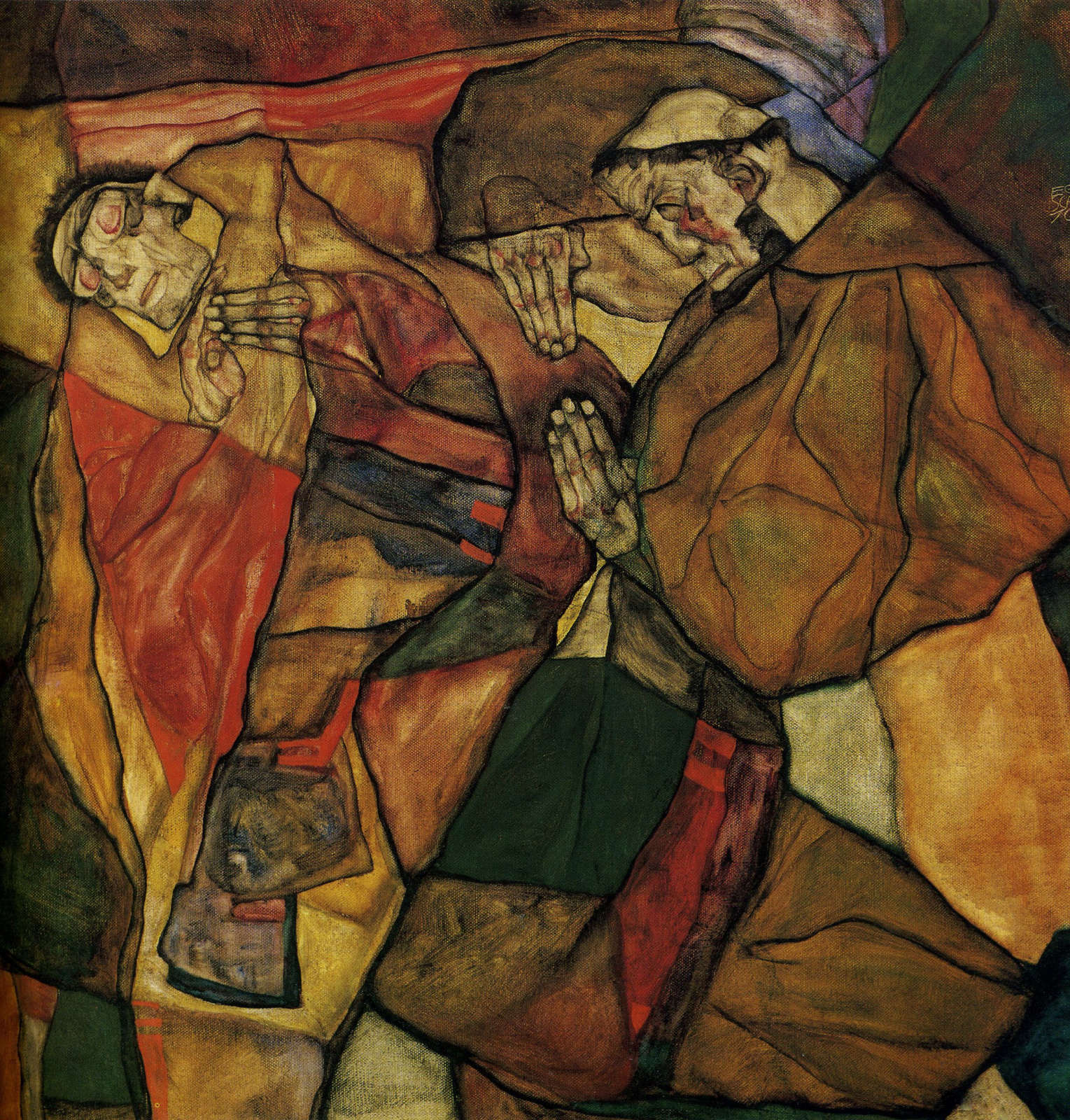
Egon Schiele:
Agony (Agonie), 1912
Oil on canvas
70 × 80 cm
©Bayerische Staatsgemäldesammlungen – Neue Pinakothek, Munich
(Kallir P230)
Agony belongs to that brief, incandescent moment in 1912 when Schiele’s painting becomes both more monumental and more inward. The composition has the stillness of a medieval stained‑glass window: two figures pressed into a single vertical field, their bodies flattened into planes of color, their outlines darkened as if held in lead. The resemblance is not accidental. Schiele was looking closely at religious imagery at the time, not to imitate its piety but to borrow its intensity — the way devotion, suffering, and revelation can be compressed into a single, iconic form. This spiritual search was fiercely amplified by the trauma of April 1912, when Schiele spent twenty-four days imprisoned in Neulengbach on false charges. The existential crisis and isolation of that experience directly shaped the painting’s raw, purgatorial atmosphere, rendering it a work suspended between the sacred and the deeply personal, between ritual and confession.
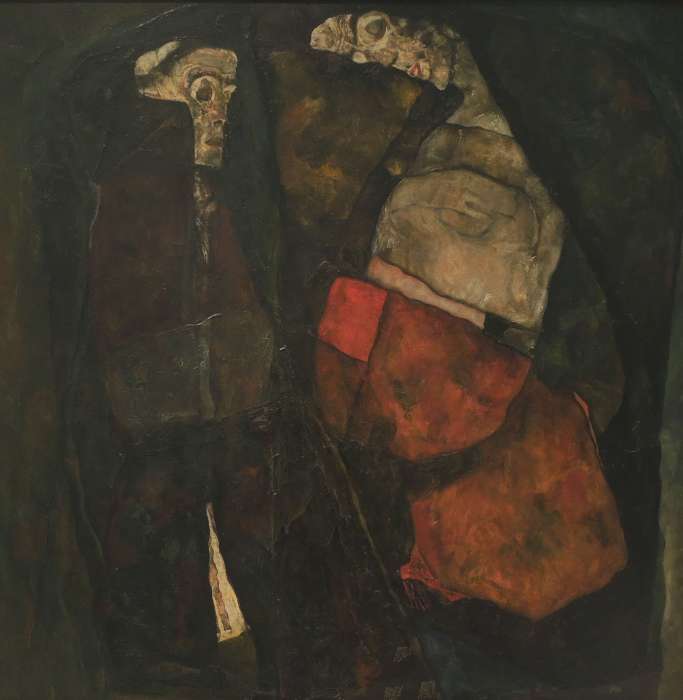
The two figures echo those in Pregnant Woman and Death, painted the same year, but here the relationship is more intimate, almost fused. Visually, both figures are enveloped in long, dark, kaftan-like habits. These garments directly evoke the floor-length studio robes that Gustav Klimt famously wore, and which Schiele eagerly adopted to signal his role as a spiritual disciple. Alessandra Comini — one of the pioneering scholars whose work reshaped the modern understanding of Schiele’s psychological portraiture — reads the painting as a profound double portrait of Schiele and Klimt. Not a literal likeness, but a mapping of influence: Klimt as the enveloping, stabilizing presence, Schiele as the restless, upward‑turning figure who leans into and away from his mentor at once. Comini has famously proposed that Schiele may have originally intended the painting for the dining room of the wealthy Lederer family, placing it within the intimate, symbolically charged environment of a major patron household that intimately understood the emotional register of his work.
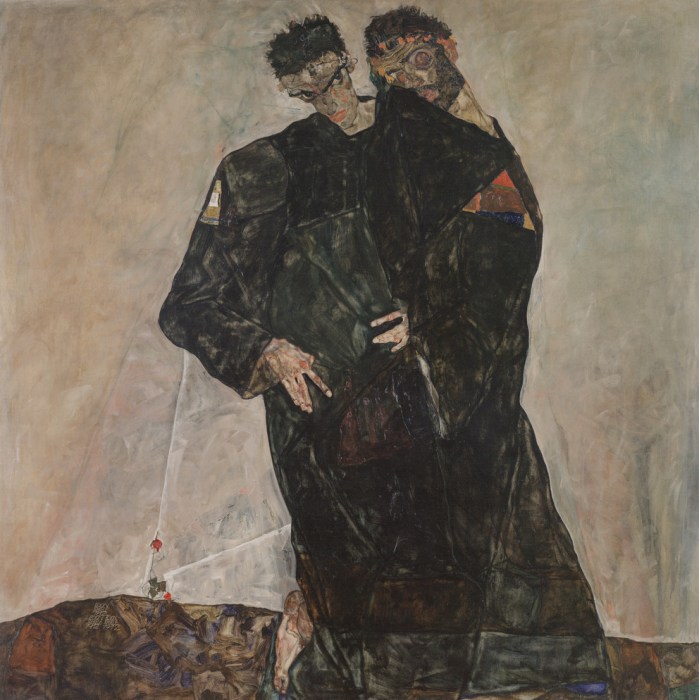
This charged emotional tension ripples beyond Schiele’s own circle. Johannes Dobai, an Austrian art historian who examined the visual exchanges within the Klimt–Schiele dialogue, even suggested that the bridegroom in Klimt’s final masterpiece, The Bride, may have been directly inspired by Schiele’s Agony, noting the shared vertical pairing of figures and the intense psychological bond that binds them. Placed alongside The Hermits, the more famous double portrait from the same period, Agony reveals a different, more brittle frequency. In The Hermits, the two figures merge into a single dark mass. Agony is more exposed; its colors are sharper, its contours more fragile. If The Hermits speaks of a shared destiny, Agony captures the painful tension between guidance and independence — the exact moment when a mentor’s influence becomes both sustaining and constricting.
When Schiele completed the canvas in the summer of 1912, it was immediately acquired by the prominent Viennese restaurant owner and collector Franz Hauer. While Hauer recognized its radical beauty, contemporary public critics of the era remained deeply baffled by Schiele’s expressionist vocabulary. One reviewer from the period famously dismissed his style as “a distorted picture of an artist’s view on life,” unable to comprehend that this distortion was deliberate: a breaking of form to expose the inner structure of feeling. The public, accustomed to Klimt’s ornamental, golden sensuality, found Schiele’s stripped, angular figures deeply unsettling. Today, more than a century later, the painting feels startlingly modern — not because of its stylistic defiance, but because of its absolute emotional clarity.
What gives Agony its lasting power is the way it holds contradiction without resolving it. The figures are both separate and joined, tender and severe, grounded and weightless. The painting seems to hover between embrace and release, as if Schiele were trying to paint the exact moment when one life touches another and then lets go. It remains a quiet, burning image of connection and separation. Decide for yourself now, more than a century later, what kind of bond you see between these two figures — and what kind of truth Schiele was trying to reach.


Leave a Reply