Egon Schiele:
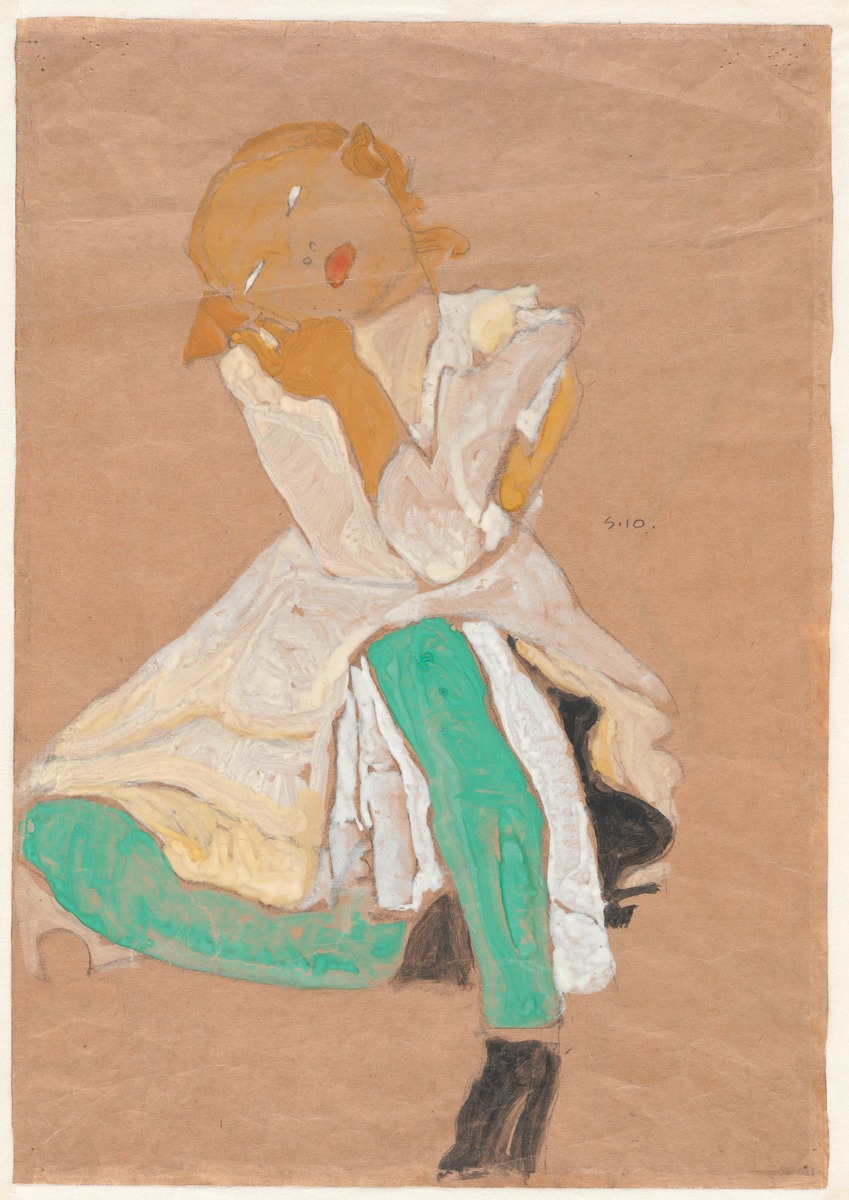
Crouching Girl (Kauerndes Mädchen), 1910
gouache and chalk
packing paper
45.1 × 31.7 cm
©Akademie der bildenden Künste, Wien
(Kallir d424)
At nineteen, Schiele produced this drawing during a period of financial instability and artistic transition. The use of packing paper—a cheap and rough material—highlights a move away from the polished, academic luxury of the era. On such a surface, the pigments are absorbed quickly, leaving an unforgiving record of the artist’s movements. This approach represents a radical break from the decorative elegance of his mentor, Gustav Klimt. While Klimt often sought to elevate his subjects through gold and ornamentation, Schiele focused on the unpolished, psychological reality of the human form.
The figure is depicted in a compressed, defensive posture that evokes a sense of intense privacy. Schiele avoids traditional grace, instead emphasizing the physical tension and the way the body occupies the space. This creates a sense of psychological discomfort for the viewer, a hallmark of the Expressionist movement which aimed to prioritize emotional experience over physical accuracy. In the context of 1910 Vienna, Schiele’s focus on marginalized subjects and unconventional poses challenged contemporary social boundaries. The viewer is placed in a position that feels inherently intrusive, as the subject appears closed off, eyes shut and head tilted away, creating a tension between the act of looking and the subject’s withdrawal.
The visual impact of the work is heightened by the contrast between the muddy brown of the packing paper and the sharp, artificial turquoise of the garments. In Schiele’s Expressionist vocabulary, color is used to signal inner alienation rather than to provide decoration. The jagged chalk lines and thin gouache application give the piece a provisional, urgent quality. By presenting the figure in this exposed manner, Schiele challenges traditional definitions of beauty, capturing the sense of existential unease that would come to define early twentieth-century art.
Leave a Reply