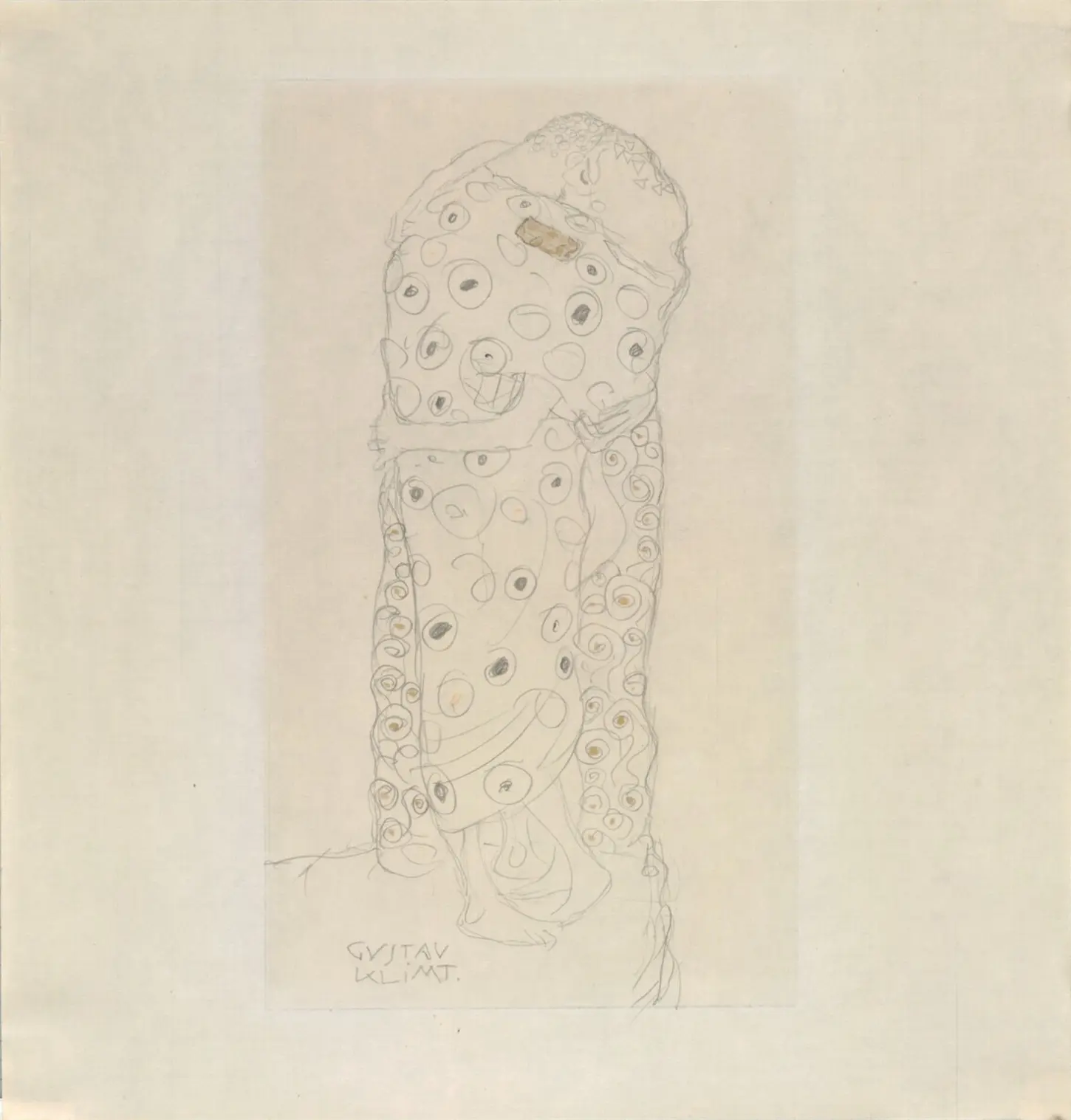
Gustav Klimt:
Standing Lovers (Stehendes Liebespaar), ca. 1907–1908
Pencil, red chalk, and gold paint on paper
55.3 x 34.8 cm
©Albertina, Vienna (Sammlung Batliner)
(strobl s1793)
Gustav Klimt drew this breathtaking study while pouring his first ideas onto paper for The Kiss. While the final painting became famous for its overwhelming gold leaf, this drawing captures the tenderness of the two lovers. Klimt’s pencil lines show a emotional closeness that he began to envelop with his early mosaic patterns and a touch of real gold directly on the paper.
Unmasking the Face
The most moving difference from The Kiss is that we can still catch the profile of the couple. On the famous canvas, Klimt turned the man away to make him an anonymous figure. This drawing shows the heads nesting together in a moment of quiet devotion. They are lost in the intensity of the embrace. Popular lore often suggests that these figures represent Klimt himself alongside Emilie Flöge. However, no surviving documents confirm this theory. The lack of proof shifts the attention toward a universal image of deep love.
The Passion of the Embrace
Klimt filled countless sketchbooks with drawings specifically to study the realities of physical passion. His unique studio practice relied on painting his subjects completely nude first, building up the composition layer by layer. He only added the ornamental clothing later, which completely hid the underlying anatomy from the viewer. This working method is clearly visible in his unfinished masterpiece The Bride, where his sudden death left the underlying, naked anatomy exposed. In this study for The Kiss, the early decorative circles already flow over their clothing, but the human form underneath remains visible. This passionate embrace marks a development from his earlier work, such as Lovers (Liebespaar). The 1903 sheet relied on a softer alignment, whereas this study locks the figures into a tight, urgent bond.
Breathing Life with Gold
Klimt chose materials that bring visual warmth to the paper. He combined graphite pencil with strokes of red chalk, using the reddish tones to make the skin look warm and alive. This soft color highlights the edges of the lips and the knuckles of the hands. Most importantly, Klimt applied real liquid gold paint directly onto the clothing of the figures. These tiny metallic particles show that he used his sketchpad to test the glowing effects that would later define his famous canvas.


Leave a Reply