Egon Schiele:
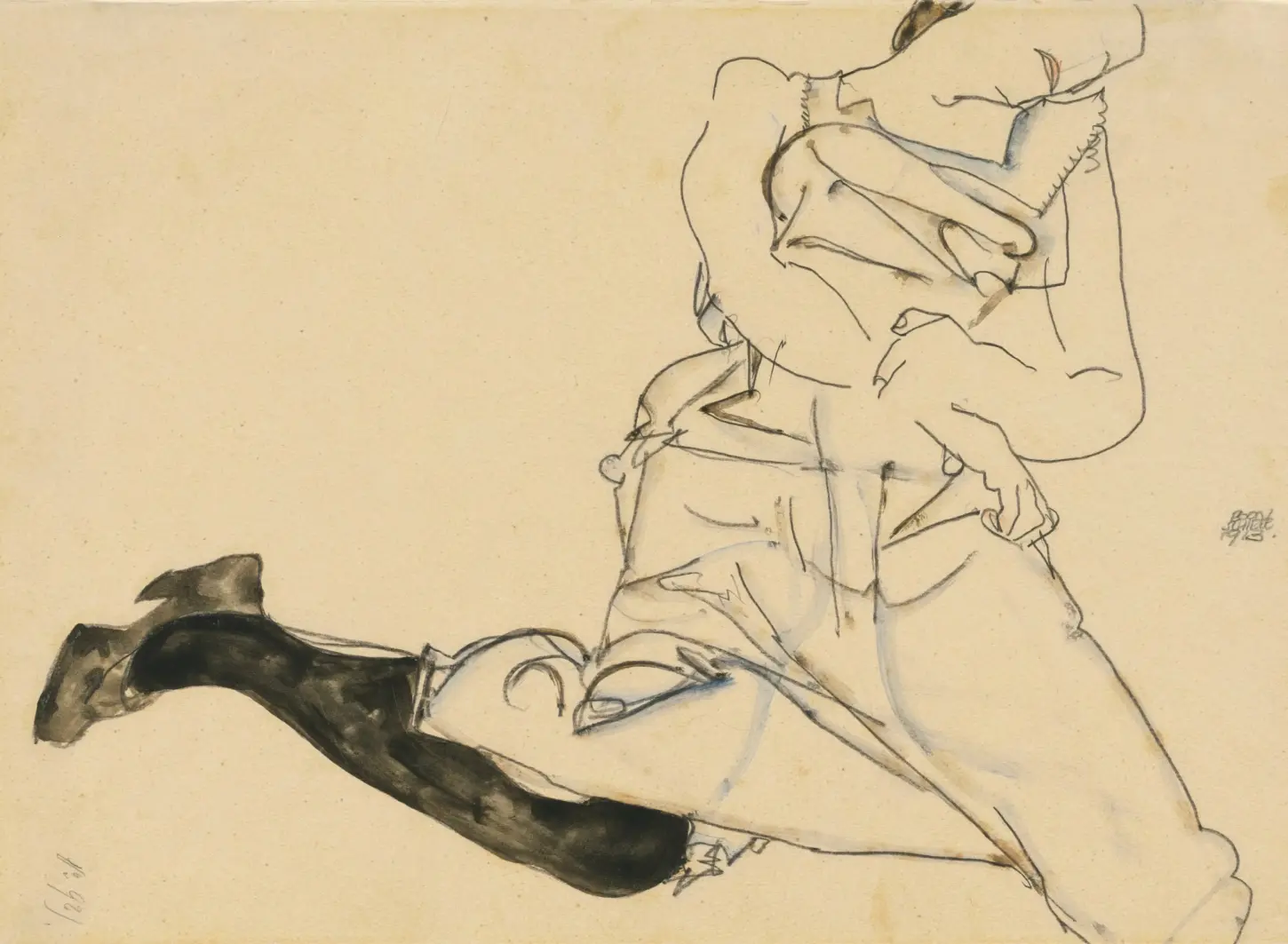
Reclining Girl with Black Stocking (Liegendes Mädchen mit schwarzen Strümpfen), 1913
Watercolor and pencil on cream wove paper
31.1 × 48.3 cm (12 ¼ × 19 in.)
Private Collection
(Kallir d1241)
One black-stockinged leg stretches across the page and immediately steals the eye. Everything else seems secondary. With little more than pencil, a few touches of watercolor and a large expanse of untouched paper, Schiele turns a simple studio pose into an image that is surprisingly difficult to forget.
One Dark Leg Anchors the Page
Almost the entire sheet consists of crisp graphite lines and untouched paper, which makes that long, ink-black leg, ending in a low-heeled shoe, impossible to ignore. Everything else in the figure seems to pivot around it.
Kneeling and twisting away from us, the model bends her head forward right into the top edge of the page. She wears a loose white undergarment with a ruffled neckline, gathered around her waist and hips in quick, angular folds. Because her face is turned down and out of sight, we do not read this as a traditional portrait. Instead, our attention shifts to the pose itself: the bent knee, the twisted torso and the long black-stockinged leg stretching across the sheet. Schiele explored similar unconventional poses in works such as Reclining Female with Red Garter and Reclining Woman with Inclined Head, where the body itself becomes the focus rather than the sitter’s identity.
Less Color, Sharper Line
A year before making this drawing, in the spring of 1912, Schiele had spent twenty-four days in a prison cell in Neulengbach over his explicit drawings of young models, an ordeal that left a lasting mark. When he returned to his Vienna studio, his approach to color and form began to tighten.
Gone are the bruised yellows and fiery reds that dominated his earlier watercolors. Here, the pencil does almost all the heavy lifting. Notice how he sketches the white chemise with rapid, broken strokes, adding only faint washes of cool blue-gray in the shadows and a tiny touch of warm orange-red along the curve of her cheek. Holding back on color makes the solid black watercolor of the stocking hit with twice the visual force.
An Unusual Viewpoint
Unusual angles were one of Schiele’s favorite tools, and here he places us slightly above and behind the model, looking down as her extended leg shoots toward the left margin. Cropping the top of her head at the upper border makes the pose feel immediate, almost as though we are looking at a fleeting moment in the studio rather than a carefully staged composition. By refusing to center the figure neatly on the sheet, Schiele gives the empty background an active role. The blank paper becomes part of the image, giving the figure room to breathe and making the black stocking stand out even more.
Signed and dated in neat, stacked lettering at the middle right (EGON SCHIELE 1913), the sheet also carries a faint handwritten inventory number (1926/8) in the bottom left corner, a quiet trace of its life after leaving the studio.
From Vienna to New York
Few works on paper carry a provenance as closely tied to Vienna’s modern art history as this one. Its first major owner was Otto Kallir, the pioneering dealer who opened Vienna’s Neue Galerie in 1923 and compiled the very first catalogue of Schiele’s work in 1930, at a time when Schiele still stood well behind his mentor Gustav Klimt in public fame.
Following the Nazi annexation of Austria in 1938, Kallir, who was Jewish, was forced to flee to the United States, where he later founded the Galerie St. Etienne in New York and introduced American audiences to Schiele’s art. Before leaving Vienna, Kallir entrusted the Neue Galerie to his colleague Vita Maria Künstler, who steered the gallery through the war years and took ownership of this sheet. For all its careful pencil work and subtle color, what stays with you is remarkably simple: a figure, a black stocking and a pose that immediately catches the eye.
Leave a Reply