Egon Schiele:
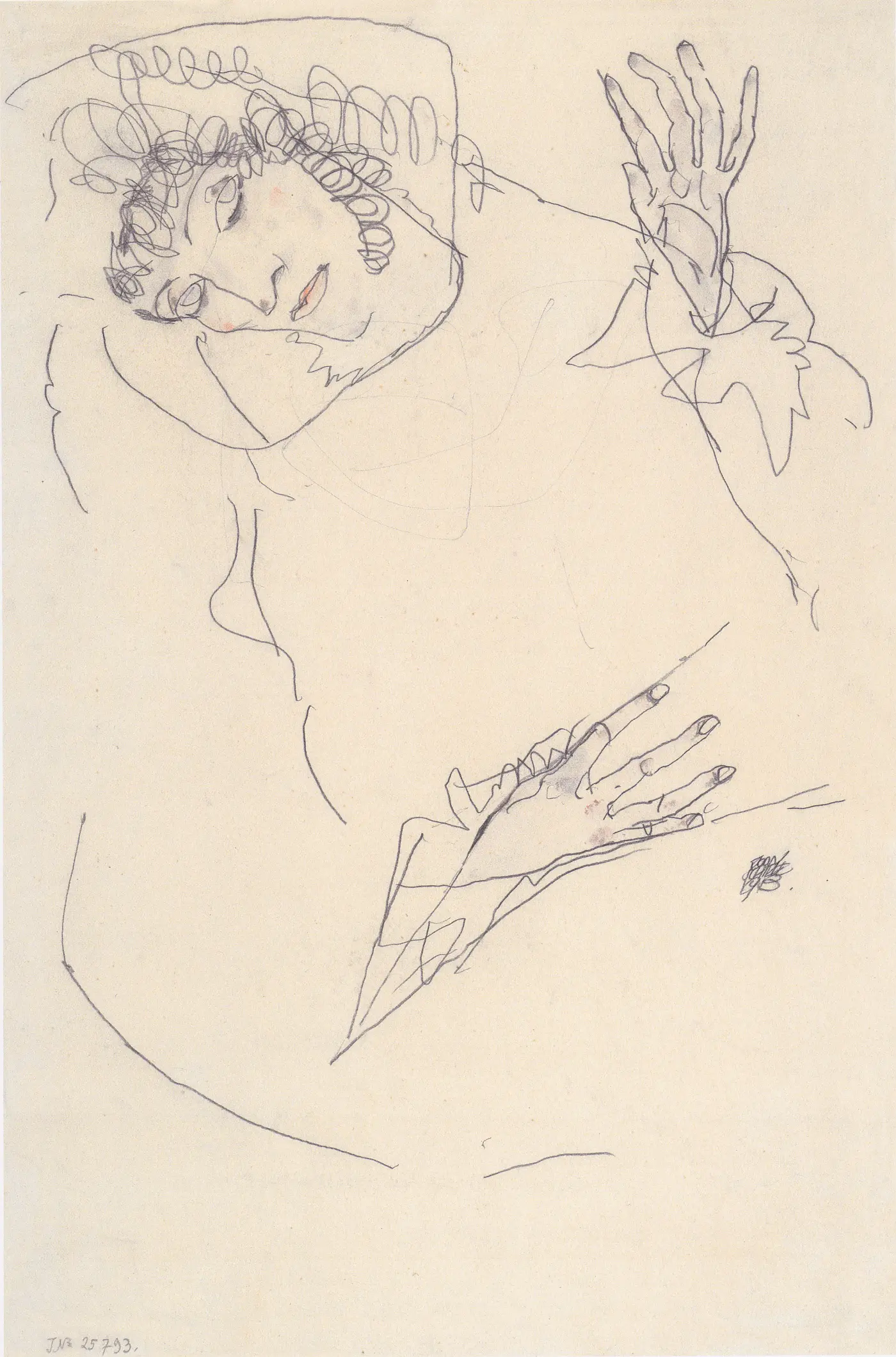
Reclining Woman with Inclined Head (Liegende Frau mit geneigtem Kopf), 1913
Pencil and watercolour on brown Japan paper
48 × 31.7 cm
©Albertina, Vienna
(Kallir d1297)
The Power of Line
Although this sheet emerged while Schiele was developing ideas for the gouache Holy Family, it asserts itself as a self‑contained work of remarkable sensitivity. The woman’s tilted head and the mirrored tension of her hands recall a posture Schiele had captured a year earlier in his final self‑portrait from the Neulengbach prison (1912), yet here the atmosphere is stripped of drama and rendered with quiet introspection.
The drawing is almost entirely carried by line: tight curls around the head, contours that halt and resume with a sharpness, and hands shaped with an elongation that gives them both fragility and presence. The faint watercolour wash warms the paper; it never competes with the graphic energy of the sheet. Within the rhythm of Schiele’s early 1913 work, the drawing reveals an artist exploring how much emotional weight could be conveyed through line alone.
Wally Neuzil: Partner in the Act of Looking
Jane Kallir identifies the model as very likely Walburga “Wally” Neuzil, and that possibility deepens the sheet’s emotional register. Wally’s presence in Schiele’s studio was not merely practical; she was a stabilizing force during years of artistic volatility, someone he trusted to inhabit even his most experimental poses.
Her ability to hold stillness without losing warmth is unmistakable here. The slight incline of her head, the relaxed yet attentive hands, and the gentle openness of her expression suggest a sitter who understood Schiele’s intentions intuitively. In drawings like Liegende Frau mit geneigtem Kopf, Wally becomes more than a model: she is a partner in the act of looking, shaping the tenderness that underlies Schiele’s most intimate works of 1913.
Art History Note Dispelling the Klimt Myth
A persistent myth claims that Gustav Klimt discovered Wally Neuzil and “passed her on” to Egon Schiele. However, there is no documented painting or cataloged drawing by Klimt verified to feature Wally. While speculation surrounds lost or unfinished works—such as The Bride or the painting Wally destroyed in 1945—the Gustav Klimt Database and leading researchers emphasize that no historical evidence exists.
This assumption largely stems from romanticized post-war biographies and art dealer speculations that favored the narrative of a generous mentor. Some major institutions, including Sotheby’s, still repeat this anecdote as fact. Officially, their actual meeting remains undocumented; Schiele likely approached Wally himself in a shop, on the street, or in Schönbrunn Park, as was his usual practice with young models.
Do you know of any verified archival evidence, letters, or primary sources that prove otherwise? We invite art historians and readers to share their findings with us to help keep this research as accurate as possible.

Leave a Reply