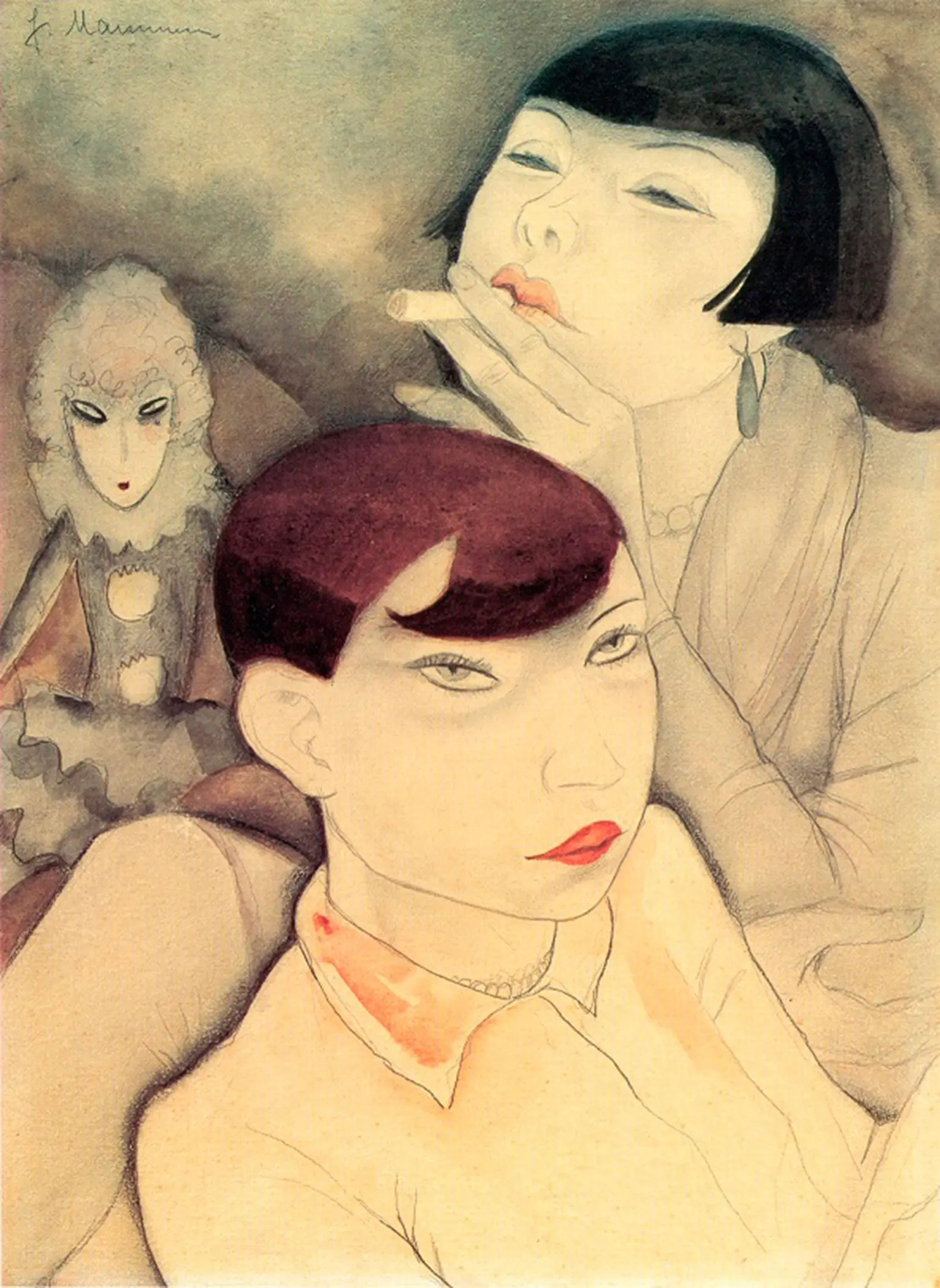
The Women of Secession: Jeanne Mammen
Boring Dolls (Langweilige Puppen), 1929
Watercolour and graphite on paper mounted on cardboard
38.4 × 28.6 cm
George Economou Collection, Athens
A thick cigarette rests between pale fingers in a smoky Berlin apartment in 1929. Two young women lounge close together. Too tired to speak, they let the afternoon drag on beside a stiff Pierrot-style boudoir doll with white curls. Jeanne Mammen caught this heavy-lidded truce in Boring Dolls (Langweilige Puppen), recording the quiet hours after Berlin’s cabarets shut down.
The Double Meaning of a Berlin Slang Word
In 1920s Berlin slang, a Puppe (doll) meant an attractive, fashionable young woman. Mammen played directly with that street vocabulary. On the left side of the composition sits a literal boudoir doll dressed like a Pierrot clown, complete with white curls, a ruffled collar, and dark eyes. Beside it lounge two real women sporting the short Bubikopf haircuts of the Weimar “New Woman.”
Calling them “boring dolls” turns a casual compliment on its head. These women refuse to perform for an audience or entertain a crowded cabaret. In the foreground, a red-haired woman in a pale yellow shirt and coral collar stares out with half-closed eyes and painted red lips. Behind her shoulder, her dark-haired companion wears a long drop earring and draws on a cigarette with an expression of pure fatigue.
Empathy Over Satire in Weimar Berlin
Male contemporaries like Otto Dix and George Grosz often painted Berlin’s nightlife with sharp, grotesque caricature. Mammen worked from a completely different vantage point. Supporting herself as a commercial illustrator for popular magazines such as Uhu and Simplicissimus, she walked through Berlin’s cafés, dance halls, and lesbian clubs as an insider.
You can see that same unhurried closeness in her 1928 watercolour Two Women, Dancing, where physical affection takes center stage on a crowded floor. In Boring Dolls, the energy drops to a whisper, echoing the quiet domestic bond she explored in Couple on the Windowsill. Mammen never judged her subjects or turned them into moral warnings. She simply watched them exist on their own terms.
Technique and Nacreous Light
Mammen’s technical choices amplify the drowsy mood of the scene. Signed “J. Mammen” in pencil at the upper left, the sheet features crisp graphite contours on slightly nacreous wove paper, a stock with a faint, pearlescent sheen, mounted onto cardboard by the artist herself. Over the pencil lines, she floated translucent washes of warm ochre, deep auburn, and smoky grey-brown.
The wet pigment pools softly around the dark bob and dissolves the boundaries of the background furniture. The Pierrot doll on the left acts as a visual anchor, its blank, painted face mirroring the heavy-lidded stillness of the foreground woman. Every brushstroke feels rapid yet controlled, preserving the immediacy of a sketch drawn from life.
Exhibition History and Provenance
Boring Dolls survived the Nazi era hidden away in Mammen’s Berlin studio on Kurfürstendamm. After the artist’s death in 1976, the sheet entered the art market.
During the early 1990s, it formed part of the renowned Marvin and Janet Fishman Collection in Milwaukee, one of the most important private holdings of Weimar art in the United States. Following a period in a Spanish private collection, the drawing sold at Grisebach in Berlin in 2009 and joined the George Economou Collection in Athens.
Like her fellow Berlin chronicler Dodo in Women in Black, Mammen left behind an honest visual record of women navigating modern city life. Yet in Boring Dolls, she added something stranger: a Pierrot doll that quietly blurs the line between observer and observed, leaving us to wonder who the real dolls are.
Leave a Reply