Women of Secession:Jeanne Mammen
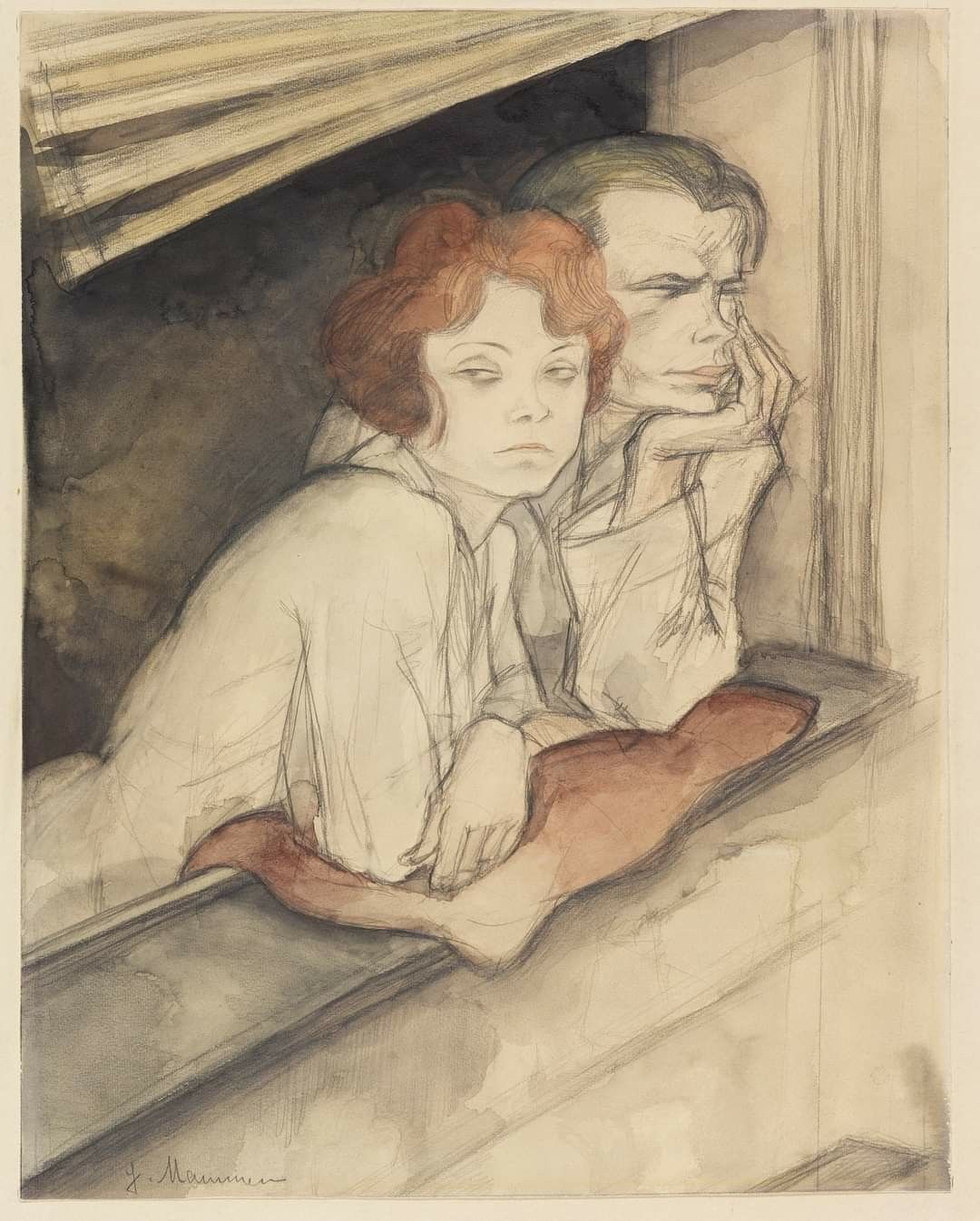
Couple on the Windowsill (Paar auf der Fensterbank), c. 1928
Watercolor and pencil on paper, laid on board
38.2 x 30.3 cm
Auctioned at Ketterer Kunst, Munich in 2021 for € 112,500
The interwar period in Berlin forced many artists to shift their focus from high-art exhibitions to commercial publication networks. Jeanne Mammen (1890-1976) excelled in this transition, moving away from her early academic training to document the unvarnished realities of the city’s working population.
Her roots in the Secession
Jeanne Mammen painted this watercolor around 1928. The sheet depicts a man and a woman crowded onto a narrow windowsill. Both figures look past the viewer into the street. Mammen applied sharp graphite outlines to define their clothes. Soft gray washes fill the composition. This linear drawing style links her work directly to the Secession movements. Before the First World War, Mammen studied art in Paris and Brussels. She exhibited with the Brussels Indépendents in 1912. The clear lines of Art Nouveau and the early Secessions shaped her draftsmanship. However, her Berlin watercolors function as a direct reaction against the aesthetic choices of Gustav Klimt. Where Klimt dominated the Viennese avant-garde with decorative, gilded allegories of women, Mammen stripped away all luxury, gold leaf, and myth. She took the precise, elegant Secessionist line but applied it to the unglamorous, everyday reality of working women in the Weimar Republic.
Work for the Berlin magazines
The watercolor was made for the commercial magazine market. In November 1928, the German monthly UHU printed the drawing on page 46. UHU was a popular magazine in Berlin. The publication printed modern literature and illustrations. It reflected the changing city life. For this specific issue, the watercolor accompanied a poem by Kurt Tucholsky titled “Liebespaar am Fenster”. Tucholsky wrote the text under his pseudonym Theobald Tiger. He praised her drawings in the journal Die Weltbühne in 1929. This work mirrors the lives of her contemporaries. Illustrators like Julie Wolfthorn and Adele von Finck also moved from art salons to print media. They used magazine commissions to earn a steady income. Art left the galleries and appeared on newsstands.
The turning point of 1933
The year 1933 changed Mammen’s career completely. Following the National Socialist takeover, authorities closed independent journals. UHU stopped publication under political pressure. The new regime banned her drawings of modern women. Mammen refused to adapt her work to the official art rules. She stopped working for magazines that followed the new laws. While other artists fled the country, Mammen stayed in Berlin. She locked the door of her studio at Kurfürstendamm 29. She worked in total isolation for twelve years. Her style changed immediately. She stopped making realistic watercolors. Instead, she created abstract paintings. She hid these pieces inside her workspace to avoid confiscation.
Looking out the window
The visual composition relies on physical proximity. Mammen places the two figures on the sill. Their bodies lean forward into the open air. Their eyes follow parallel lines without intersecting. The red hair of the woman stands against the profile of the man. Mammen frames a moment of shared exhaustion at the edge of the apartment. Viewers can see the physical weight as the man rests his chin on his hand. The woman stares ahead without blinking. Does this silence suggest a distance between the two individuals, or does it show a mutual withdrawal from the busy streets below?
Leave a Reply