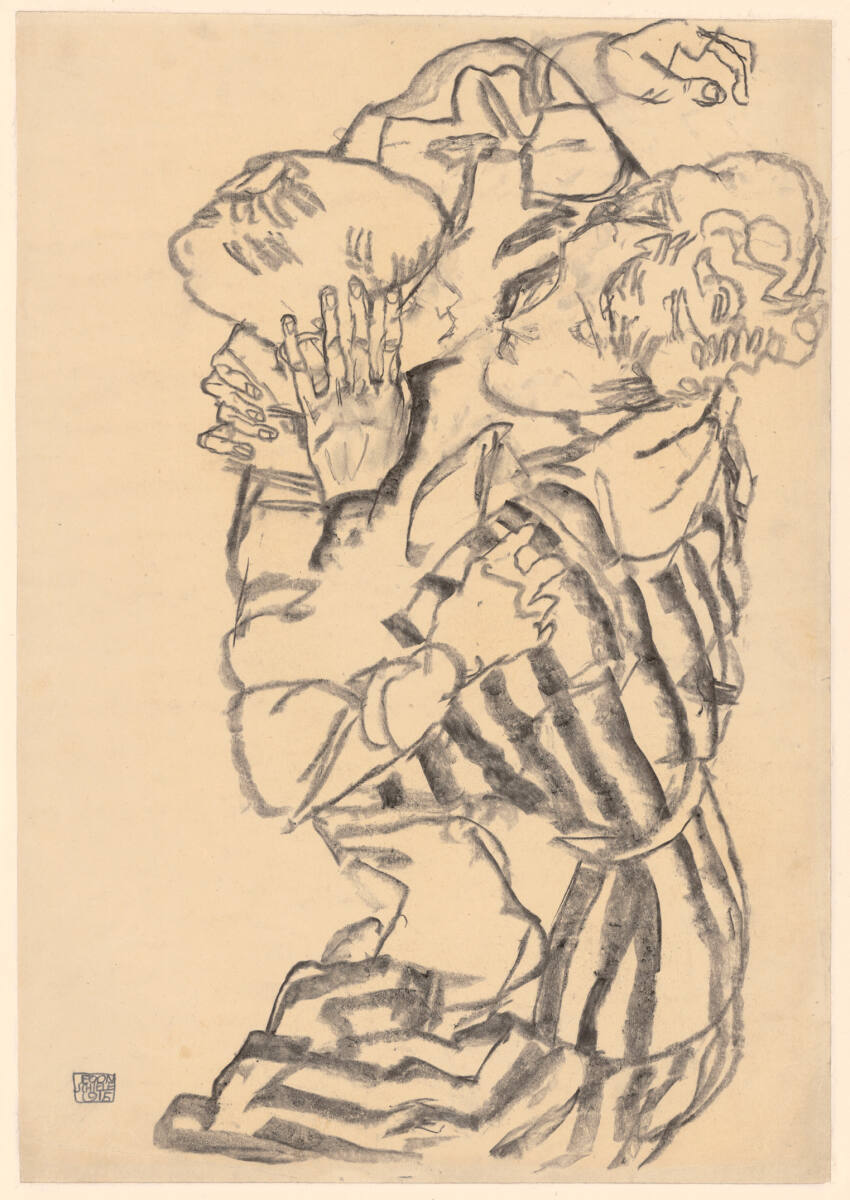
Egon Schiele:
Aunt and Nephew (Tante und Neffe), 1915
Charcoal
48.4 × 33.5 cm
© Albertina, Vienna
(Kallir d1797)
1915 is a year that steadily restricts Schiele’s working conditions. Military service obligations begin to take time away from the studio, and by the second half of the year the effect is visible in his output. Production slows. The nude — once a central field of experimentation — almost disappears for months. What remains is the immediate domestic circle: Edith, her relatives, the people physically present and available. Portraits take over not as a stylistic shift but as a practical result of a life shaped by external demands.
Aunt and Nephew belongs directly to that limited sphere. Jane Kallir places it within the “embracing” group, a cluster of drawings in which the boy’s face sometimes moves between Paul Erdmann — Edith’s nephew, the son of her half‑brother — and a softened trace of Schiele himself. That drift appears often in Schiele’s work, especially in quick, close studies. Here, however, the identification remains stable. The boy is Paul. The woman is Edith Schiele. Schiele records a moment of contact that seems grounded in everyday family interaction rather than any symbolic intention.
The drawing carries an ambiguity that simply remains. The original position of the two bodies is not immediately clear. The Albertina notes this uncertainty, and it is worth retaining: the pose does not settle. It could have been upright, horizontal, or somewhere in between. Schiele’s signature fixes the sheet vertically, directing the viewer to read the embrace as an upright hold even if the situation may have been different. That orientation introduces a slight interpretive shift. The bodies appear close, but the structure of the contact remains undefined. You see the proximity, but the mechanics stay open.
Schiele’s domestic drawings from 1915–16 often show a new kind of nearness — not emotional intimacy, but physical closeness shaped by circumstance. Edith’s hold in this sheet is steady and supportive. Paul leans in because her arm encloses him. Schiele does not idealize the moment. He notes it with the same directness he used for strangers, lovers, and himself: two people held together briefly while the conditions of the year limited the world around them.
The drawing’s tension comes from that combination: a compressed period, a domestic focus shaped by necessity, a pose that does not fully settle, and a vertical orientation that guides the viewer toward a reading that may not match the original scene.
Leave a Reply