Egon Schiele:
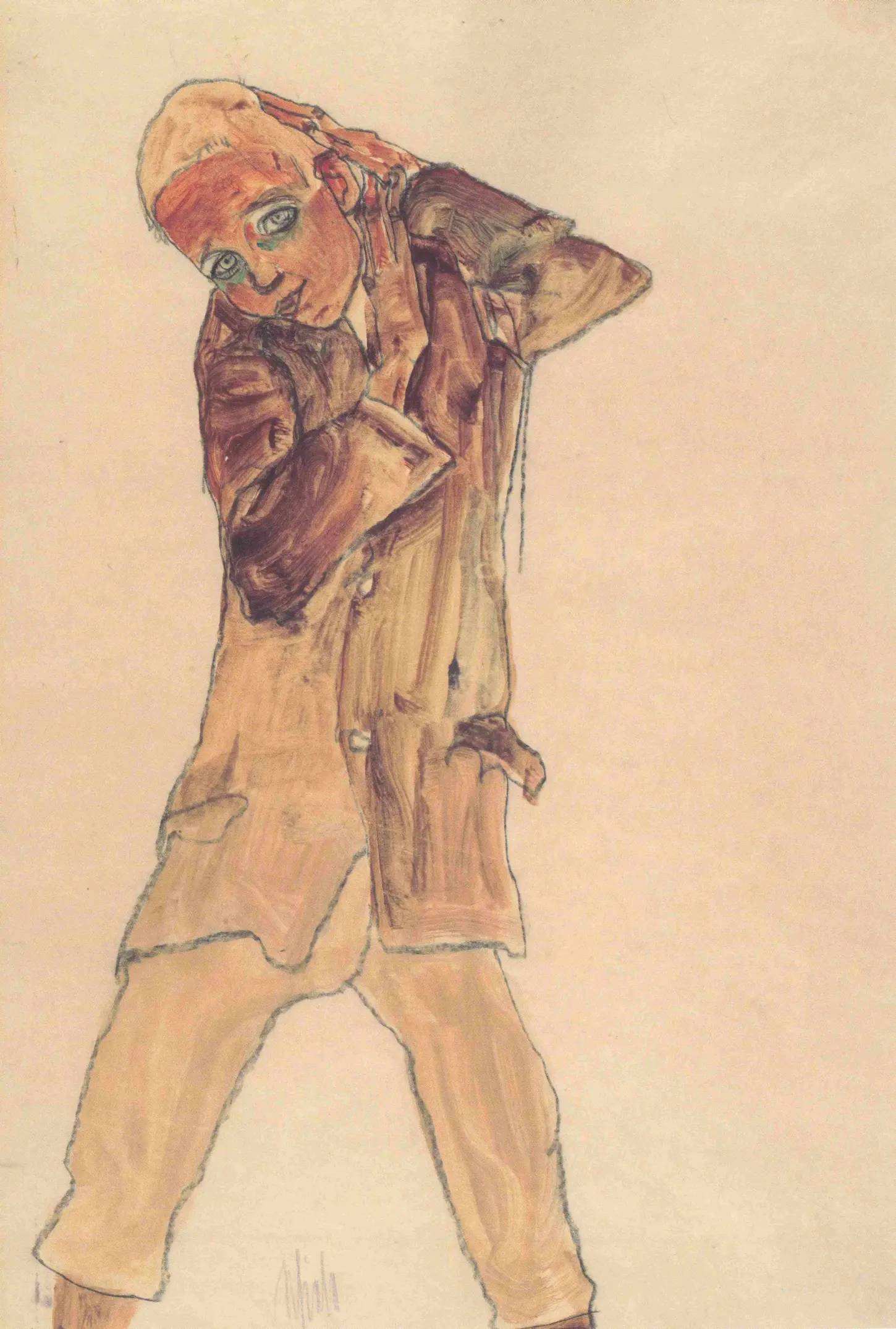
Boy with a Long Smock (Knabe mit langem Rock), 1910
Black chalk, watercolor, and opaque colors on brown wrapping paper
44.9 × 30.2 cm
©Albertina, Vienna
(Kallir d434)
Egon Schiele executed Boy with a Long Smock in 1910 on coarse brown wrapping paper. The choice of material provided a raw, textured ground that absorbed the watercolor and opaque layers. This work coincided with Schiele’s relocation from Vienna to the rural town of Krumau. The move triggered a distinct change in his studio methods. He abandoned the harsh color contrasts of his earlier academic training. Instead, he limited his palette to a narrow scale of muted earth tones, utilizing deep browns, mauves, and ochres.
Forced Geometries and Engineered Poses
Look closely at the posture. This is not a child relaxing; it is a body held in a geometric grid. Schiele mapped this pose using a calculated series of sharp triangles and rigid lines. The boy’s arms are bent at precise angles to frame his face, while his lower legs are cut off by the edge of the paper. By locking the model into these heavy, dark outlines, Schiele flattened the space. Do not let the realistic face fool you. This is not a spontaneous sketch from life. Archival records confirm that Schiele invented this vocabulary of body language and dictated it directly to his models.
The Street Urchins of Krumau
The appearance of children and street urchins as subjects in Schiele’s drawings expanded significantly during the middle of 1910. Neighborhood children regularly frequented his workspace to watch him paint. These models provided a technical challenge because their restless, impatient movements forced Schiele to develop a faster, more condensed line. Employing local youth also carried a lower financial cost than hiring professional adults from the Viennese academies. However, this practice sparked severe social disapproval among the residents of Krumau and later Neulengbach, where locals openly objected to his unconventional bohemian lifestyle and studio visits. Look past the individualized facial features and ask yourself who truly determined this posture: a child or a calculating artist?
Material Rawness
The Albertina museum acquired the work in 1957 from a private collection in Salzburg. In Krumau, Schiele began using the brush to model the pigment directly onto the cheap wrapping paper, using the visible brushstrokes to inject a sense of life into the rigid forms. Modern curators note that the high degree of formal abstraction in Schiele’s Krumau period often goes unnoticed because the individualized facial features distract the eye from the underlying geometric construction.
Leave a Reply