Gustav Klimt:
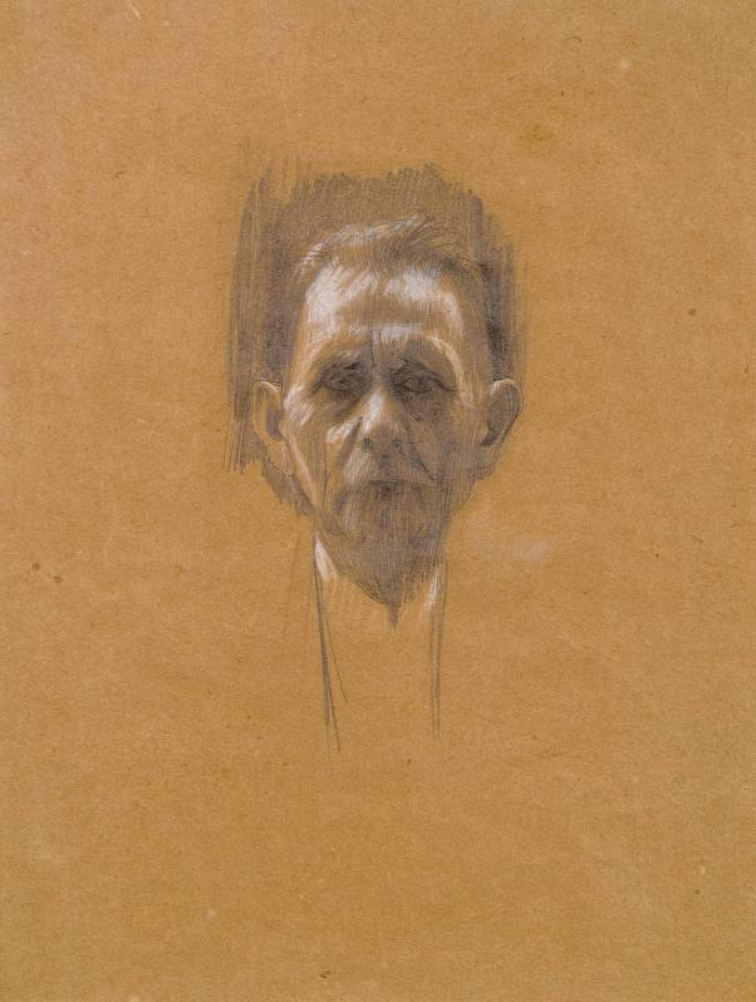
Head of a Man from the Front (Männerkopf von vorne), 1897/98
Pencil heightened with white on paper
35.5 × 27 cm
Private collection, Vienna (Offered at Auktionshaus im Kinsky, Vienna in 2010, unsold)
source: ©Auktionshaus im Kinsky GmbH, Wien (via ALBERTINA Digitale Publikationen)
(Strobl s3316)
Male portraits remain rare across Gustav Klimt’s entire career, and they vanish almost completely after 1900. Drawn right as Klimt broke away from Vienna’s conservative art establishment in 1897–1898, this frontal study focuses on an unidentified sitter whose head appears almost suspended in the empty space of the sheet. White highlights catch the forehead, nose, and cheeks, while the rest dissolves into soft graphite shadows. Against the broad expanse of untouched paper, the figure seems to emerge from the paper, yet could just as easily fade back into it.
A Rare Male Subject at a Turning Point
Most of Klimt’s surviving portraits focus on female sitters, particularly once his career shifted toward society commissions in the early twentieth century. After 1900, male figures appear mainly as allegorical characters in his large decorative cycles rather than standalone studies. This 1897–1898 sheet therefore belongs to a small group of independent male portraits from the close of his early period.
The timing matches a major break in Vienna’s art world. In 1897, Gustav Klimt left the traditional Künstlerhaus to co-found The Vienna Secession, serving as its first president. Even while leading that modern movement, he continued using classical portrait studies to explore facial character and presence.
Light, Shading, and White Highlights
Klimt placed the man’s head squarely at the center of the sheet, facing the viewer without any theatrical pose. The eyes sink deep into shadow, the mouth is barely defined, and only a few lines suggest the neck and collar. Klimt concentrated almost entirely on the face, allowing the surrounding emptiness to become part of the image.
Soft pencil strokes build up shadows around the eye sockets, cheeks, and jaw. Touches of white catch the light on the forehead, nose, and chin, making the head seem to emerge from the surface of the paper itself. The drawing remains remarkably economical, yet the figure acquires an unexpected sense of presence.
This technique links the sheet directly to other frontal head studies from the same years, including Lady’s Bust Portrait from the Front. Both drawings show how Klimt used toned paper and white highlights to suggest light falling across a living face. Even with only a few materials at hand, he was able to create a compelling sense of presence.
Rediscovery and the Zimpel Family Provenance
The high catalogue number Strobl 3316 reflects the late rediscovery of this drawing. Art historian Alice Strobl recorded the sheet only in 1989 when she published the fourth supplementary volume of her catalogue raisonné of Klimt’s drawings.
Archive records trace the sheet’s likely path through Klimt’s immediate family after his death in February 1918. It passed to his youngest sister Johanna Zimpel in Vienna, and after her death in 1950 to her son Rudolf Zimpel, who managed a substantial portion of the family’s inherited drawings. Its documented provenance preserves a direct link to Klimt’s own family, an unusually well-recorded history for a drawing of this period.
Leave a Reply