Egon Schiele:
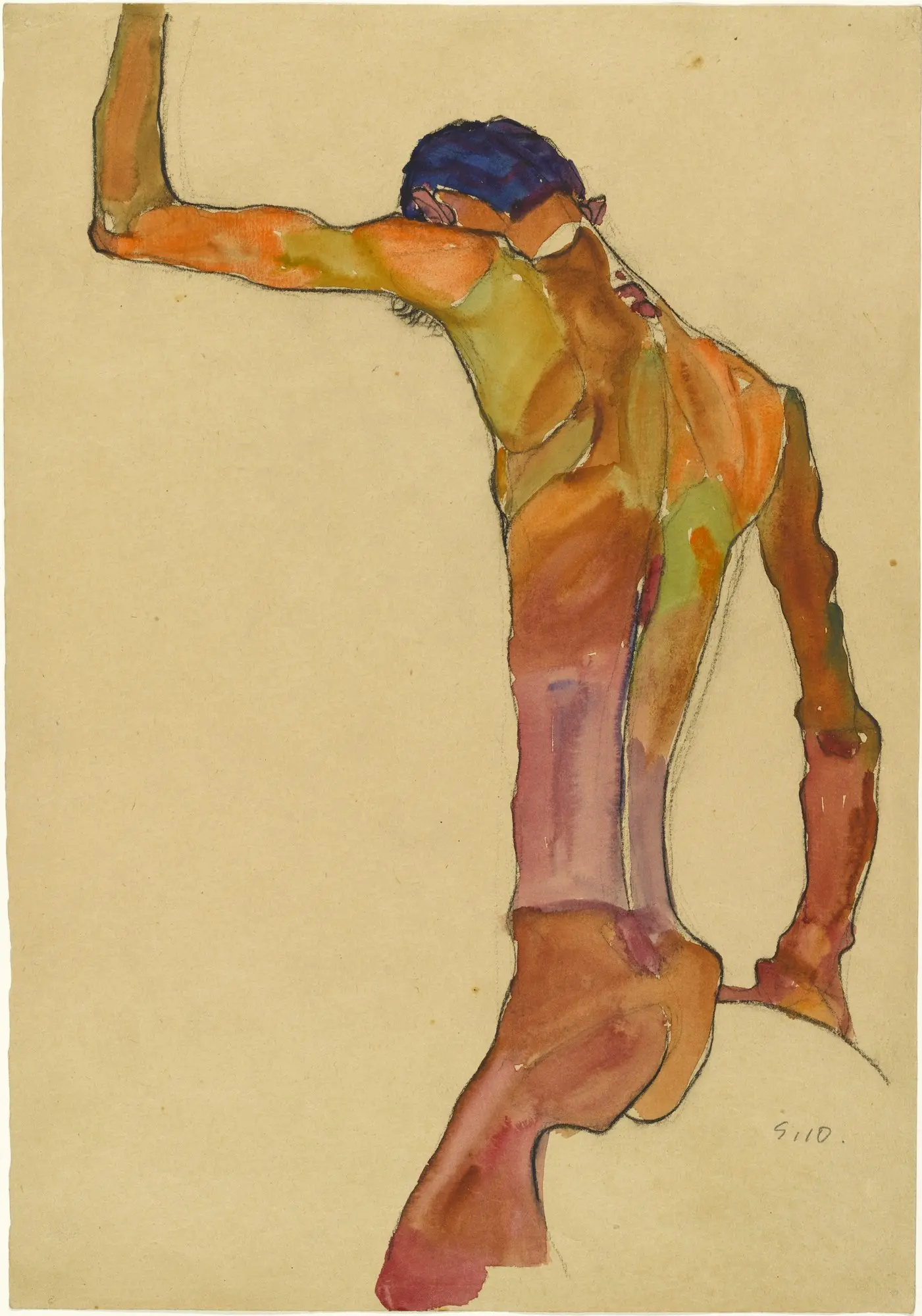
Standing Male Nude with Arm Raised, Back View (Stehender männlicher Akt mit erhobenem Arm, Rückenansicht), 1910
Watercolor and charcoal on laid paper
44.8 × 31.4 cm (17 5/8 × 12 3/8 in.)
©The Museum of Modern Art (MoMA), New York (Gift of Jo Carole and Ronald S. Lauder, 1985)
(Kallir d650)
In this 1910 drawing, Schiele shows us little more than a back, a raised arm, and a twisting body. Somehow, it is enough to hold the eye. Jagged charcoal contours lock vibrant washes of orange, olive green, pale violet, and reddish brown onto the bare cream sheet.
Placement Within the 1910 Male Nude Series
Jane Kallir indexed this work as D650 inside a prolific run of male nudes from 1910. While explicit self-portraits from later that year, such as Self-Portrait, 1910, confront the viewer head-on, this group hides the face entirely. The head pitches forward, revealing only a dense cap of dark blue hair and the outer rims of both ears. Across drawings by Egon Schiele from this studio phase, that deliberate turn away from the viewer removes the usual clues of personality. No face, no eye contact, no expression, yet the figure remains surprisingly present.
Neighboring works in the catalogue show Schiele testing new physical configurations from sheet to sheet. Directly afterward, he rotated the torso toward a frontal stance in Male Nude, 1910, then compressed the spine into a seated angle in Seated Male Nude, Back View, 1910. Earlier and subsequent variations, including Male Semi-Nude, Rear View, 1910 and Male Nude, Back View, 1910, push the shoulders into fresh contortions. Here, the twist of the body creates the sense of a movement briefly interrupted rather than a carefully posed studio exercise.
A Raised Arm and a Twisting Body
The raised left arm snaps into a sharp ninety-degree angle at the elbow. It shoots horizontally out from the shoulder before climbing vertically until the paper crops the wrist. Opposite that lift, the right arm drops straight down, bracing the hand against a single curved charcoal line at the lower right. That minimal arc hints at a low studio stool while leaving the surrounding room completely blank. The result is a figure that appears isolated, with nothing to distract from the tension of the pose itself.
Schiele carved the back into abrupt chromatic blocks. Bright orange and ochre pigment floods the shoulders, clashing against patches of olive green tucked beneath the left armpit and lower shoulder blade. Tiny dabs of red punctuate the upper vertebrae just under the hairline. Across the waist, a wide band of diluted violet separates the upper torso from the reddish-brown wash covering the hips and upper left leg. Dry charcoal strokes sharpen the outer silhouette, anchored by the artist’s crisp signature “S. 10.” in the lower right corner.
Provenance Through the Schiele Family
Following Schiele’s death in Vienna in October 1918, this sheet stayed inside his immediate family for decades. His mother, Marie Schiele, kept the drawing until she died in 1935. It then passed to the artist’s younger sister, Gertrude Peschka-Schiele, who safeguarded numerous early works on paper from her brother’s estate.
Decades later, the drawing reached the New York art market through dealer Serge Sabarsky, a leading specialist in Austrian Expressionism. Collectors Jo Carole and Ronald S. Lauder purchased the sheet from Sabarsky. In 1985, they donated the work to the Museum of Modern Art in New York, where it remains in the permanent collection. Today, the drawing remains in the collection of MoMA, where this anonymous figure, seen only from behind, continues to hold the viewer’s attention.
Leave a Reply