Egon Schiele:
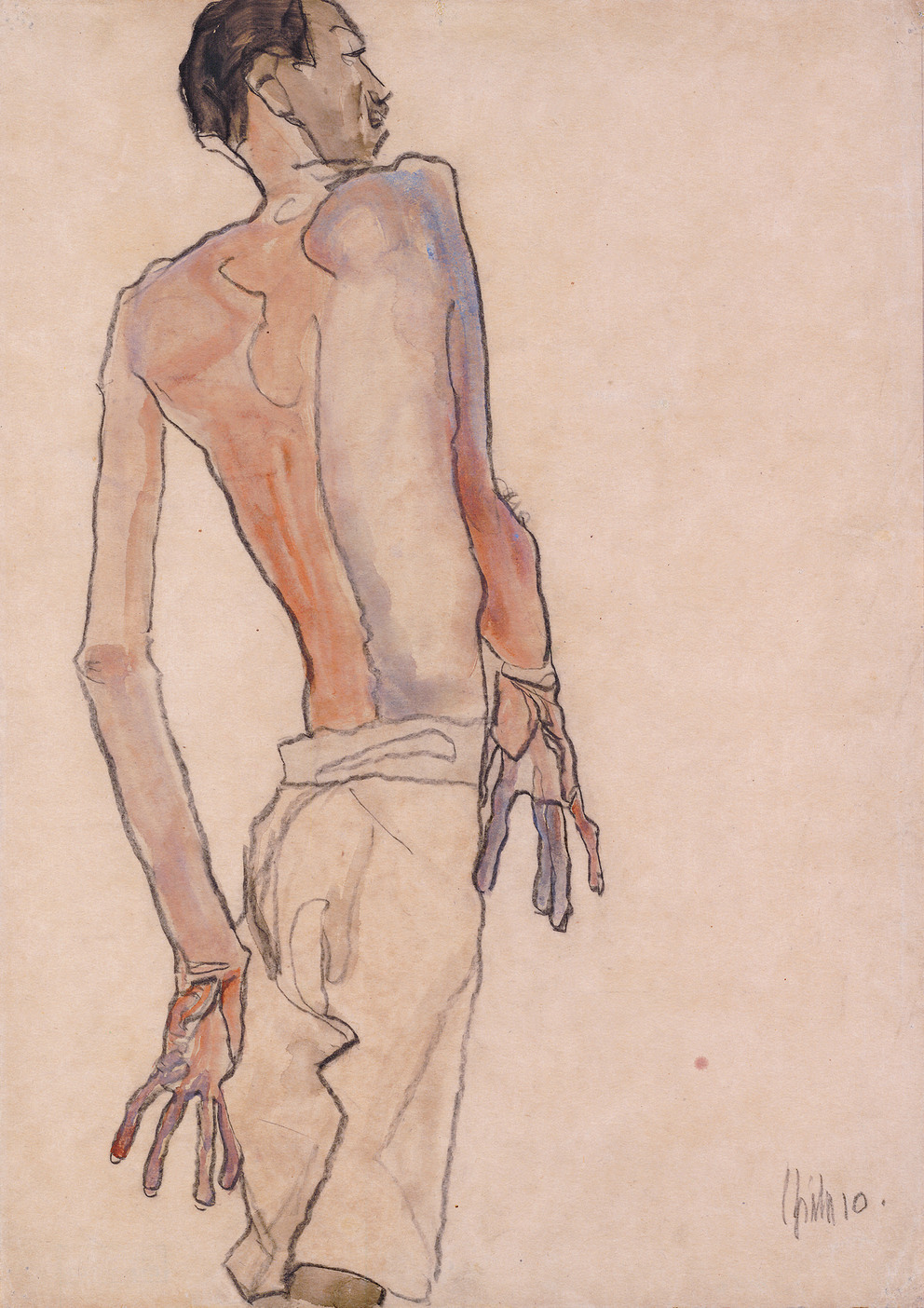
Male Semi‑Nude, Rear View (Männlicher Halbakt, Rückansicht), 1910
Black chalk, gouache on paper
45.3 × 32.3 cm
©Leopold Museum, Vienna
(Kallir 645a)
This drawing belongs to Schiele’s intensive study period of 1910, when he produced a large number of male and female nudes in direct studio poses. The sheet shows a standing male figure from behind, the torso slightly turned to the left. The contour of the back, shoulders and arms is firmly drawn, with restrained gouache accents that mark anatomical structure. The hands are elongated and clearly modelled, and the figure wears light trousers. The back is built up with patches of red, blue and purple, applied in small, concentrated areas.
Schiele worked with several male models that year, and he often used his own body as the basis for many male poses, repeating positions in different variations. In this period he worked obsessively with a large floor mirror in his studio, taking extreme, uncomfortable positions and looking over his shoulder to capture the complex angles they produced. This drawing is an example of that practice. At the time, viewers sometimes interpreted the coloured patches on the body as signs of sickliness or decay, but current scholarship understands them as Schiele’s way of colouring emotional states. The red and purple tones on the back reflect the internal physiological and psychological tension of the pose. Although the Leopold Museum presents the sheet with neutral collection data, art‑historically it is considered a key work in which Schiele used his own body as an experimental surface to explore the human psyche.
The drawing remained in the Schiele family and belonged to Melanie Schiele before entering the collection of Rudolf Leopold. Because the sheet was left in Schiele’s studio after his death in 1918, it received the official Nachlass stamp. Melanie received a selection of these intimate nude studies, many of which stayed within the family for decades until Rudolf Leopold, then a young physician, began acquiring them actively in the 1950s and 1960s. It is now part of the Leopold Museum’s core collection, where it is consistently classified as a 1910 work without indications of later reworking.
Leave a Reply