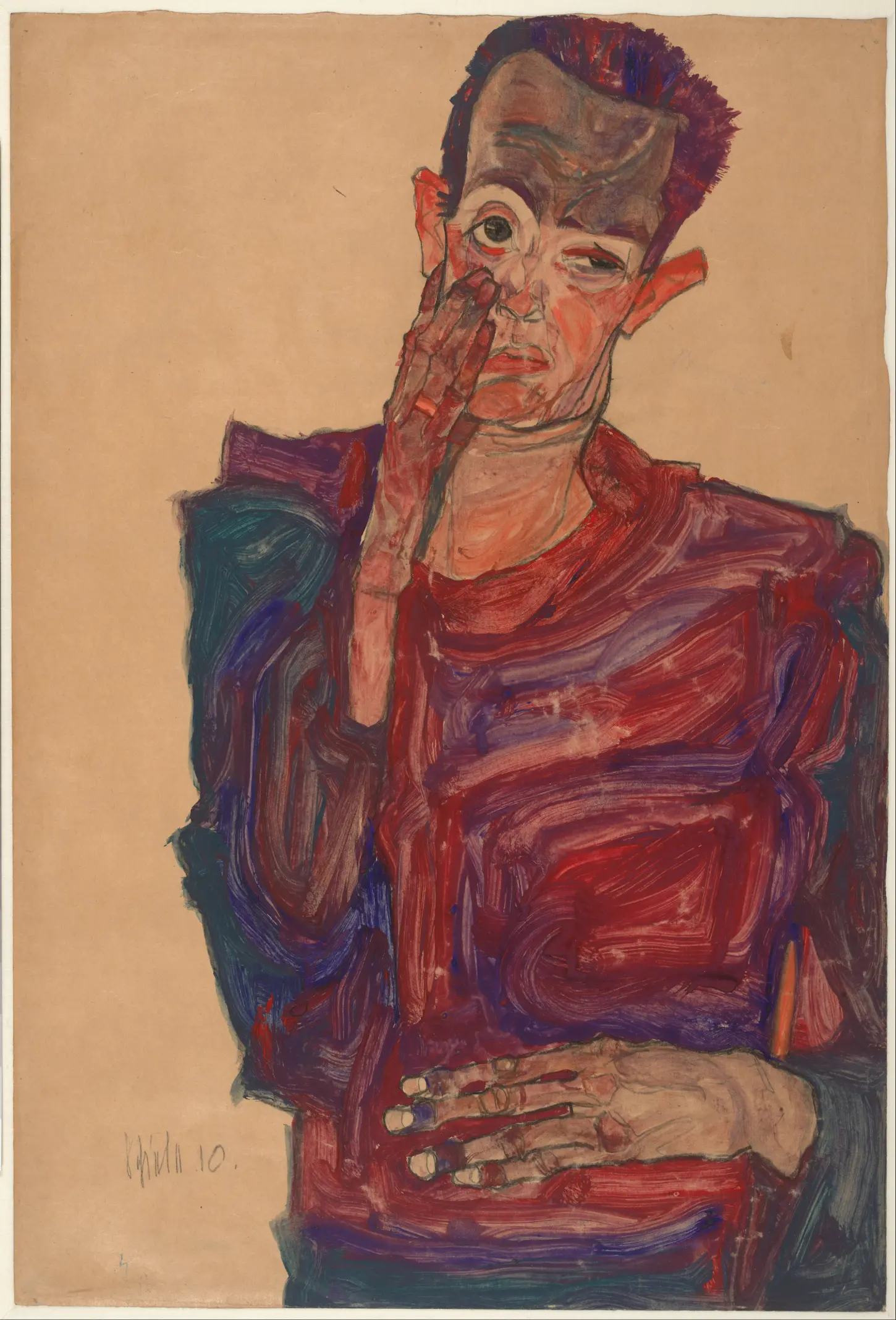
Egon Schiele:
Self-Portrait with Pulled Down Eyelid (Selbstbildnis mit herabgezogenem Augenlid), 1910
Chalk, brush, watercolor, and gouache on brown packing paper
44.3 x 30.5 cm
©Albertina, Vienna
(Kallir d706)
Egon Schiele made this self-portrait on a rough piece of brown packing paper in 1910. The image hits you the moment you look at it. A Viennese collector named Otto Schatzker kept the drawing in his private collection for years. He eventually donated it to the Albertina Museum in 1946, just after the war ended.
A Confrontational Look
The drawing works because it breaks all the rules of a normal portrait. Schiele looks straight out of the paper and uses his fingers to pull down his own eyelid. In Vienna, people used to call this gesture the “Äugl”. It was a common sign on the streets that meant “I see through your game.” Schiele took that exact movement to shock the person looking at the sheet. To make the image even more uncomfortable, he based his twisted facial expression on old documentary photographs of psychiatric patients from local clinics.
Wild Paint and Glue
Schiele did not want to make something neat or pretty. He deliberately made his own face completely uneven, with ears at different heights and crooked shoulders. He then mixed his paint with thick office glue and slapped it onto his shirt with a broad brush. This cheap mixture left messy, dark, and sticky swirls all over the paper. The whole figure tilts away from the hand, abandoning the clean style of his early days for a raw look that either grabs you or pushes you away.
The Raw Reaction
A lot of people simply find this drawing ugly. It offers no beauty, no elegance, and no comfort. In a time when the Viennese upper class wanted gold decorations and sweet portraits, Schiele offered them a distorted face on industrial wrapping paper. He did not care about pleasing wealthy buyers or making decorations for a living room. This uncompromising attitude is exactly what defines Schiele today. The sheet remains physical proof of a young artist who preferred a harsh, honest reaction over traditional approval.
Leave a Reply