Gustav Klimt:
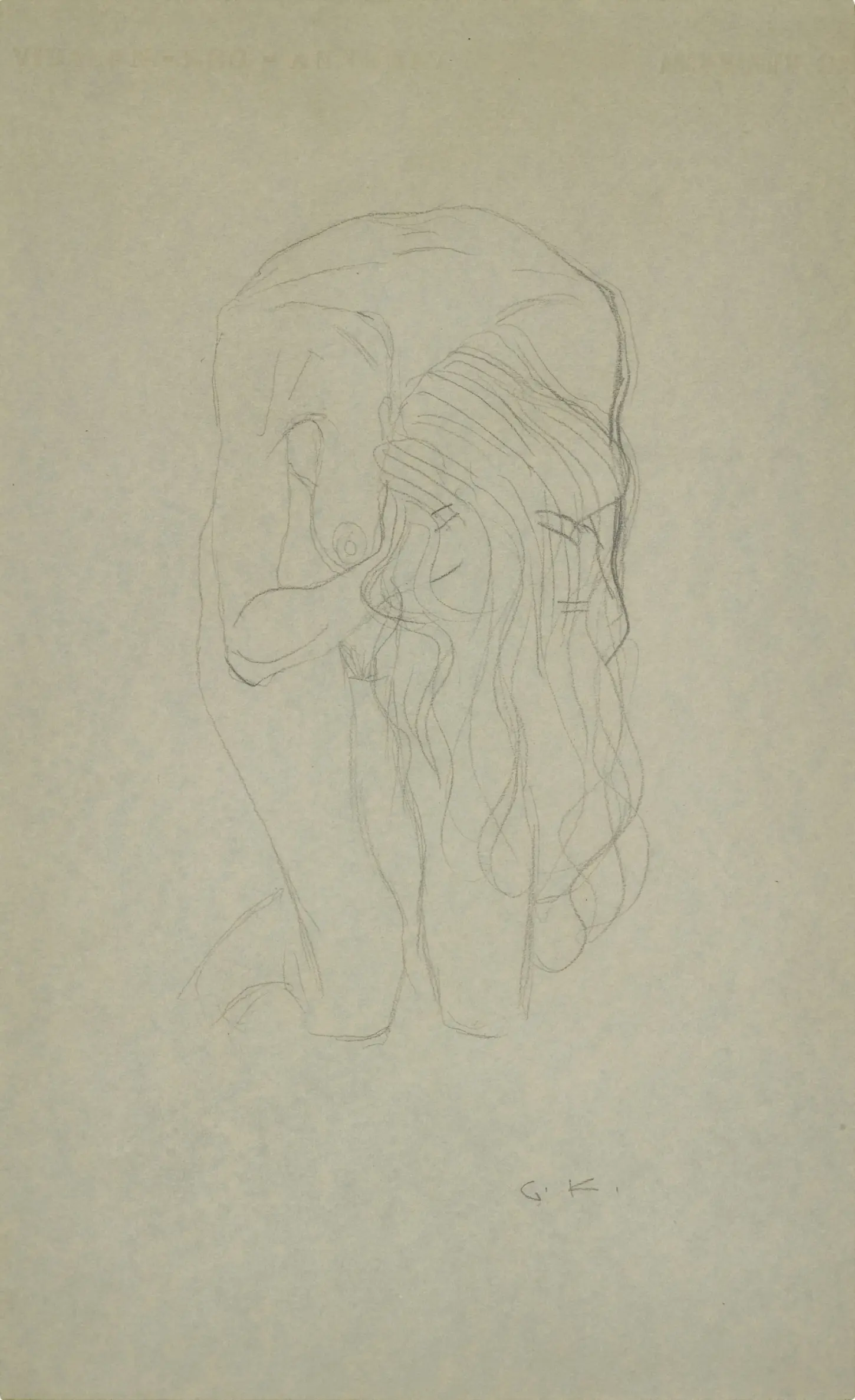
Kneeling Female Nude from the Front (Kniender Frauenakt von vorne), 1902
Pencil on paper
48.2 × 31.2 cm
Private collection, United Kingdom (sold at Sotheby’s, London in 2023)
(Strobl s822)
In 1902, Gustav Klimt drew this frontal study of a kneeling woman while planning his monumental Beethoven Frieze in Vienna. Thin, unbroken pencil lines trace the curve of her back, the fall of her hair, and the weight resting on her knees. Marked with a small R beside Klimt’s initials at the lower right, the sheet stayed closely tied to the mural itself, passing from its first buyer, Carl Reininghaus, into the Vienna collection of the Lederer family.
Pleading for Happiness on the Left Wall
Klimt spent the winter of 1901 and spring of 1902 preparing a 34-meter wall painting for the fourteenth Vienna Secession exhibition, built around Max Klinger’s Beethoven sculpture. Before touching the plaster walls, he filled over a hundred sheets of paper with quick life studies, now gathered across Drawings by Gustav Klimt. While sheets such as Standing Nude Couple, Embracing. Study for the Beethoven Frieze, 1901 – Gustav Klimt tested the final embracing pair, and Female Head in Three-Quarter Profile, Left, Study for “Lust” in the Beethoven Frieze, 1901 – Gustav Klimt explored the hostile forces, this study belongs to the opening wall.
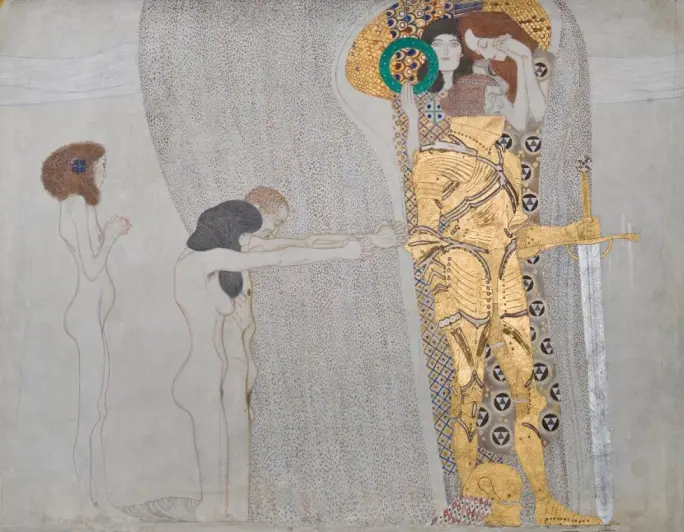
There, Klimt painted The Sufferings of Weak Humanity: a kneeling couple reaching toward a heavily armed knight who stands between them and the forces they cannot overcome themselves, a figure Klimt later revisited in The Golden Knight, 1903 – Gustav Klimt.
From Live Model to Wall Design
Seen from the front, the kneeling woman bends forward with her head lowered, her face almost hidden by her long hair. A few pencil lines are enough to define the figure.
Placed beside the finished mural, the drawing reveals how Klimt transformed a study from life into a figure within the Beethoven Frieze.
Just as he had done in Female Head, Her Chin Resting in Her Hands, 1901 – Gustav Klimt, Klimt reduced the figure to a few carefully observed contours that would remain clear when translated into the monumental scale of the frieze.
The Little “R” and the Lederer Family
According to the provenance records, the sheet bears a small R beside Klimt’s initials, linking it to the group of Beethoven Frieze drawings once given to Carl Reininghaus. When the Secession show closed in summer 1902, the temporary wall paintings were slated to be destroyed. Collector Carl Reininghaus stepped in during 1903, bought the frieze, and paid workers to saw the plaster panels out of the building. To thank him, Klimt gave Reininghaus more than a hundred drawings from the project and marked each sheet with his initial. In 1915, August and Serena Lederer bought both the mural and this drawing from Reininghaus. After surviving Nazi seizure and postwar return to their son Erich Lederer, the drawing stayed in Vienna until November 1973, when Erich sold it through London’s Piccadilly Gallery, the exact same year Austrian export rules pressured him into selling the Beethoven Frieze to the state.

Leave a Reply