Egon Schiele:
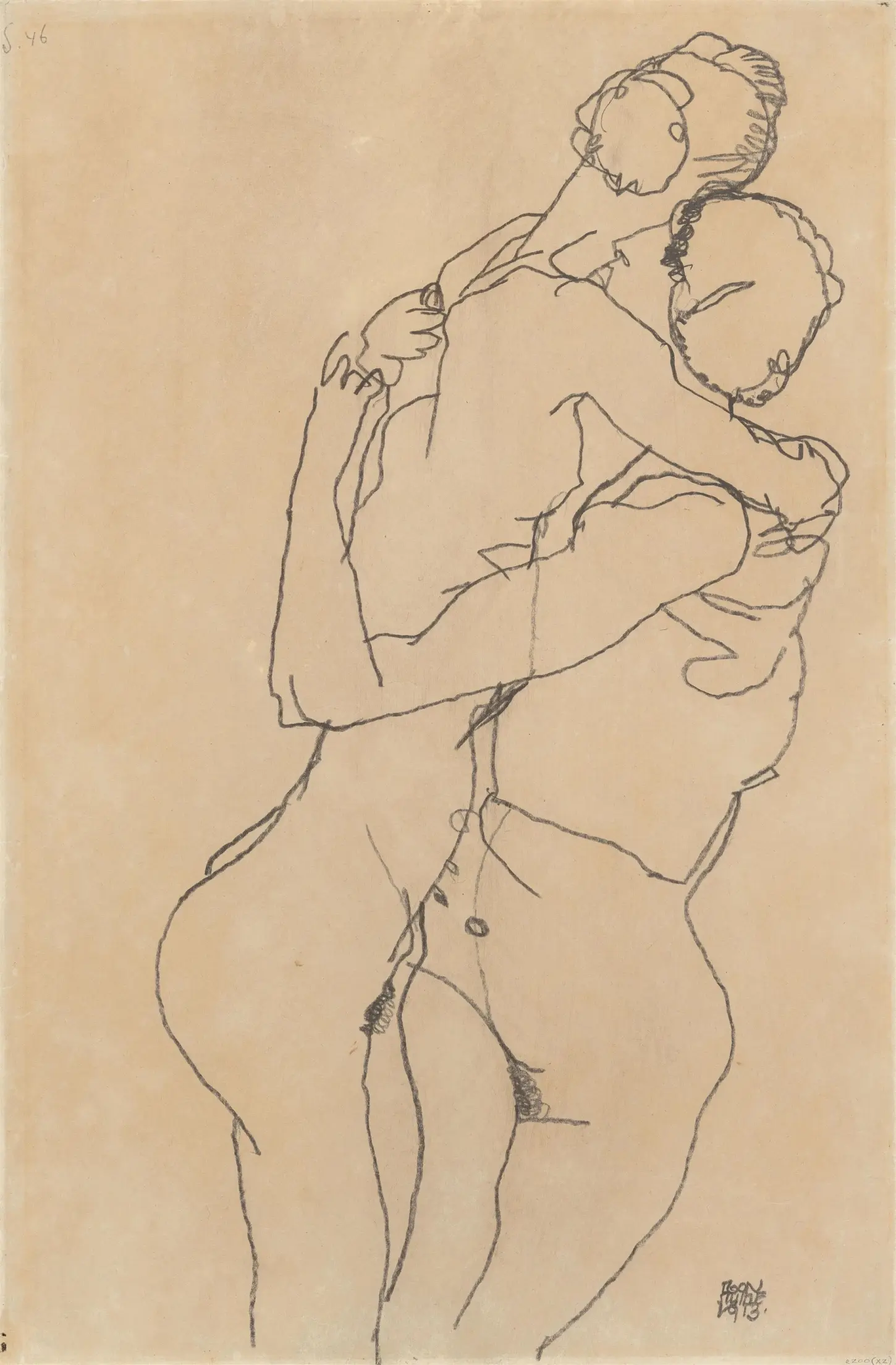
Two Standing Female Nudes, Embracing (Zwei stehende weibliche Akte, sich umarmend), 1913
Pencil on Simili Japan paper
46.9 × 31.1 cm
Auctioned at Kunsthaus Lempertz in 2024 for € 162,500
(Kallir d1354)
Two women stand so close together that it takes a moment to separate one from the other. Their faces are turned away, their bodies overlap, and the embrace feels private, as if it was never meant to be observed. Drawn in 1913 with nothing more than graphite on smooth paper, the sheet proves how little Schiele needed to create tension and intimacy. Even without the color of his watercolors and gouaches, the embrace remains unforgettable.
Turning Away After 1912
Readers familiar with earlier drawings will notice how much has changed in just two years. The earlier drawing confronts us with nervous tension, while here Schiele seems more interested in the quiet bond between the figures than in provoking the viewer.
Following his brief imprisonment in Neulengbach and his return to Vienna, Schiele pulled back from direct provocation and stepped into a cooler, more distanced way of looking. Across Drawings by Egon Schiele from this period, models frequently drop their gaze or turn their heads completely out of view. Here, neither woman acknowledges us. The result is strangely intimate. We are allowed to witness the embrace, but not to join it. Without facial expressions to guide us, our attention shifts to the way the women lean into each other. One seems to support the other, making the embrace feel both steady and fragile at the same time.
Pure Graphite Beside Two Gouaches
In Jane Kallir’s catalogue raisonné, this sheet sits directly between two related studies of the same pair: Embrace (Kallir D1353) and Friendship – Egon Schiele. While Schiele brushed rich gouache and watercolor onto those versions, he kept this drawing strictly in pencil. That decision brings us unusually close to the artist’s hand. Every adjustment remains visible. A contour is strengthened here, repeated there, until the two figures seem to lock together. The embrace feels both tender and slightly awkward, as if the women are searching for the most natural way to occupy the same space.
What makes the sheet remarkable is not complexity but restraint. There are no dramatic gestures, no direct stare, and none of the vibrant color found in related works. Yet Schiele still manages to suggest an entire relationship through a handful of pencil lines. The closeness of the two women also looks ahead to works such as Nude Girls Embracing, 1914, where he continued exploring the emotional possibilities of intertwined figures.
Sideways on the Auction Block
This drawing has one of the more unusual histories among Schiele’s works on paper. After leaving Vienna, it passed through Otto Kallir’s Galerie St. Etienne in New York and appeared in museum exhibitions across the United States. When it came up for auction in Munich in 1978, however, someone catalogued the work horizontally rather than vertically. Seen that way, the intertwined bodies become surprisingly difficult to read. Only later was the mistake corrected and the sheet restored to the upright orientation Schiele intended. For a time, collectors and viewers were literally looking at the drawing from the wrong direction, a reminder of how radically Schiele reduced the human figure to a few essential lines.
Later preserved in Munich’s Günter P. Landmann collection, the drawing resurfaced at Kunsthaus Lempertz in 2024. Schiele offers few clues beyond the embrace itself. The women stand close together, their bodies touching, their faces turned away. What that embrace means is left largely to the viewer.
Leave a Reply