Gustav Klimt:
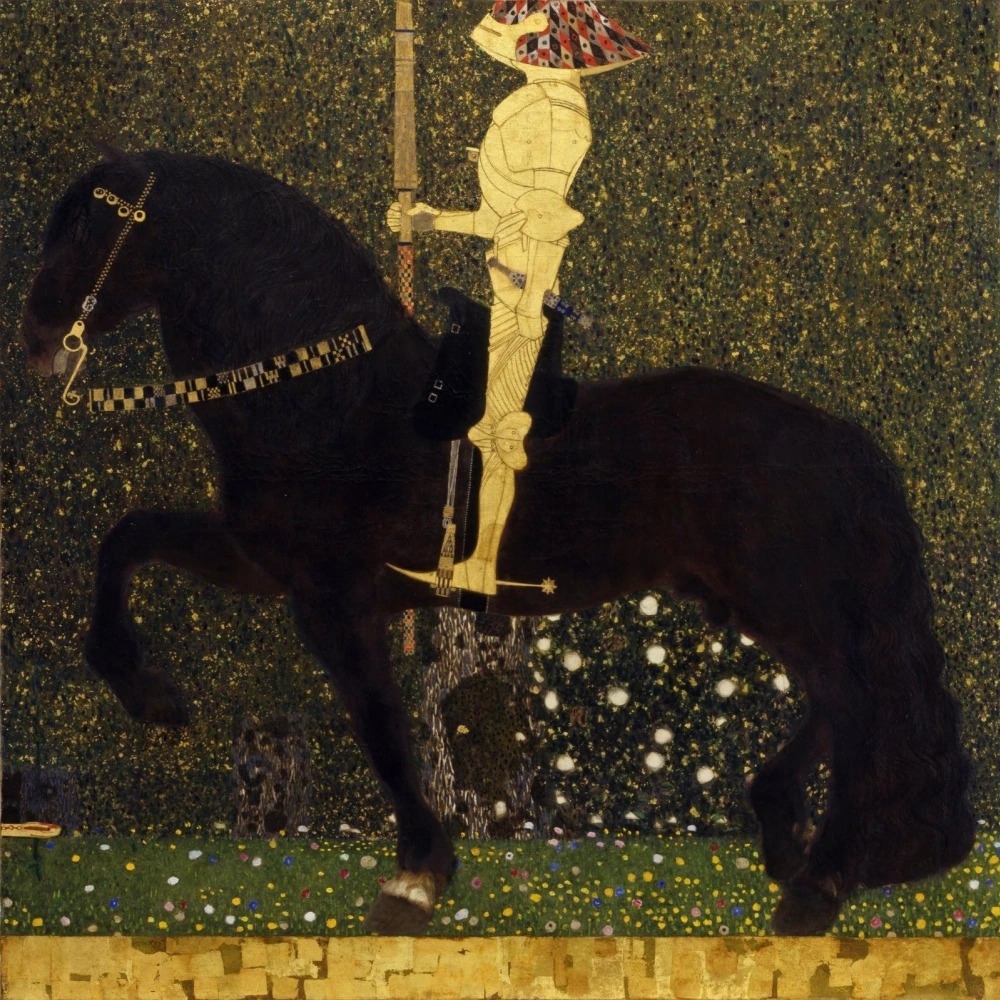
The Golden Knight (Der goldene Ritter) or Life in Battle (Lebenskampf) (1903)
Oil on canvas
100 × 100 cm
© Aichi Prefectural Museum of Art, Nagoya, Japan
(Natter no. 155)
The Golden Knight belongs to the moment when Klimt’s art glowed with its most unmistakable radiance — the years when gold leaf, ornament, and symbolism fused into a language entirely his own. The painting has long invited comparison with a figure from the Beethoven Frieze of 1902. There, Klimt imagined a standing knight, bare‑headed, hair flowing, a youthful guardian who steps forward to defend vulnerable humanity. He is the embodiment of “the well‑armed strong one,” the hero who hears the cries of the world and answers them.

In this later work, Klimt returns to the idea but reshapes it. The knight is no longer on foot; he rides a horse, encased in armor that gleams like a ceremonial object. The composition is dense with gold and patterned surfaces, as if the figure has been absorbed into a world of spiritual metalwork. The horse’s head, the shield, the armor plates — all of it feels both ancient and strangely modern, a fusion of medieval form and Secessionist abstraction. Klimt’s fascination with historical armor, which he studied closely in the Kunsthistorisches Museum, is unmistakable. The suit is not fantasy; it is rooted in real models, then transformed through Klimt’s decorative imagination.
Some writers have suggested that the knight may carry a personal resonance — a symbolic self‑portrait of Klimt at a moment of trial. The painting was created shortly after the storm surrounding the Faculty Paintings, when the University of Vienna rejected his monumental commissions and the public debate grew bitter. Klimt withdrew from state projects entirely, choosing independence over compromise. Seen against that backdrop, the armored rider becomes more than a medieval figure. He can be read as the artist himself, moving forward with resolve, protected by the integrity of his own vision.
What gives the painting its lasting power is the tension between vulnerability and strength. The knight is encased in gold, yet the scene is quiet, almost contemplative. Klimt seems less interested in battle than in the inner state of someone who has endured conflict and continues on his path. The work stands as a luminous emblem of perseverance — a reminder that, for Klimt, beauty and struggle were never far apart.
Leave a Reply