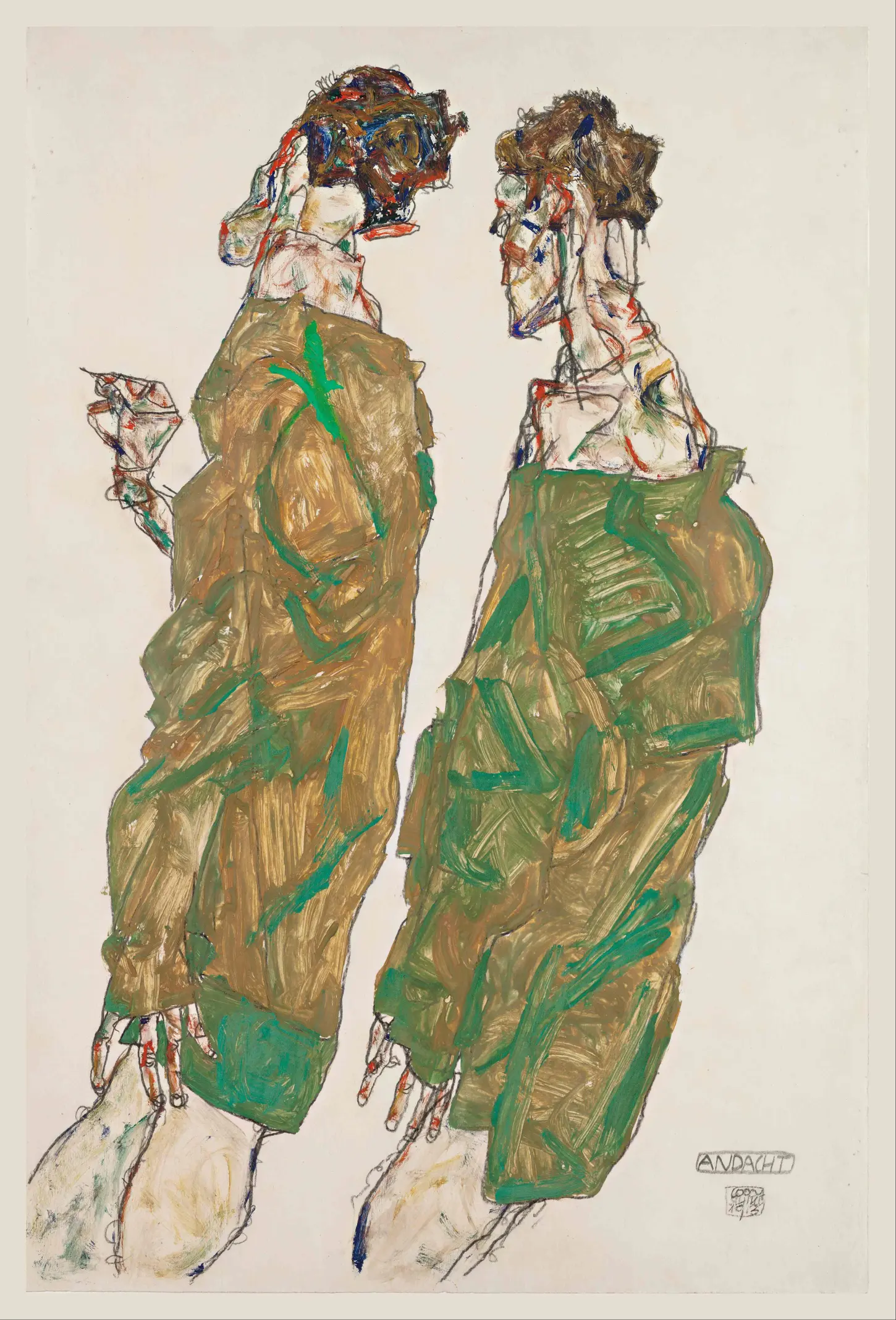
Egon Schiele:
Devotion (Andacht), 1913
Pencil and gouache on paper
48.3 × 32 cm
©Leopold Museum, Vienna
(Kallir d1418)
Look closely at the lower-right corner of this sheet, and you will find the word ANDACHT, written in Schiele’s own hand. That small inscription is more unusual than it might first appear. Schiele rarely gave his drawings explicit titles, making the word especially intriguing. Rather than identifying the figures before us, he offers a clue to how he may have understood them. Andacht is often translated as devotion, contemplation, or quiet reflection.
What makes the title so interesting is that the drawing itself offers no immediate answer. Quick lines move across the paper, flashes of red, blue, green, and ochre appear throughout the composition, and the eye shifts constantly between the two figures. Yet the longer one looks, the more the title begins to feel appropriate.
Between Presence and Reflection
At first glance, the oversized coats dominate the sheet. Painted in broad strokes of ochre and green, the garments occupy far more space than the heads themselves. The figures seem almost swallowed by the heavy clothing, which gives these otherwise fragile forms an unexpected physical presence.
Schiele places two closely related figures side by side, shown from slightly different angles. Whether we are looking at the same sitter twice or at two closely connected studies is not entirely clear, and that ambiguity adds to the fascination of the sheet. The repeated figures encourage us to look back and forth across the page, noticing subtle differences in posture, line, and colour.
The restless lines remain unmistakably Schiele’s. Faces, hands, and clothing are built up through a network of quick marks that never completely settle. Yet despite this energy, both figures appear curiously absorbed in their own world. They do not acknowledge one another, nor do they engage directly with the viewer. Perhaps this inward quality is what Schiele had in mind when he chose the title Andacht.
The Footsteps of a Lost Collection
Part of the story of Andacht begins long after Schiele completed the drawing. The sheet is associated with the collection of Fritz Grünbaum, one of Vienna’s most celebrated cabaret performers and a passionate collector of modern art. His collection included numerous works by Egon Schiele and reflected the rich cultural life of pre-war Vienna.
That history took a tragic turn after the Anschluss. Grünbaum was arrested by the Nazi regime in 1938, his possessions and art collection were subsequently dispersed, and he died in Dachau concentration camp in 1941. Many works that once belonged to him later became the subject of provenance research and restitution claims that continue to attract attention today.
Like many works associated with the Grünbaum collection, Andacht appears to have followed a complex journey through the upheavals of the twentieth century. The drawing passed through Brussels and Switzerland before eventually being acquired by Dr. Rudolf Leopold in 1964 and entering the collection that would form the Leopold Museum.
Knowing this history does not change the drawing itself, but it does add another layer to it. A sheet associated with contemplation and inward reflection survived events that transformed Europe and destroyed much of the world in which both Schiele and Grünbaum had lived.
More than a century later, the inscription remains one of the drawing’s most intriguing features. The figures never fully explain the title, and perhaps that is exactly the point. Schiele leaves us with a suggestion rather than an answer, inviting each viewer to discover a personal meaning in the word Andacht.
Leave a Reply