Emilie Mediz-Pelikan:
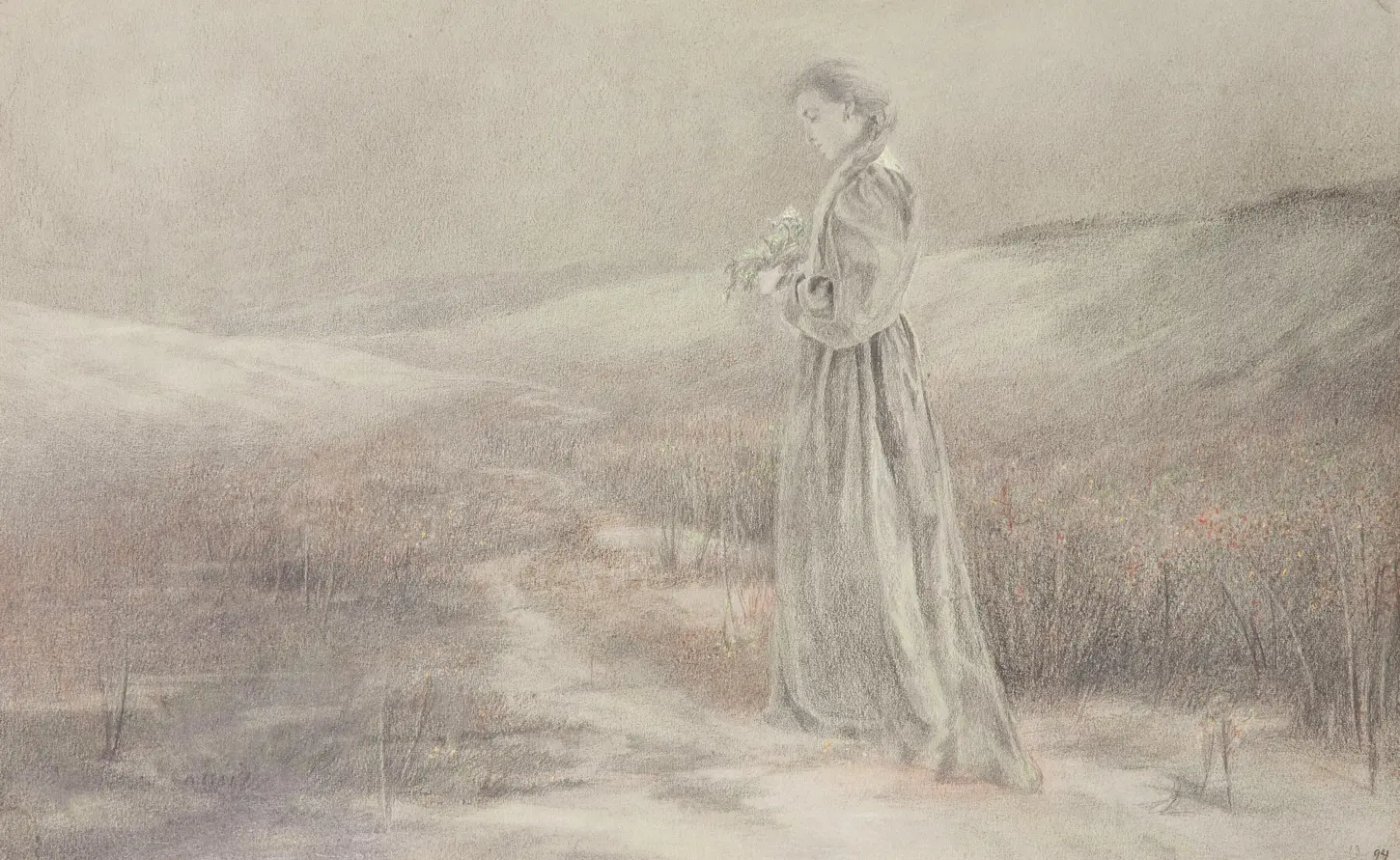
Girl with Flowers (Mädchen mit Blumen), 1894
Pastel on paper
27.4 × 39.2 cm
©Leopold Museum, Vienna
At first glance, the flowers mentioned in the title may seem misleading. Rather than depicting a girl surrounded by blossoms, Emilie Mediz-Pelikan shows her alone in a wide, open landscape with only a small bouquet in her hands. Near the lower right corner, the artist marked the sheet ’94—a small detail that situates the pastel in a specific moment of her life.
Among the Meadows
The first thing that stands out is not the bouquet but the space around the girl. She occupies only a small part of the sheet. The meadows, low hills, and soft bands of colour around her gradually fade into the distance. Nothing appears crowded or forced. Instead, the landscape seems to unfold at its own pace.
Pastel was ideally suited to Mediz-Pelikan’s artistic practice. Its powdery texture allowed her to soften edges and blend colours gently into one another. The folds of the dress, the pale path beneath her, and the grasses of the meadow are treated with the same delicate touch. As a result, the girl never feels separated from her surroundings. She belongs to the landscape rather than standing apart from it.
The scene is simple, yet it rewards close attention. The longer one studies the sheet, the more one’s attention shifts from individual details to the overall atmosphere. There is no dramatic event and no obvious narrative. Much of its appeal lies in its quietness and restraint.
A Partnership Bound in Hardship
The calm mood of Girl with Flowers contrasts sharply with the realities of Emilie’s daily life. In 1891, she married the Viennese painter Karl Mediz, marking the beginning of a partnership that would shape both artists’ careers. The couple often struggled financially and received little immediate support for their artistic ambitions.
Karl’s interest in the study of plants encouraged Emilie to look closely at nature, yet she developed a visual language distinctly her own. While both artists were part of the broader artistic currents linking Vienna, Munich and, later, Dresden, Emilie was drawn to softer transitions and atmospheric effects. In Girl with Flowers, pastel allowed her to convey precisely this quality.
The date inscribed on the sheet—1894—coincided with a difficult period for the couple. Financial pressures would eventually lead them to leave Vienna in search of new opportunities in Dresden, where both hoped to build more secure careers.
The Locked Studio
The peaceful world depicted in this pastel was followed by a series of personal tragedies. Just as her work was beginning to receive wider recognition around the turn of the century, Emilie’s career was cut short. In March 1908, at the age of forty-six, she died unexpectedly in Dresden.
The loss deeply affected Karl Mediz. Unable to part with much of the work they had created together, he kept Emilie’s artistic estate in his studio for decades. Many works remained hidden from public view, preserved as a personal remembrance of his wife and artistic companion.
Karl died in January 1945, only weeks before Dresden was devastated during the final months of the Second World War. The survival of this fragile pastel, which remained in the family before eventually entering public collections, helped ensure that Emilie Mediz-Pelikan’s work would continue to be seen and appreciated.
More than 130 years after it was created, Girl with Flowers still rewards those who take the time to look. The girl, the small bouquet, and the open landscape do not demand attention. Instead, they quietly invite it.
Leave a Reply