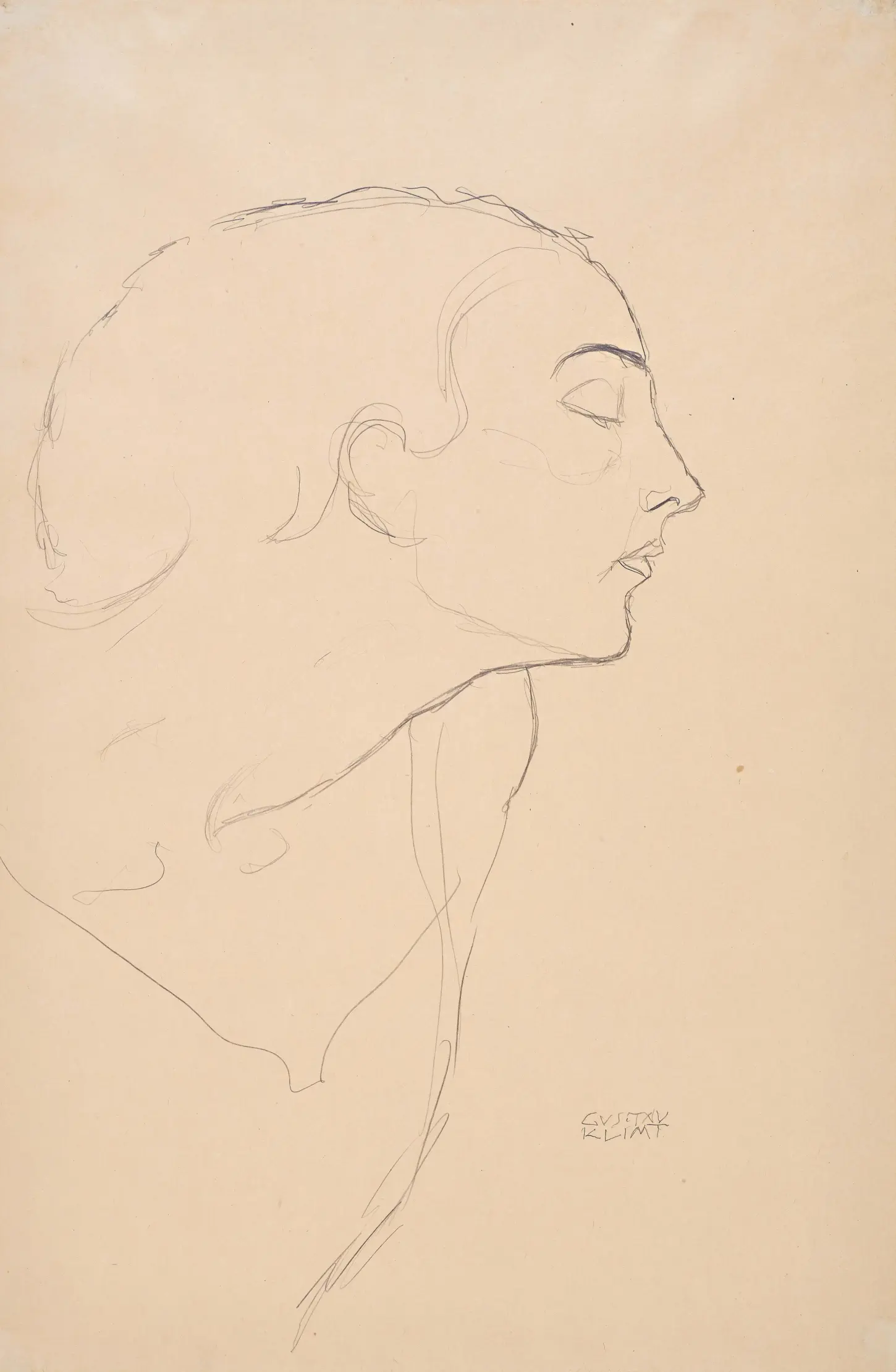
Gustav Klimt:
Bust Portrait of a Lady in Profile from the Right with Closed Eyes (Study for The Virgin), 1911/12
Pencil on Japanese paper
57.1 × 37.4 cm
©Leopold Museum, Vienna
(Strobl s2296)
A woman sits in profile before us, her eyes closed and her head gently lowered. In this delicate drawing on thin Japanese paper, Gustav Klimt leaves aside the patterns, gold, and ornament that often define his paintings. What remains is a few carefully observed lines and the quiet presence of the sitter. The result is one of the most intimate aspects of Klimt’s art: his ability to suggest an entire personality with the lightest touch of a pencil.
The Searching Line
A closer look reveals that Klimt did not rely on a single continuous contour. Instead, the profile emerges through short pencil strokes that gradually find their way across the page. Around the forehead, chin, and hairline, several lines remain visible, allowing us to follow the artist’s hand as he worked. The Japanese paper plays an important role in this effect. Its soft surface catches the graphite gently, giving the drawing a lightness that would be difficult to achieve on a heavier sheet. Nothing feels forced. The portrait seems to emerge naturally from the paper.
A Study for The Virgin
Alice Strobl connected this drawing to Klimt’s work on The Virgin, completed in 1913. Although this exact profile does not appear in the finished painting, the sheet belongs to the period in which Klimt was exploring female heads and figures for one of his most ambitious late compositions. Like many preparatory drawings, it offers a glimpse into the artist’s search for form before colour entered the process. Yet it also stands comfortably on its own. Even without knowledge of the painting, the drawing possesses a quiet completeness.
The Signature and Provenance
Klimt signed the sheet in pencil at the lower right. The drawing later passed through the Galerie Wolfgang Gurlitt before entering Rudolf Leopold’s collection and eventually the Leopold Museum Foundation in 1994. Its survival is remarkable in itself. Japanese paper is delicate, and works such as this depend greatly on careful handling and preservation. Today the sheet remains one of many drawings that reveal how confidently Klimt could work with the simplest of materials.
The Closed Eyes
What lingers most is the expression. With her eyes closed and her head slightly lowered, the woman appears lost in a private moment. There is no attempt to engage the viewer directly. Instead, the drawing invites us to observe quietly from a distance.
Klimt gives us very little. There is no elaborate costume, no jewellery, and no decorative background. Yet the portrait never feels incomplete. A few pencil lines are enough to suggest calm, concentration, and inner stillness. More than a century later, the drawing retains the same quiet presence. Rather than drawing attention to itself, it rewards those willing to slow down and look closely.
Leave a Reply