
Vienna Secession: Maximilian Lenz
The Golden Cloak (Der goldene Mantel), ca. 1903
Oil and gold relief on composite board
117.5 x 67.9 cm
Private Collection / Auctioned at Christie’s in 2005 for 273,619 USD
The Vienna Secession at the turn of the century was famous for its rich, decorative style. Maximilian Lenz was a founding member of this group of artists. He made this tall painting during a time when he just as Gustav Klimt experimented a lot with gold leaf and special patterns. The artwork shows how the ideas of the Viennese artists spread to other painters in the group, changing how they used colors and shapes.
The Klimt Confusion and the Mystery Model
Many websites and art lovers often think this painting was made by Gustav Klimt. The heavy use of gold leaf, the mosaic look, and the stylized pose look very similar to Klimt’s work. On major commercial platforms like Etsy and digital archives like Alamy, this canvas is regularly sold under the invented title Portrait of a Woman in a Golden Dress with Klimt listed as the artist. Sellers use his famous name as a search keyword to generate sales, which completely erases the true creator, Maximilian Lenz, from history. While official art historical records leave no doubt that Lenz painted this work, the internet has created a false image around its authorship.
Modern viewers also wonder about the model’s identity. The auction house described the figure as a woman, yet the strong jawline, broad shoulders, and hidden body also reflect the Secessionist fascination with androgynous beauty. Lenz possibly intentionally hid these traditional gender features under the heavy cloak to turn the figure into a timeless symbol.
The Trip to Ravenna and the Power of Gold
The idea for using all this gold came from a special trip. In the winter of 1903, Lenz traveled to Ravenna in Italy together with Klimt. They wanted to study old Byzantine art. Both artists spent weeks inside the famous San Vitale church to look at the gold mosaics on the walls. This trip changed their art forever. Klimt brought these mosaic ideas back to Vienna, where they slowly developed into his famous Golden Phase, leading to The Kiss several years later in 1908. Lenz applied these lessons also in his studio, using gold leaf and raised patterns for his own immediate work. We can see this same gold style in his other large paintings on this site, like Autumn Gold.
Materials and the Art Market
The materials of this painting have an interesting history. At first, the auction house wrote that it was painted on wood. Later, they had to correct this because Lenz actually painted it on a modern composite board. Even though Lenz helped build the Vienna Secession and made art for their magazine Ver Sacrum, he is not very famous today. While Klimt’s paintings sell for hundreds of millions, this work by Lenz was sold at a Christie’s auction in 2005. It did set a record for Lenz by selling for over a quarter of a million dollars, but it still shows the huge gap in fame between Klimt and his close friend.
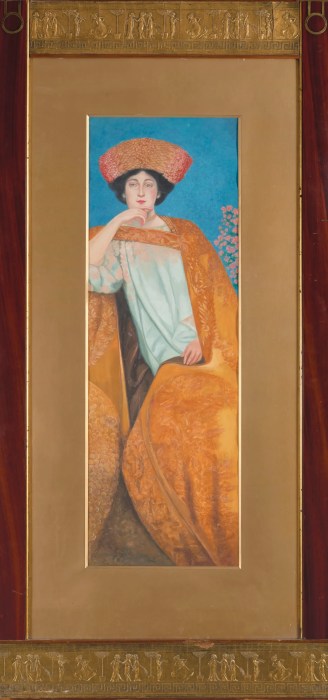
The Frame and the Total Work of Art
This physical presentation of the painting shows the true ambition of the Vienna Secession. Lenz did not just buy a standard frame for his canvas. He designed the entire border to work as a total work of art, or Gesamtkunstwerk. The dark wooden columns on the sides make the painting look like a classical building, while the top and bottom bands are covered in small, raised golden figures that tell their own visual story. By adding these heavy, golden decorations to the outside of the frame, Lenz connected the painted surface directly to the surrounding room, turning a simple portrait into a sacred object.
This custom design proves that Lenz viewed the frame as an essential part of the artistic message. The border acts as a bridge between the physical world of the viewer and the golden dreams hidden inside the painting. While modern online shops copy just the face to sell prints, the full object remains a rare survival of Viennese design, showing how these artists wanted to change every object in modern life.
Leave a Reply