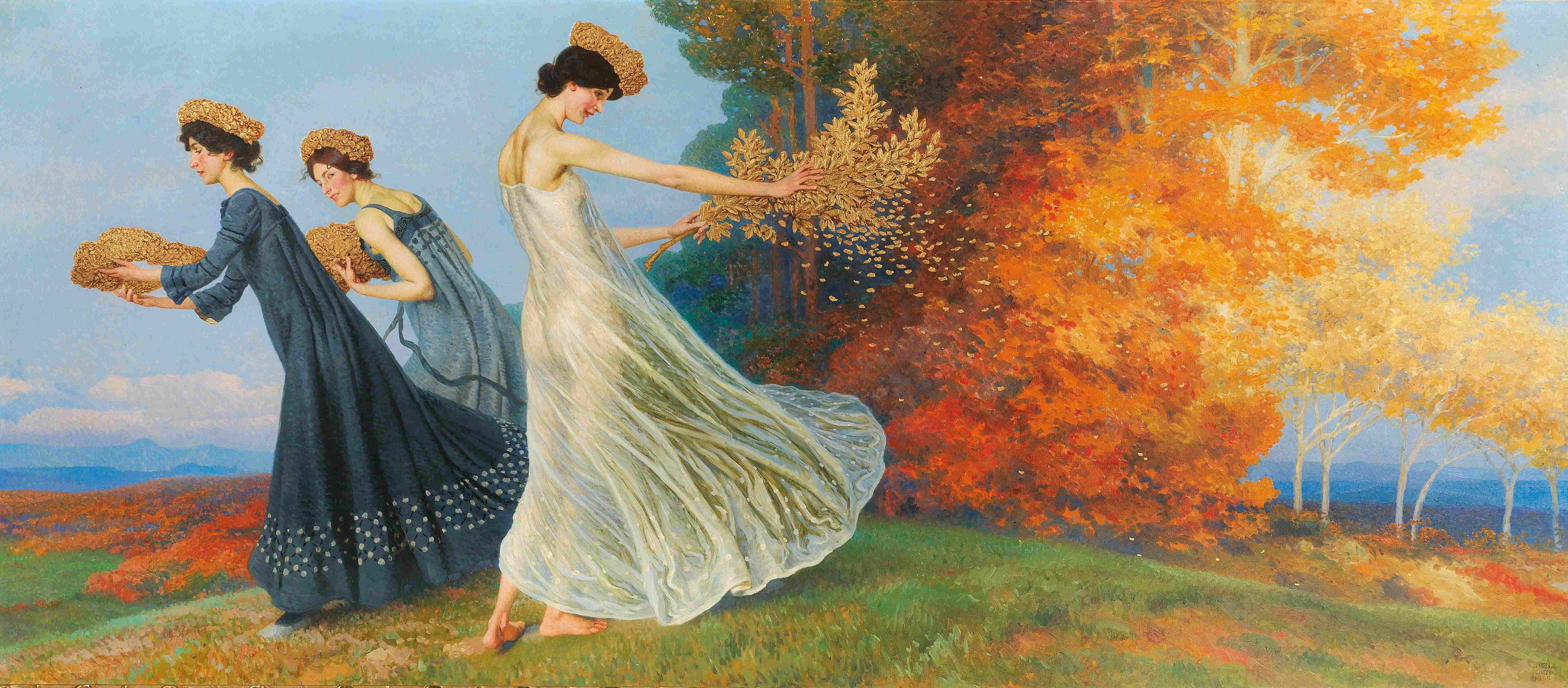
Vienna Secession: Maximilian Lenz
Autumn Gold (Herbstgold), 1905
titled and inscribed on the reverse;
signed, inscribed, and dated M. Lenz Vienna 1905
oil with gold relief on canvas
102 × 230.5 cm
Auctioned at Dorotheum in 2018 for EUR 68,750
Autumn Gold (Herbstgold) can be placed within one of the most assured and resonant moments in Maximilian Lenz’s career — a period shaped by early discipline, wide travel, and a lifelong openness to artistic influence. Lenz entered Vienna’s School of Applied Arts at fourteen and was admitted to the Academy of Fine Arts soon after. A two‑year scholarship carried him to Rome, and in the early 1890s he travelled to Buenos Aires with the engraver Ferdinand Schirnböck for a commissioned project. Returning to Vienna, he joined the Künstlerhaus in 1896 and became a founding member of the Vienna Secession the following year, remaining connected to the movement for more than four decades.
In 1903 he journeyed to Italy with Gustav Klimt. Their time in Ravenna, where Lenz studied the gold‑laden Byzantine mosaics of San Vitale, left a gentle but unmistakable trace on his work. A year later he moved to Lower Austria to teach drawing to the Kupelwieser family. Among them was Ida Kupelwieser, gifted and deeply admired, whom he married late in life. Her early death marked him profoundly, and he never fully returned to an independent artistic rhythm, turning instead to designing war‑bond posters during the First World War.
Lenz’s oeuvre is marked by variety rather than a single, fixed style. He adapted his approach to each medium and each idea, allowing every work to find its own form. Autumn Gold belongs to the years in which he found renewed inspiration within the Kupelwieser circle. Its raised gold accents echo both Klimt’s influence and the impressions gathered during his Italian journey. The composition is expansive yet gently ordered: three women in flowing gowns, crowned with wreaths and carrying bundles of wheat, move across a grassy landscape. The leading figure scatters seeds into the air, while the others follow in quiet procession. Behind them, autumnal trees shift from green to gold, and a soft blue sky opens above — evoking the warmth and stillness of a harvest afternoon.
The scene likely draws on the region around Lake Lunz, where Lenz spent time during this period. The figures are carefully studied, with one seen from behind in a subtle twist, linking the foreground’s movement to the wreath‑bearers drifting into the distance. Surviving sketch sheets confirm Lenz’s attention to these poses. The painting’s mood is lyrical and serene, inviting the viewer into a world of seasonal ritual and quiet celebration.
The companion work to Autumn Gold (Herbstgold) is Maximilian Lenz, The Old Song (Das alte Lied), auctioned in the same Dorotheum sale. It depicts a flautist playing for a circle of dancing women — the very figures who, in Autumn Gold, move across the landscape with wreaths and sheaves of grain. The two paintings share scale, palette, and mood, and were conceived as complementary scenes: one centred on music and movement, the other on harvest and seasonal abundance. Together they form a lyrical diptych of autumnal ritual and quiet celebration.

Together with its companion piece, the work offers a moment of stillness — a golden pause in time, rich with atmosphere and memory.
(based on the auction note by ©Dr. Christl Wolf)

Leave a Reply