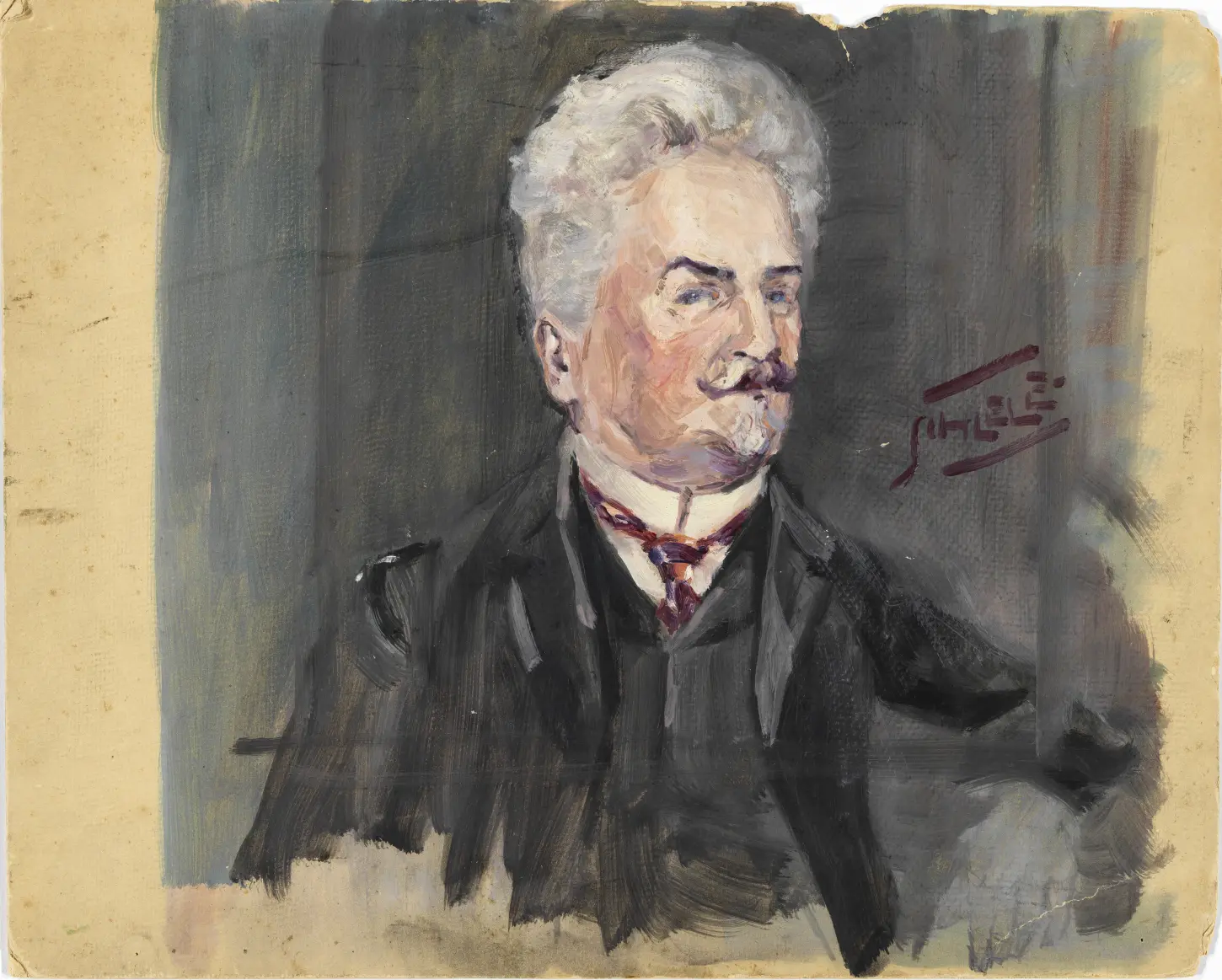
Egon Schiele:
Portrait of Leopold Czihaczek (Porträt Leopold Czihaczek), 1907
Tempera on cardboard
32 x 39.9 cm
©Wien Museum, Vienna
(Kallir P3b)
Egon Schiele was still a teenage art student when he captured this stern profile of Leopold Czihaczek in 1907. Czihaczek was Schiele’s uncle and legal guardian, a strict railway official who held the family purse strings and reluctantly funded his nephew’s controversial education. This early painting shows the exact man Schiele had to win over before he could break every rule in the Viennese art world.
The Demands of Uncle Leopold
This portrait highlights the complex, tense family dynamic that shaped Schiele’s youth. After Schiele’s father died tragically in 1905, Czihaczek—who was married to the sister of Schiele’s mother—stepped in as the legal head of the family. As a high-ranking official for the state railways, Czihaczek expected absolute discipline, financial security, and respectability. He viewed his teenage nephew’s obsession with drawing as a dangerous, unstable distraction and resisted Egon’s dream of becoming a professional artist.
The painting offers a glimpse into this world. By using his uncle as a model, Schiele practiced his technical skills on the person who controlled his daily life. Schiele felt trapped by his uncle’s demands, yet he remained entirely dependent on Czihaczek’s financial approval to attend the Academy of Fine Arts in Vienna. This confrontation was a recurring theme in the household. Schiele spent that same winter tracking his uncle’s mood in other works, like this painting: Portrait of Leopold Czihaczek, 1907. The rigid authority he faced here also stood in sharp contrast to the distant, cold relationship he shared with his mother, Marie Schiele, a tension you can trace all the way back to his academy submission drawing: Marie Schiele, the Artist’s Mother, 1906.
Academic Form and the Final Split
The academic neatness of this cardboard surface reveals a style heavily influenced by Schiele’s professors. He chose tempera paint, using blocky colors to shape his uncle’s profile against a muted background. He paid close attention to the formal suit and the stiff collar, capturing the exact social status of a high-ranking Viennese official. At this stage, the young painter was still working hard to prove his technical skills to his guardian.
However, this quiet approval did not last long. As Schiele later developed his signature expressionist style, focusing on raw, distorted figures and explicit nudity, Czihaczek grew increasingly deeply disturbed. The final breach came when Schiele abruptly walked out of the art academy to found the Neukunstgruppe. Furious over his nephew’s stubborn defiance and radical lifestyle, Czihaczek permanently cut off his financial support and resigned as his legal guardian. This explosive break allowed Schiele to fully escape the conservative constraints of his youth, though the complex psychological scars of his family life would continue to surface until his final days, visible in later works.
Leave a Reply