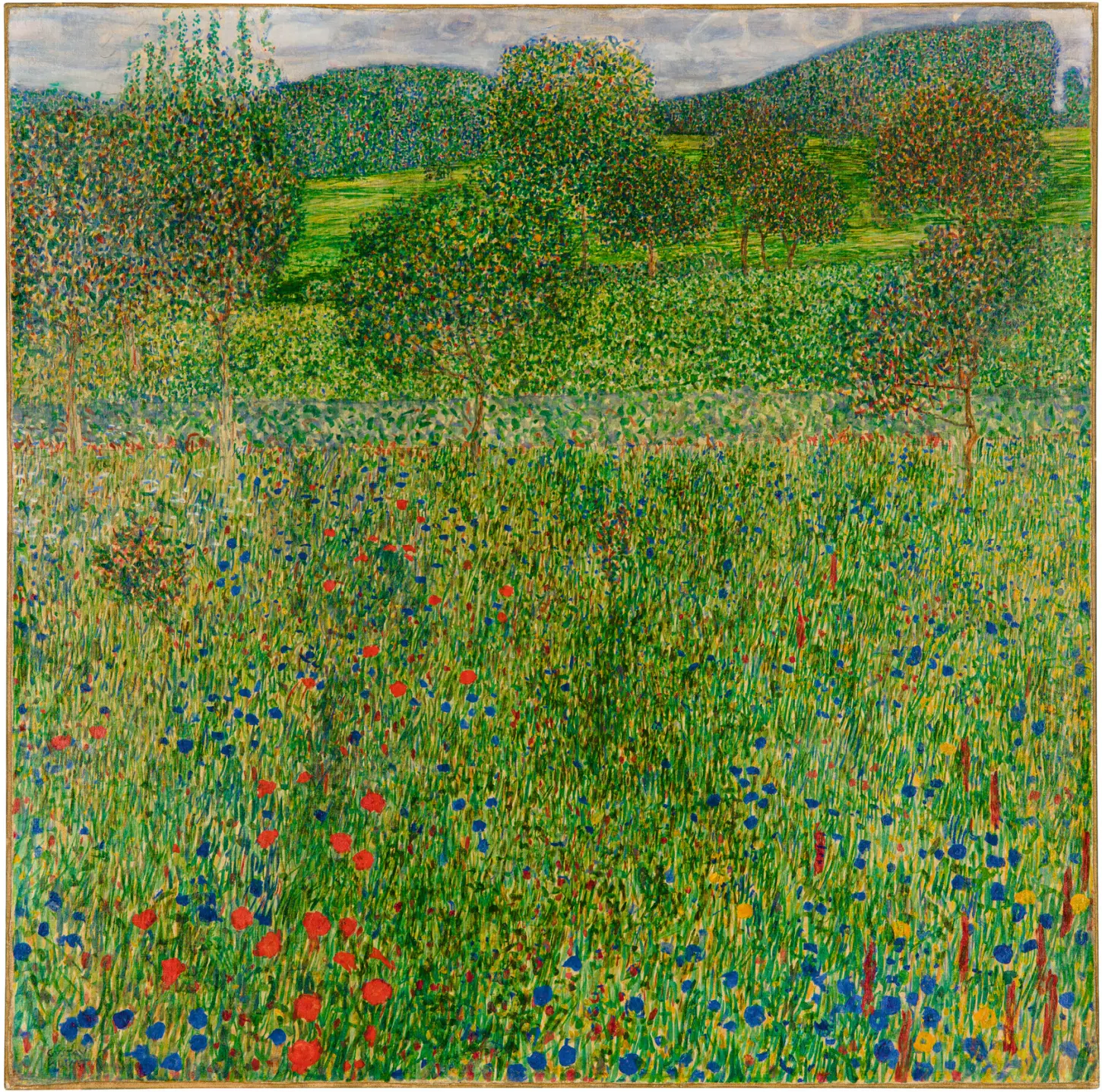
Gustav Klimt:
Orchard (Obstgarten), 1904/1905 (reworked/completed 1907)
Tempera and oil on canvas
100.17 × 100.33 cm
©Carnegie Museum of Art, Pittsburgh
(Natter 167)
Gustav Klimt focused extensively on square landscape paintings during his summer months at the Attersee. Away from his demanding portrait commissions in Vienna, he utilized these rural retreats to experiment with pure color patterns. Orchard is one of several works produced during these artistic retreats. While the Carnegie Museum of Art records the execution date as 1907, modern scholarship challenges this single chronology.
The composition avoids traditional perspective. Klimt raised the horizon line to the absolute top of the canvas. This choice completely eliminated the sky. The viewer faces a flat, carpet-like surface where depth is indicated only by the shrinking scale of the lower flowers. Slender tree trunks slice vertically through the pictorial plane. The entire surface vibrates due to tiny, isolated brushstrokes of tempera and oil paint. This technique stems directly from French Post-Impressionist pointillism. Klimt adapted this method to transform a natural setting into a dense, decorative pattern.
Archival documentation and formal analysis reveal significant inconsistencies regarding the creation of the work. In his 2012 catalogue raisonné, Tobias G. Natter catalogued the painting as entry 167, assigning it a primary date of 1904/1905. The physical surface suggests that Klimt either reworked the canvas at a later stage or left it unfinished in his studio. This ambiguity led to the scholarly suggestion that another hand completed the composition after Klimt’s death.
Provenance records clarify the legal status of the canvas during the Second World War. The Austrian architect Carl Maria Urban acquired the painting in Vienna and brought it to New York during his emigration in 1912. Because the artwork remained in the United States within the family estate after Urban’s death in 1933, it escaped wartime confiscation or forced sale in Europe. The documented gap in public exhibitions between 1933 and 1960 reflects private family ownership rather than any illicit transfer. The reputable art dealer Otto Kallir eventually acquired the canvas directly from the estate through his Galerie St. Etienne, selling it transparently to the Carnegie Museum of Art in 1960. Scholars continuing to analyze the physical paint layers still confront an unresolved problem when reconciling the upper foliage with Klimt’s fully authenticated timelines from 1905.
Leave a Reply