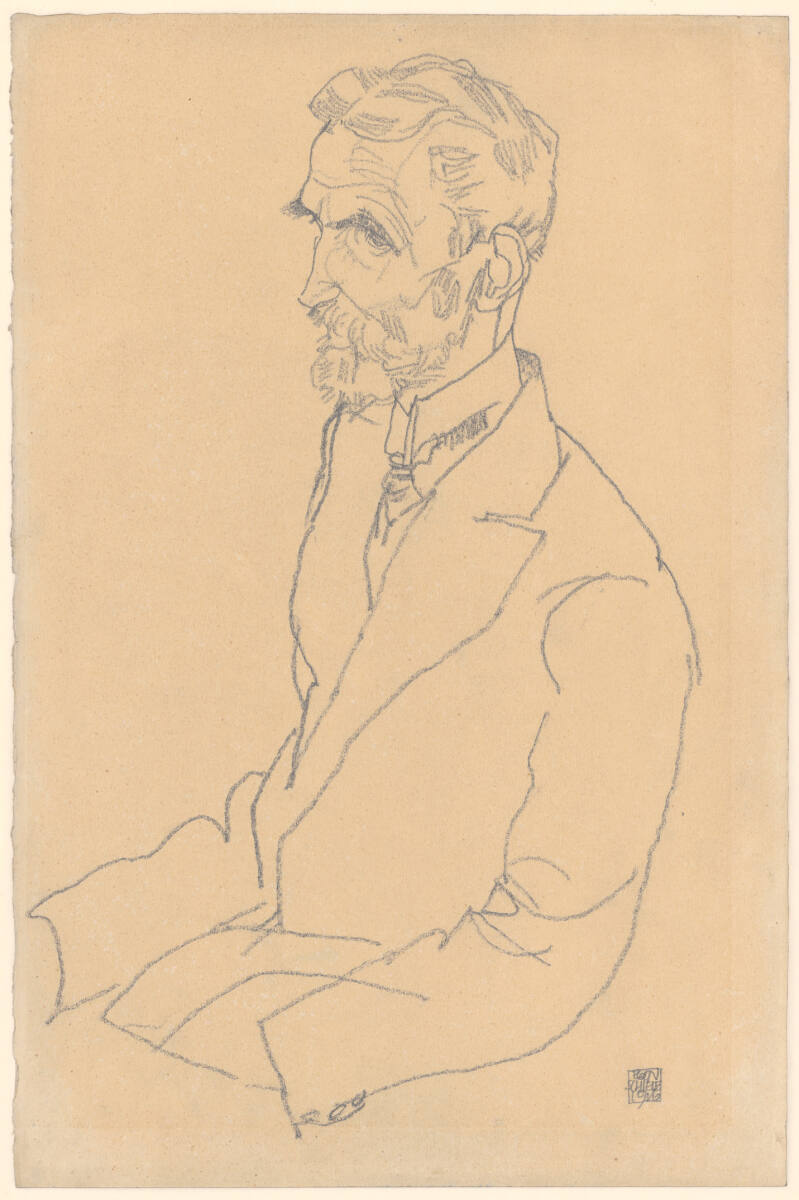
Egon Schiele:
Portrait of Johann Harms (Bildnis Johann Harms), 1916
Pencil on Japan paper
48.9 × 31.7 cm
©Albertina Museum, Vienna
(Kallir d1845)
Egon Schiele made this pencil drawing in 1916. The First World War disrupted much of his artistic work because of his military service, making this a period of very low production. In fact, archival records show that Schiele completed only nine oil paintings and roughly 100 drawings and watercolors during the entire year of 1916. During his time in Vienna, he focused heavily on his immediate surroundings, drawing for instance his aging father-in-law, Johann Harms.
A New Family and a Rare Kind of Portrait
Johann Harms lived from 1843 to 1917 and worked as a railway official before he retired. He was married to Josefa Bürzner (1850–1939), and together they had two daughters: Adele (1890–1968) and Edith (1893–1918). Josefa also brought a son from her first marriage into the household, Paul Erdmann. This extended family network became highly integrated into Schiele’s personal life and artistic output after he married Edith in June 1915. He lived in close contact with the family, and Paul Erdmann became a prominent subject in Schiele’s compositions, appearing in several intimate family drawings and photographs from this period.
The men in the household shared a close connection with the artist. Schiele got along remarkably well with Johann Harms and genuinely liked his father-in-law. Because of this warm, personal bond, the drawings and the final painting of Harms are unusually sympathetic compared to Schiele’s sharper, more aggressive portraits. This sheet on Japan paper was a study for a large oil painting that Schiele started in April 1916. In a letter to his brother-in-law Anton Peschka from January 1917, Schiele mentioned that his father-in-law had passed away of old age, and noted the companion oil portrait.
Catching the Quiet Dignity of Old Age
Schiele used clear pencil lines to catch the thin face of the elderly man. Harms is shown in a high collar, with his long beard and deep-set eyes forming the core of the drawing. The artwork reflects Schiele’s growing interest during his late career in capturing human dignity and mortality without his focus on intense sexuality.
Harms passed away shortly after the drawing was finished, on January 5, 1917. In a letter to Peschka, Schiele recorded the loss with great affection, writing: “My father-in-law died of old age on 5th Jan., I liked him very much, he was tall and slim, – 76 years old.”
From a Loyal Patron to the Albertina
Schiele signed the paper with his initials and the date in a small block in the lower-right corner. The archives show that the drawing was part of the Viennese collection of Heinrich Benesch before 1919. Benesch was one of Schiele’s earliest patrons and bought hundreds of drawings during the artist’s lifetime. The Albertina Museum bought the work from the Benesch estate in 1951. Today, the sheet allows visitors to see the preliminary drawing that came before Schiele’s later oil portrait.
Leave a Reply