Die Neukunstgruppe and Friends of Schiele: Franz Wiegele
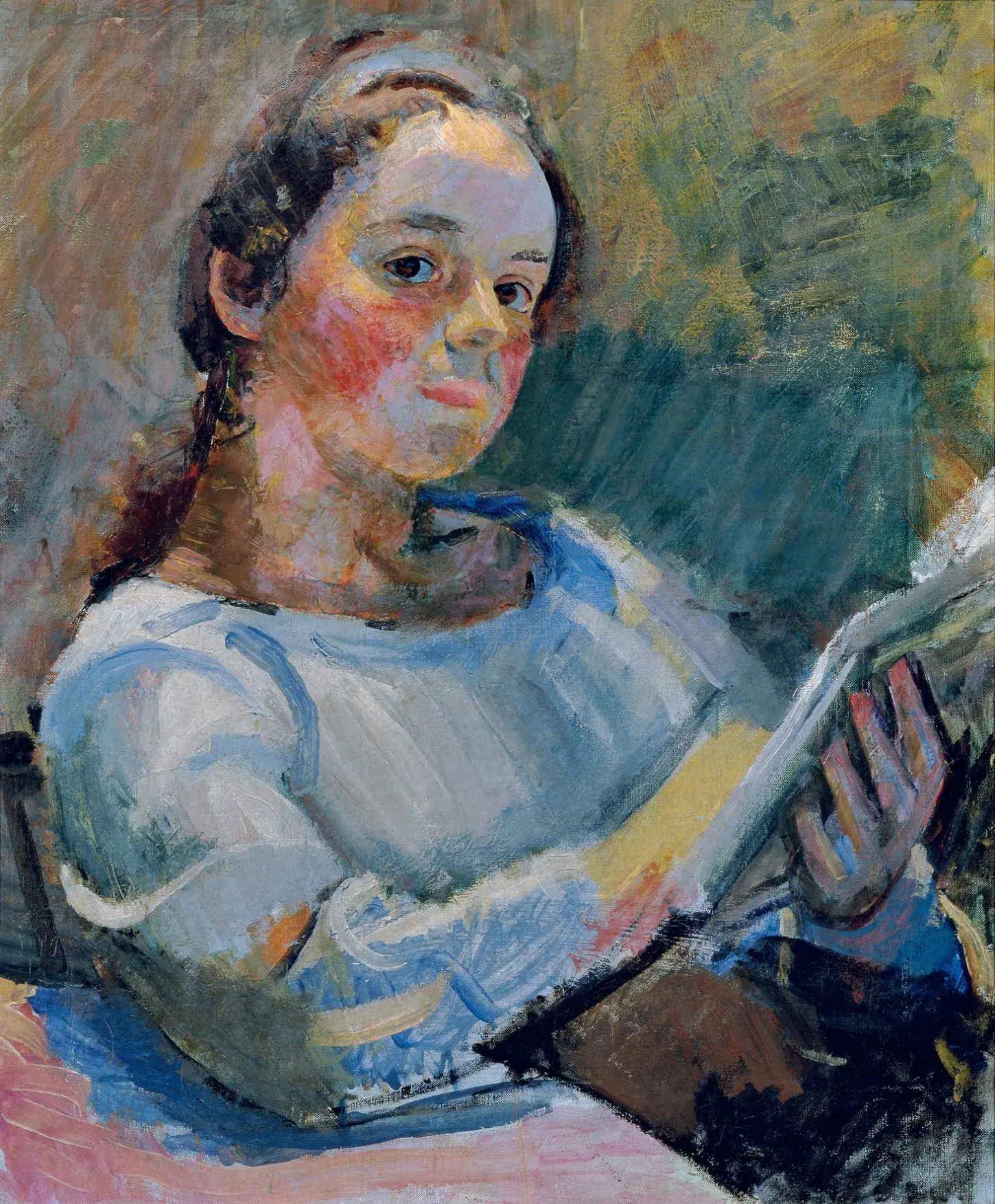
A Girl Reading (Lesendes Mädchen), c. 1920
Oil on canvas
55.5 x 46 cm
©Belvedere, Vienna
In the years surrounding the First World War, the radical core of the Viennese avant-garde began to splinter into separate geographic regions. Franz Wiegele had been a foundational member of the Neukunstgruppe in 1909, walking out of the Academy alongside Egon Schiele and Anton Faistauer to protest conservative teaching. By 1920, however, Wiegele had largely withdrawn from the volatile Viennese gallery scene, returning to his native village to form the nucleus of the Nötsch Circle. This unsigned canvas, Lesendes Mädchen, dates from this transitional window, catching the artist as he traded academic rebellion for a deeper, material exploration of form.
The Intertwined Network of Carl Moll and Anton Kolig
The physical history of this canvas reveals the close connections that remained between the older generation of the Vienna Secession, the Nötsch Circle, and the younger dropouts of the Neukunstgruppe. Wiegele’s artistic life was bound by a deep familial connection to fellow student Anton Kolig, who married Wiegele’s sister Katharina in 1911. This marriage established the rural village of Nötsch as a shared domestic and professional sanctuary for both painters. Recognizing their combined potential, Gustav Klimt and Carl Moll recommended the brothers-in-law for a prestigious Paris travel scholarship in 1912, allowing the extended family to travel to France together. Following this international exposure, it was Moll who eventually acquired this specific canvas for his private collection. After Moll’s death in the final weeks of the Second World War in 1945, the artwork passed to the Belvedere museum as a permanent bequest.
From Schiele’s Line to the Nötsch Volume
The viewer is confronted by a portrait that avoids both the golden ornamentation of Gustav Klimt and the emaciated lines of Egon Schiele. While Schiele stayed in Vienna and specialized in hyper-nervous, graphic contours that exposed the psychological tension of his sitters, the extended family in Nötsch chose a painterly alternative in the provinces. Wiegele and Kolig rejected Schiele’s sharp, linear approach to focus entirely on building three-dimensional space and volume through the pure application of color.
In Lesendes Mädchen, this departure is complete. Historically, artists depicted reading women as passive, delicate figures lost in bourgeois reverie. Wiegele used thick, painterly layers of oil to give the young girl a heavy, sculptural presence. The focus of the composition lies entirely on the volumetric mass of her head and shoulders, which fill nearly the entire frame. This specific handling shows how Wiegele transformed the early expressionism he shared with Schiele into a solid, physical realism, utilizing dense brushstrokes to ground his subject in a tangible reality.
Leave a Reply