Egon Schiele:
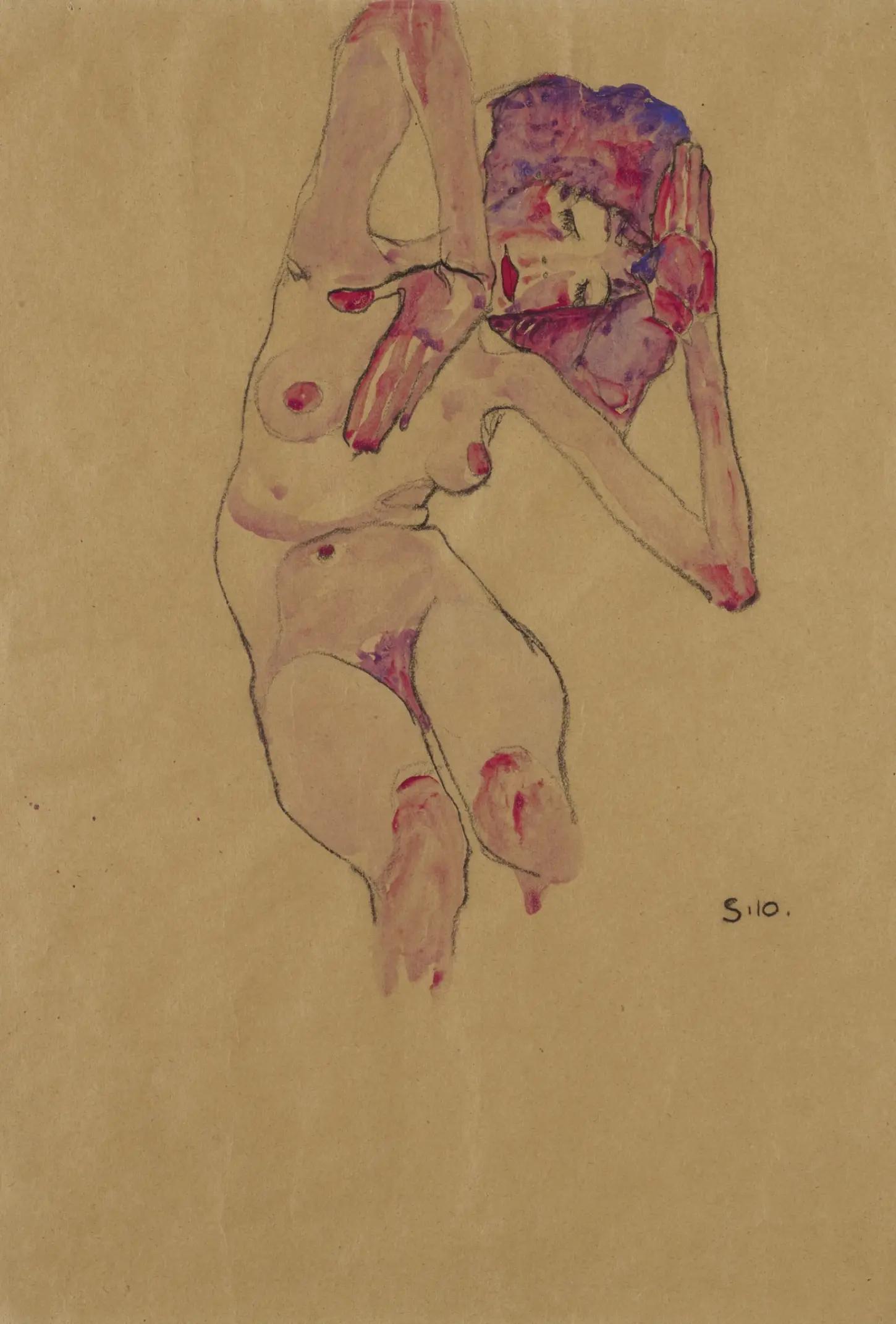
Seated Female Nude with Tilted Head and Raised Arms (Sitzender Frauenakt mit Geneigtem Kopf und Erhobenen Armen), 1910.
Gouache, watercolor and black crayon on paper
44.8 x 31.1 cm (17 5/8 by 12 1/4 in.)
Auctioned at Sotheby’s in New York (November 2018) for 1,515,000 USD
(Kallir d512)
The year 1910 was a period of rapid, clear rupture for Egon Schiele. Within months, the twenty-year-old artist abandoned the decorative safety nets of the Vienna Secession. While Gustav Klimt looked at his early drafts and noted that Schiele already knew more than he did, Schiele refused to follow Klimt’s focus on surface harmony. He stepped away from the ornamental style of the Belle Époque to focus entirely on a direct, psychological reality. The sheer speed of his development in 1910 moved past academic traditions, producing figure drawings that lacked any clear historical precedent.
This shift is most evident in his handling of the nude. More than a century later, Schiele’s 1910 nudes continue to divide viewers just as fiercely as they did when they were first drawn. This is not historical provocation safely locked in the past; even today, these drawings instantly separate audiences into two distinct camps. For some modern viewers, the work remains deeply uncomfortable, borderline grotesque or explicitly offensive. For others, it represents the absolute peak of draftsmanship—a direct, unparalleled control over line that drops the polite lies of traditional studio art. Schiele does not offer an idealized body for easy consumption. Instead, he presents a raw, confrontational view of flesh, nerves, and psychological vulnerability that simply refuses to soften with age.
In Sitzender Frauenakt mit Geneigtem Kopf und Erhobenen Armen, Schiele isolates the female form within a empty vacuum of blank paper. There are no domestic backdrops, no interiors, and no environments to shield the viewer. We are left alone with the model’s physical reality. With a heavy black crayon, Schiele cuts a sharp, distinct contour around the skin, separating her from the space. He animates the body with translucent watercolor washes, then disrupts that balance with localized, intense shocks of pure red pigment on her hair, lips, and nipples. These strokes act as direct focal points, forcing the eye to confront the raw sensory zones of the figure.
The sheet’s history links it directly to the core of expressionist collecting, having once been a central piece in the private collection of Serge Sabarsky, the prominent art dealer who spent four decades focused on early twentieth-century Austrian art. Far from being a passive life-drawing exercise, this sheet records the exact moment Schiele established his own formal independence. It marks a shift where drawing stopped being about replicating an optical view, and became a direct tool to expose an internal state.
Leave a Reply