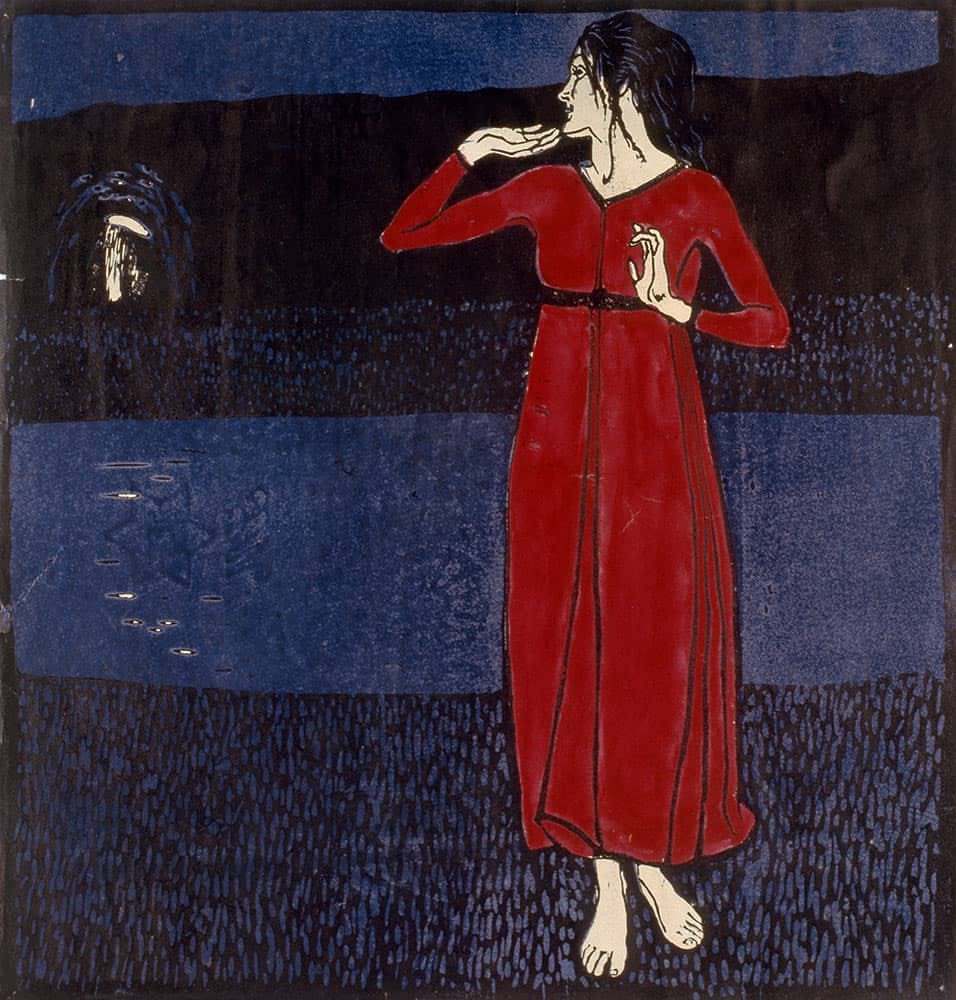
Vienna Secession: Erwin Lang
Grete Wiesenthal (The Red Girl) (Grete Wiesenthal / Das rote Mädchen), c. 1904
Woodcut on paper, colored
38 x 36 cm
University of Applied Arts Vienna
At the turn of the twentieth century, Vienna became the core center for a major revival of the color woodcut. Between 1900 and 1910, artists within the Vienna Secession turned to printmaking, heavily influenced by traditional Japanese woodcuts, creating a widespread movement that altered the local art market. This shift was driven by a deliberate effort to make art collecting accessible to a broader public, pushing the concept of the original artwork out of its traditional, elite isolation. While established figures like Carl Moll, Emil Orlik, and Koloman Moser achieved lasting fame for their innovative graphic experiments during this print boom, younger practitioners like Erwin Lang (1886–1962) were heavily involved in the movement but have since been largely forgotten by mainstream art history.
The son of the prominent Austrian feminist and activist Marie Lang, Erwin Lang received a rigorous education under Alfred Roller at the Vienna School of Arts and Crafts. His early career focused significantly on the performing arts, gaining recognition as a prominent stage designer in Berlin and Vienna. By 1911, his artistic reputation was firmly established when he participated in a major exhibition at the Vienna Hagenbund alongside Oskar Kokoschka and Egon Schiele. Despite these high-profile connections and his technical mastery, Lang’s name slipped into the margins of the Secession narrative, overshadowed by his more famous contemporaries.

Erwin Lang was completely mesmerized by the dancer Grete Wiesenthal (1885–1970), who became a leading figure in modern dance and its development in Austria. Wiesenthal revolutionized the medium by transforming the traditional, rigid Viennese Waltz into a fluid, ecstatic dance. She became Lang’s primary model and muse, inspiring him to create a series of several woodcuts dedicated to capturing her performance presence. The two eventually married in 1910, cementing a deep personal and creative partnership that defined his early graphic output.
Rather than attempting to illustrate his future wife’s performance within a realistic stage setting, Lang compresses her form into a flat, highly stylized composition in Grete Wiesenthal (The Red Girl). The work relies on a direct contrast between the heavy woodblock lines and the dense red color block of the garment, which completely dominates the square layout. Lang drops standard atmospheric perspective, using the flat properties of the wood block to create a clean, graphic silhouette. This approach aligns with the wider “Art for All” philosophy of the period, which favored direct visual impact and clear lines over complex academic modeling.
This flat, graphic approach contrasts sharply with Wiesenthal’s reputation for fluid, ecstatic movement. By locking her form into a rigid woodcut pattern, Lang swaps physical motion for geometric structure, creating a clear tension between the dancer’s freedom and the constraints of the print medium.
Leave a Reply