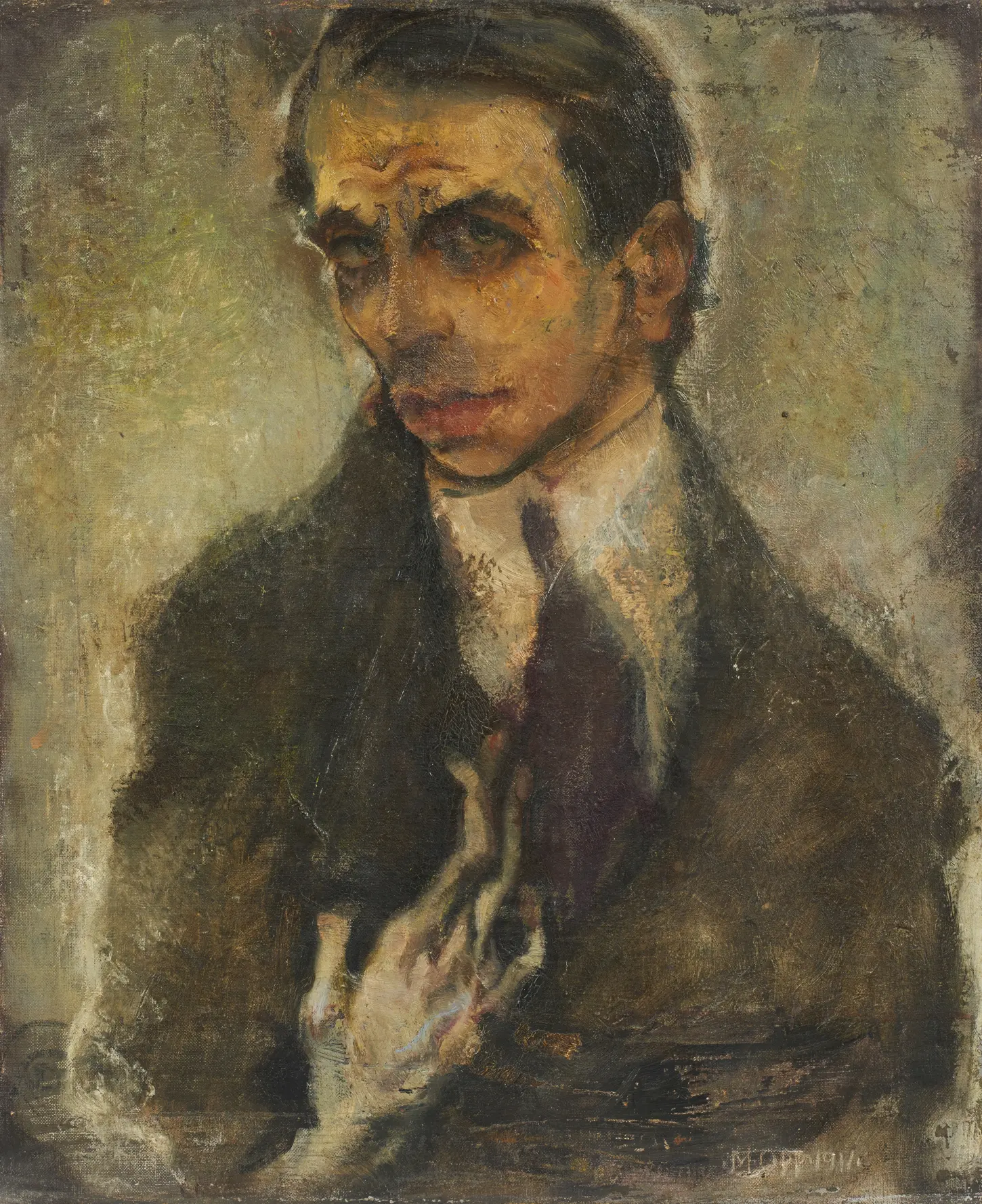
Max Oppenheimer:
Self-Portrait (Selbstbildnis), 1911
Oil on canvas
63 × 51.3 cm
©Leopold Museum, Vienna
Few artworks carry a history as heavily tied to the tragic fate of Viennese collecting as Max Oppenheimer’s 1911 Self-Portrait. Regarded as an icon of early Austrian Expressionism, the canvas represents a deeply personal declaration by the artist. Oppenheimer structures his pose to reference classical art history, presenting himself in a direct front view with a raised, skeletal hand. This specific gesture mirrors traditional Salvator Mundi religious depictions, famously used by older masters like Albrecht Dürer.
Yet, Oppenheimer rejects the confidence of the old masters. He depicts himself with a wrinkled forehead and a slightly turned, questioning gaze, capturing the image of an artist isolated by doubt rather than celebrated by society. The painting was clearly a milestone for Oppenheimer, who chose to include it in all his major early career exhibitions across Munich, Zürich, and Berlin between 1911 and 1912.
Parallel Paths with Egon Schiele
The visual language of this 1911 canvas highlights the deep stylistic dialogue between Oppenheimer and Egon Schiele. Just a year prior, in 1910, the two young artists shared a studio space in Vienna, intensely observing and influencing each other’s work. The choice to utilize extreme anatomical distortion—specifically the highly expressive, elongated, and bony fingers of the raised hand—directly reflects the radical experiments Schiele was conducting in his own self-portraits during that exact window.
Furthermore, Oppenheimer’s decision to drop his model into an empty, abstract space mirrors Schiele’s technique of isolating bodies to amplify psychological strain. Both artists were moving aggressively away from the flat, ornamental gold leaf patterns of Gustav Klimt. Instead, they weaponized raw flesh tones and nervous contours to expose an uncomfortable, interior reality.
The Plunder of the Reichel Collection
By 1913, the Self-Portrait had entered the private collection of Dr. Oskar Reichel, a prominent Viennese physician, businessman, and pioneering art patron. Reichel was a central figure in the early Expressionist network, using his wealth to support young radicals who were routinely rejected by the academic establishment. He built an extraordinary archive of modern Austrian art, acting as a crucial early patron to both Oppenheimer and Schiele. In 1913, this specific canvas was a centerpiece when Reichel’s collection was publicly exhibited at the Vienna Galerie Miethke.
The fate of both the collector and the artwork changed completely following the Nazi annexation of Austria in March 1938. Because of his Jewish heritage, Dr. Reichel was systematically persecuted by the Nazi regime. His business assets were frozen, and his legendary art collection—which also housed vital early drawings and paintings by Schiele—was entirely plundered and scattered, leaving its exact modern whereabouts largely unknown to this day. Dr. Reichel remained trapped in Vienna, where he passed away in 1943 amid the ongoing destruction of his life’s work.
Disappearance and Restitution
Oppenheimer’s Self-Portrait vanished into private hands for decades after the war, passing unrecorded through several obscure Austrian collections. It briefly resurfaced on the commercial market in early 2023 when a private party attempted to sell the canvas through an international auction house in Cologne. Recognizing the painting’s heavy history, the auction lot was quickly withdrawn so that a legal solution could be pursued.
In late August 2023, the Leopold Museum stepped forward to purchase the painting from its private possessor. Crucially, the acquisition was predicated on reaching a formal, equitable settlement with the legal successor and heirs of Dr. Oskar Reichel, adhering directly to the international guidelines. Now permanently housed in the Leopold Museum—coincidentally alongside the world’s largest collection of works by Egon Schiele—the canvas is displayed not just as a landmark of Expressionist art, but as a public commemoration of the legacy and persecution of Dr. Oskar Reichel.
Leave a Reply