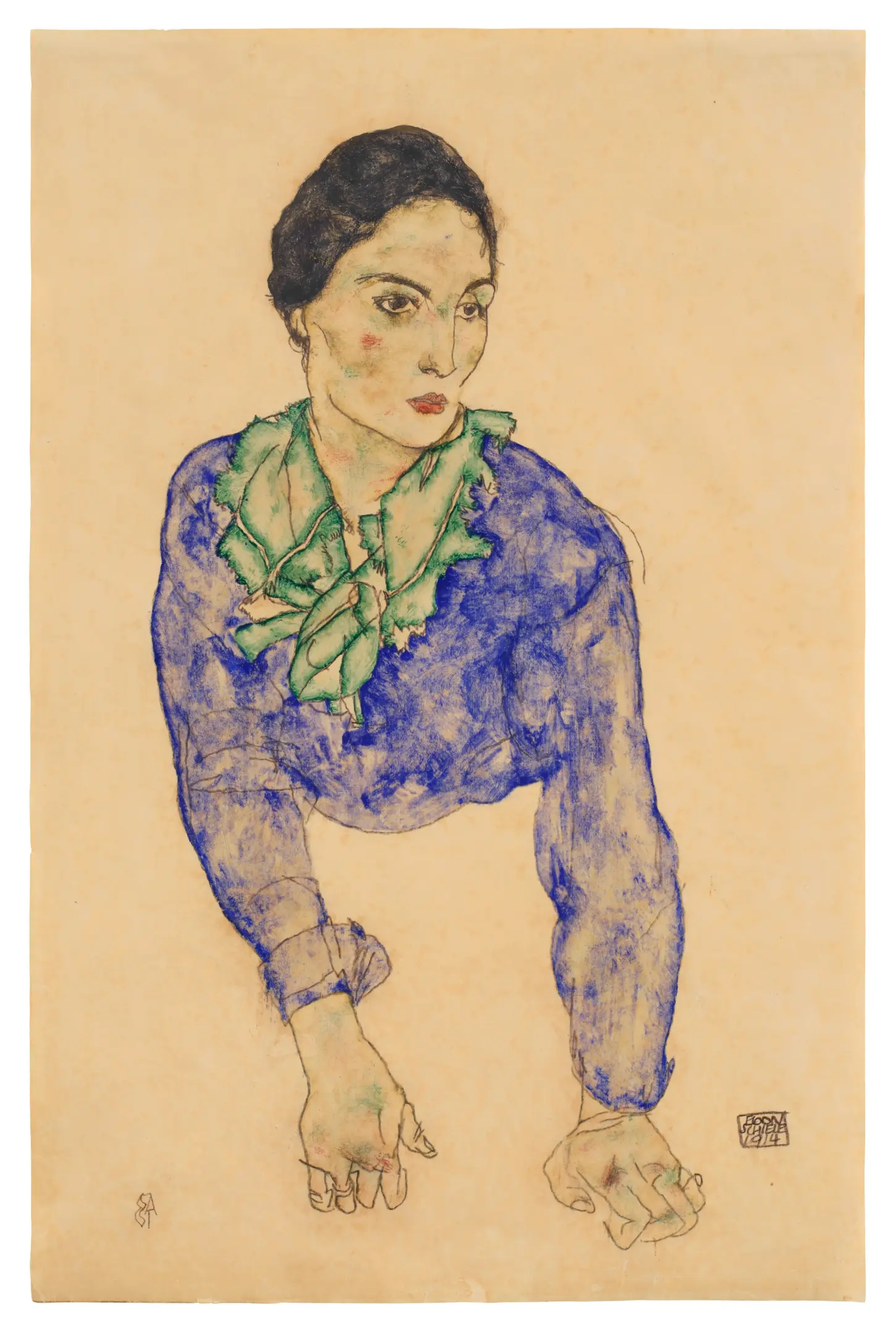
Egon Schiele:
Portrait of a Woman with Blue and Green Scarf (Frauenbildnis mit Blauem und Grünem Halstuch), 1914
Gouache and pencil on paper
45.5 x 30 cm (17 ⅞ by 11 ¾ in.)
Auctioned at Sotheby’s in New York (May 2024) for 1,920,000 USD
(Kallir d1595)
The year 1914 marked a clear shift in Egon Schiele’s life and work. Vienna was under the shadow of the impending World War I, and Schiele faced significant personal changes. His sister Gerti married, altering their close family dynamic, and he was experiencing mounting social pressure to leave his partner, Wally Neuzil, in favor of a conventional marriage. These tensions influenced his style, causing his usual sharp angularity to soften into rounder, more contained forms, though the underlying emotional strain remained entirely intact.
In Frauenbildnis mit Blauem und Grünem Halstuch, these pressures result in a figure that feels both assertive and restricted. Schiele isolates the woman against a blank paper background, completely removing any domestic or decorative setting. By 1914, his mentor Gustav Klimt had already moved away from his famous golden style toward fluid, colorful floral patterns. Yet, while Klimt continued to focus on elaborate surface decorations, Schiele chose a more direct approach, stripping away any framing to focus entirely on the subject’s internal state.
The technical execution balances a firm pencil outline with flat, dense gouache coloring. The woman’s face is tightly framed and almost compressed by the blocks of blue and green from her scarf. Rather than providing a realistic description, the contrast between the cool tones of the fabric and her pale skin creates a specific, quiet mood. The piece passed through several private collections in Europe and the United States before selling at Sotheby’s in May 2024. Beyond its commercial value, the drawing remains a clear example of how Schiele captured the changing psychological reality of a society on the brink of historical rupture.
Leave a Reply