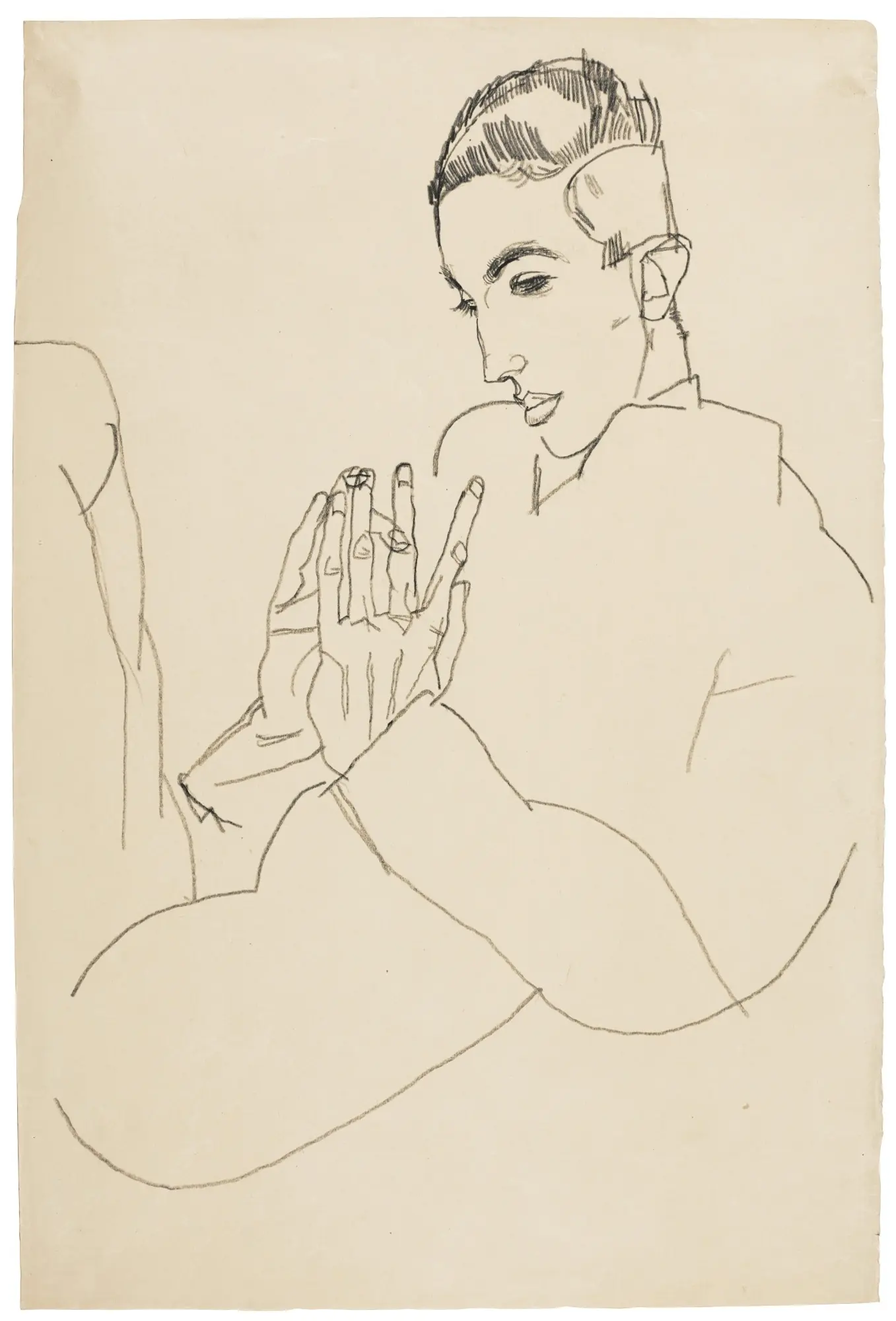
Egon Schiele:
Portrait of Erich Lederer with Hands Clasped (Erich Lederer, die Hände gefaltet), 1915
Pencil on paper
48 x 32 cm (18 ⅞ by 12 ⅝ in.)
Auctioned at Sotheby’s in New York (November 2019) for 300,000 USD
(Kallir d1762)
The relationship between Egon Schiele and the prominent Lederer family was one of the most significant patronage connections of his career. Introduced to the wealthy industrialist August Lederer and his wife Serena by Gustav Klimt in 1912, Schiele was quickly integrated into their circle. During a Christmas stay at their Hungarian estate that same year, Schiele developed a close friendship with their son, Erich Lederer (1896–1985). The young Lederer drew and painted as well, prompting Schiele to describe him in a letter as a “born painter” with a “long aristocratic face.” While Schiele only completed one oil portrait of the boy, their bond resulted in numerous drawings over the following years.
Executed three years after their first meeting, Erich Lederer, die Hände gefaltet captures the sitter with a new sense of personal maturity. Schiele moves away from his earlier, more youthful depictions of Erich, focusing instead on a quiet self-possession and deep thoughtfulness. The drawing relies entirely on linear economy, a key feature of Schiele’s draftsmanship during this mid-career period. With simple precision, the artist uses just a few sparse pencil lines to block out the form of the body, allowing precise details to gather only in two focal areas: the face and the interlocked fingers. Left entirely without a background or domestic setting, the composition focuses all attention onto these specific features.
The provenance of this sheet is tied directly to the history of Viennese art collecting. Acquired from the artist by the sitter’s father, August Lederer, the drawing remained within the family’s private collection for decades, descending through generations before appearing on the secondary market. By removing all non-essential elements, Schiele relies solely on the downward gaze of the teenager and the posture of his hands to establish an intimate space. The work reflects both the growth of a young man and a deliberate shift in the artist’s technique, conveying an internal stillness through a minimal use of graphic marks.
Leave a Reply