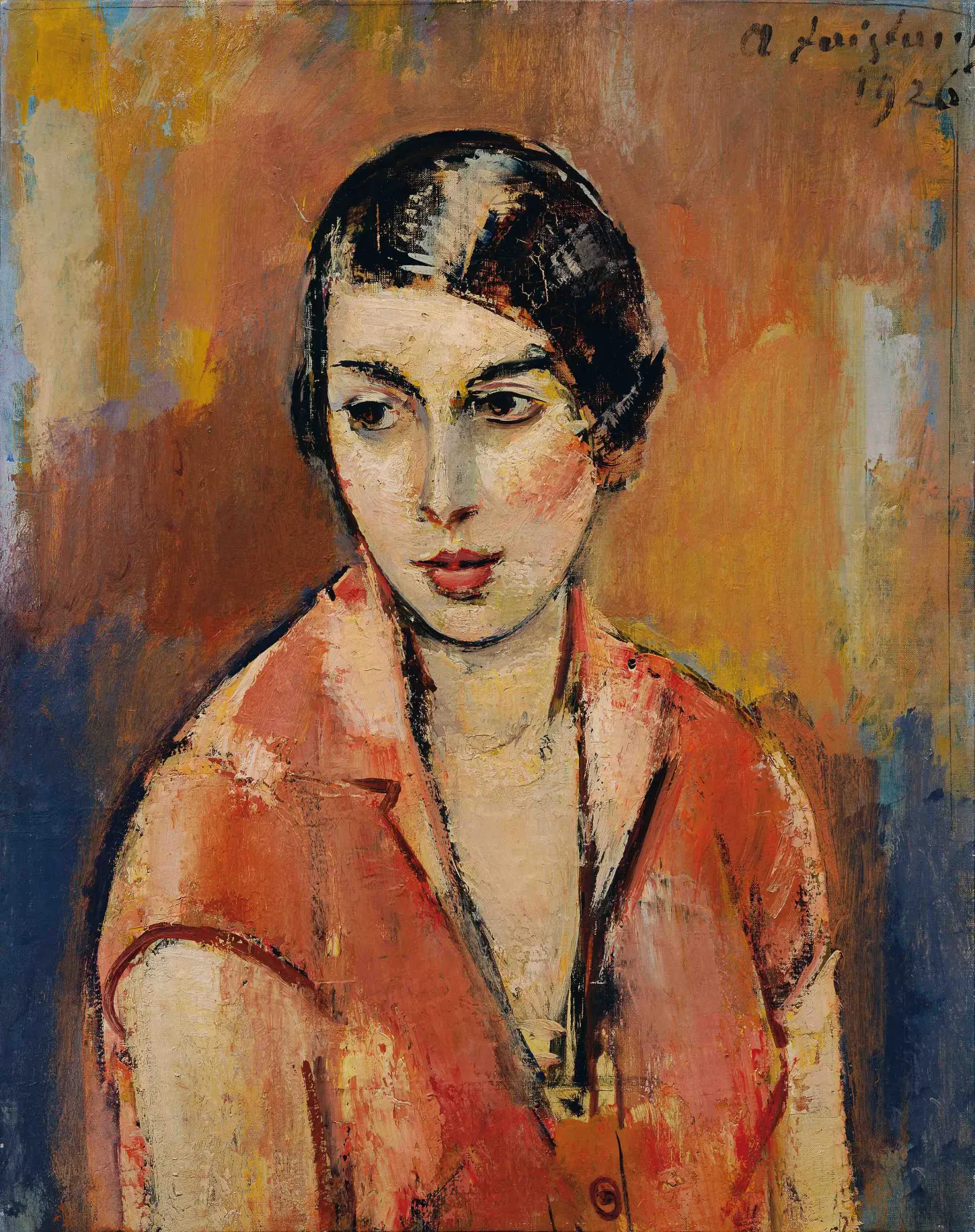
Die Neukunstgruppe and Friends of Schiele: Anton Faistauer:
Young Woman in Pink Dress (Junge Frau im rosa Kleid [Pariserin]), 1926
Oil on canvas
58 × 46 cm
©Belvedere, Vienna
The 1920s presented a complex challenge for Austrian modernism. Following the collapse of the Habsburg Empire and the sudden deaths of Gustav Klimt and Egon Schiele in 1918, the next generation of painters had to find a way forward. Anton Faistauer handled this transition by turning away from radical psychological shock values. His late work, Young Woman in Pink Dress (Junge Frau im rosa Kleid), alternative title Pariserin, demonstrates how he chose painterly texture over the nervous, graphic lines that had previously defined the Viennese avant-garde.
Faistauer’s position in this history is directly tied to Schiele. In 1909, both artists famously walked out of the rigid Academy of Fine Arts in Vienna to found the Neukunstgruppe (New Art Group). They shared a mutual disgust for academic historical painting, yet their artistic solutions split early on. While Schiele used the human anatomy as a canvas for existential angst, Faistauer’s later style focused heavily on French-influenced color theory, demonstrating how far the former members of the Neukunstgruppe diverged over the span of two decades.
A Departure from Existential Tension
In this portrait, the model looks out toward the viewer, but she remains emotionally distant. Faistauer does not slice into the subject’s psyche with raw contour lines, nor does he surround her with Klimt-like gold mosaics. Instead, the boundary between the figure and her background is deliberately blurred.
The focus rests entirely on how light interacts with the garment. The pink fabric is built through rapid, heavy strokes of the brush, creating a sense of volume and movement without relying on solid outlines. The surface feels alive because of the paint application itself, rather than any dramatic pose or facial expression. By prioritizing the physical qualities of oil paint over precise drawing, Faistauer achieved a quiet stability that offered an alternative to the restless energy of his youth.
The Palette and Visual Contrast
The composition avoids the aggressive contrasts found in early Expressionism. Faistauer limits his palette to a set of harmonic tones, balancing the soft pink against neutral, deep background shades.
The skin tones are rendered through a mix of warm and cool highlights rather than a smooth academic finish. This specific choice gives the portrait an unpolished, immediate quality. It feels less like a formal studio commission and more like an observant study of light on cloth. By steering clear of heavy symbolism, Pariserin shows how Faistauer remained independent, using the color freedom championed by the 1909 movement to create a calmer, more painterly modern style.
The Legacy of the Rieger Collection
The provenance of the canvas links it directly back to the golden age of Viennese collecting. The painting was originally purchased by Dr. Heinrich Rieger, a prominent dentist whose legendary collection housed some of the most important early
expressionist works in Austria, including numerous masterpieces by Schiele. In 1951, the painting was acquired from Robert Rieger by the Belvedere in Vienna, cementing Faistauer’s post-war transition as a permanent chapter in the story of Austrian art.
Leave a Reply