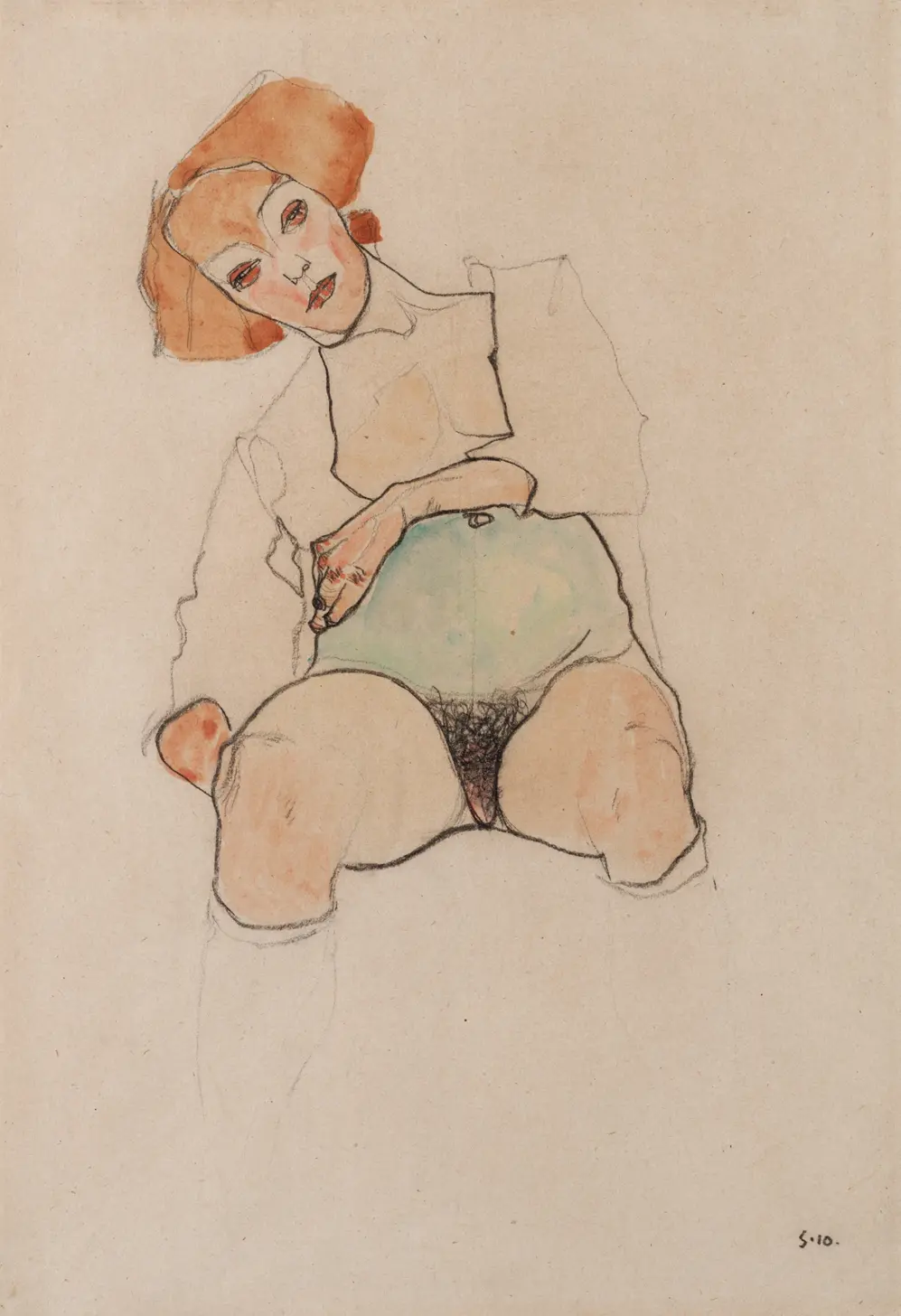
Egon Schiele:
Pregnant Woman with Green Stomach, Seated (Sitzende Schwangere mit grünem Bauch), 1910
Black chalk and watercolour on paper
44.1 × 30.2 cm
©Leopold Museum, Vienna
(Kallir d540)
The Clinical Setting and Erwin von Graff
This 1910 sheet belongs to a distinct series of at least sixteen drawings of pregnant women and newborn children executed outside of Schiele’s private studio. The works were produced at the Second Women’s Clinic in Vienna. Access to the gynecological ward was granted through Schiele’s personal friendship with the physician Dr. Erwin von Graff. Von Graff met Schiele early in 1910 through the art collector Carl Reininghaus, and subsequently permitted the artist to draw patients directly in the clinic. Later that year, Schiele painted von Graff’s portrait as an expression of gratitude. This collaboration reflects a broader, contemporary interest in the human body shared by both progressive artists and medical professionals in Vienna around 1900.
While Schiele places the subject within an empty, abstract image space without physical architecture, the medical reality remains embedded in the presentation. The specific posture—with an exposed abdomen and pulled-up clothing—directly references the clinical setting of a contemporary gynecological examination.
The Connection to Erwin Osen
This practice of using medical institutions as a studio environment was closely linked to Schiele’s close friend and fellow artist, Erwin Osen. Osen, who served as a key model and companion to Schiele during this exact period, shared this fascination with the pathologically expressive body. While Schiele focused on the maternity ward under von Graff in 1910, Osen later expanded this trend by executing portrait series of patients undergoing treatment at the Garrison Hospital II in Vienna. Together, Schiele and Osen established a strand of Viennese Modernism that relied heavily on clinical spaces to develop an uncompromising, non-academic style of figuration.
The Ethics and Anonymity of the Models
Unlike Schiele’s studio work with hired muses or family members, the identity of the model in Sitzende Schwangere mit grünem Bauch remains entirely unknown. The subject was an actual patient hospitalized at the Vienna women’s clinic. In the social context of 1910, allowing a male avant-garde artist into a public ward to sketch vulnerable, lower-class or unwed expectant mothers was highly unconventional, morally contested, and strictly unusual.
By modern ethical and legal standards, such a practice would be completely unthinkable. Today, any physician granting an outside artist unrestricted access to private medical wards to sketch vulnerable patients would face severe professional, legal, and disciplinary consequences, including immediate termination and the loss of their medical license. Even in 1910, the arrangement relied entirely on a problematic power dynamic; the clinical setting allowed Schiele to observe the female body strictly as a medical and formal subject. He did not seek a conventional portrait of a specific individual, but concentrated on the physical state of pregnancy. This isolation is reinforced by his decision to strip the paper of any hospital interior, leaving the patient suspended in an empty void.
Color and Form
The drawing relies on the stark juxtaposition of bare paper, dark chalk contours, and localized watercolor washes. The title-giving application of green watercolor across the swollen belly acts as the visual anchor of the composition.
Schiele utilizes a stylized approach to color that moves away from naturalistic representation, applying unexpected tones to the flesh and garments to build formal tension. The seated figure is framed by the heavy fabric of her blouse, isolating the exposed skin and structural lines of the lower body. This graphic isolation emphasizes the anatomical focus of the work, rendering a subject matter that fundamentally challenged the conventional studio themes of the early twentieth century.
Leave a Reply