
The Final Chapter: A Forgotten Photograph of Emilie Flöge from the Late 1940s
Most accounts of Emilie Flöge’s life fade into obscurity after the forced closure of her fashion salon in 1938 and the devastating fire that consumed her Vienna apartment in 1945. For decades, the public imagery of Flöge remained limited to the vibrant reform dresses of her youth or the informal portraits from the mid-1930s. However, a highly rare vintage photograph that quietly surfaced at a Dorotheum auction in Vienna in April 2020 offers a glimpse into her final years.
A Discovered Portrait from the Archives
The original gelatin silver print, preserved for decades within the Flöge family archives, is broadly cataloged by the auction house as dating from the “1940er Jahre”. Given her appearance and silver-white hair in the portrait, it was highly likely taken in the late 1940s, just a few years before her death in 1952. The cataloging details reveal a poignant historical fact: the photograph captures Flöge outdoors in Weißenbach am Attersee, specifically walking in the garden of the ‘Villa Klimt-Flöge’.
Returning to the Attersee
This location adds significant context to her later life. Even after the collapse of her business, the loss of her sister Helene in 1936, and the destruction of World War II, Flöge continued to return to the Attersee. This was the exact region where she and Gustav Klimt had spent their summer months decades earlier, escaping the social pressures of Vienna.
In this late portrait, Flöge appears as an elderly lady, walking along a garden path next to blooming flowers, with the villa and a white picket fence visible behind her. Rather than a staged studio portrait, it serves as a documentary record of her later years. She outlived the Secession movement by over three decades, eventually passing away in Vienna on May 26, 1952, at the age of 77.
The Fate of the Flöge Collection
While the auction at Dorotheum passed without widespread media attention, the rediscovery of this print provides a rare concluding image to her biography. It demonstrates that her connection to the landscapes of her youth remained intact until the very end of her life.
A Protected Legacy in Vienna
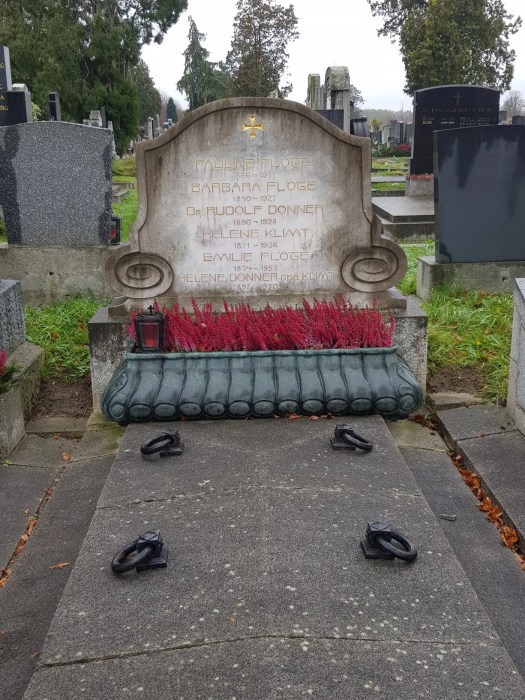
Today, she rests in the family grave at the Evangelischer Friedhof Simmering in Vienna. The headstone stands as a quiet monument, uniting Emilie with her sisters Pauline and Helene, and her niece Helene Klimt. This final resting place itself narrowly survived being cleared away; after the family rights to the plot expired, the grave faced demolition and was nearly lost to history. Fortunately, following its rediscovery by researchers, the city of Vienna stepped in to grant it a permanent preservation status (‘ehrenhalber gewidmetes Grab‘). The grave is now protected by the state, ensuring that the legacy of these women will be preserved for future generations.
(Note: During a visit to the cemetery in November 2025, I located and photographed this family monument, which remains a physical link to the Flöge family’s place in Vienna’s cultural history.)
Leave a Reply