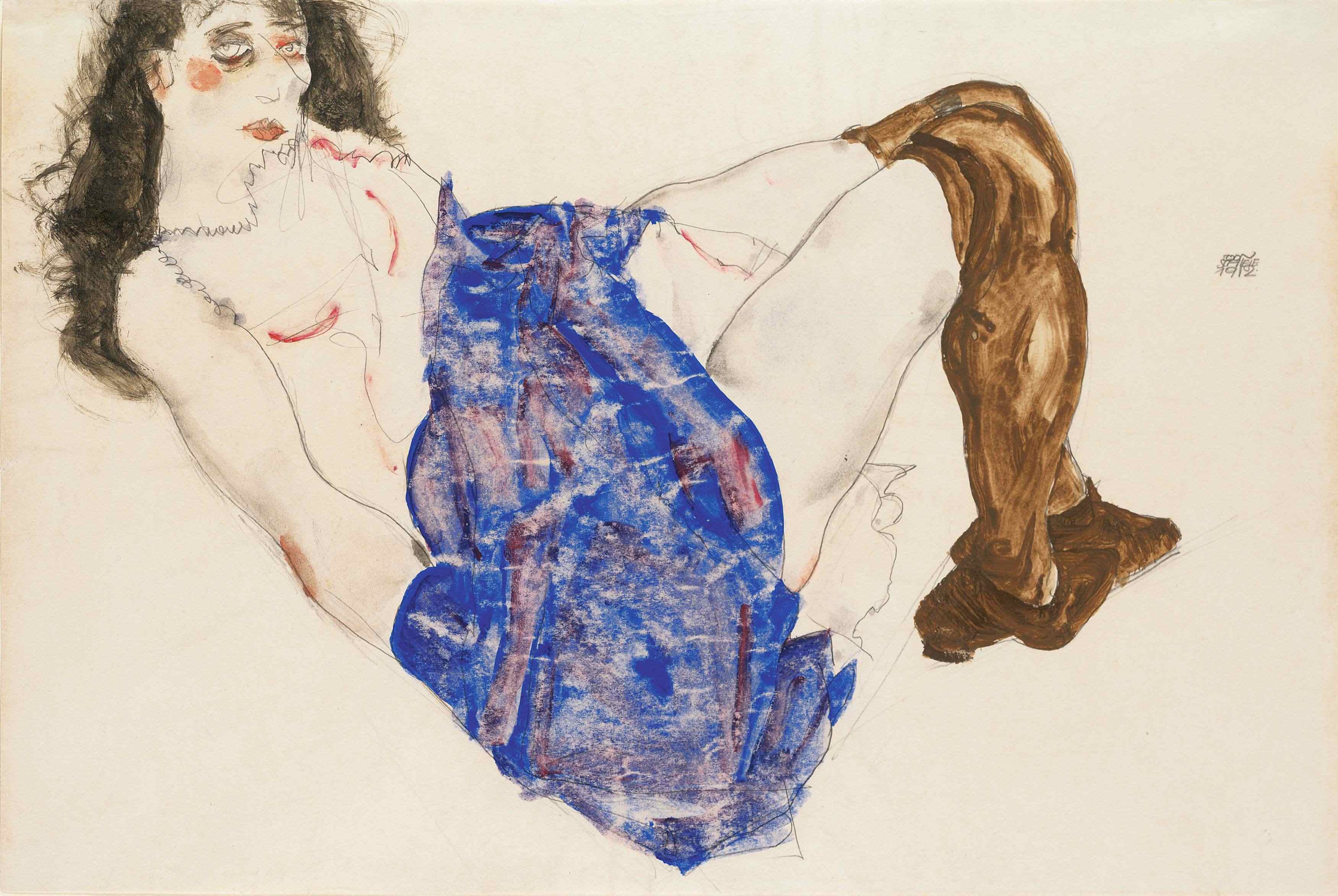
Egon Schiele:
Dark-Haired Woman with Blue Cloth over her Hips (Schwarzhaarige mit blauem Tuch über den Hüften), 1912
Pencil and gouache on paper
29.4 x 43.2 cm
©Leopold Museum, Vienna
(Kallir d1100)
Egon Schiele’s Schwarzhaarige mit blauem Tuch über den Hüften (Dark-Haired Woman with Blue Cloth over her Hips) is a figure study from 1912. Created during a turbulent yet highly productive period in Schiele’s career, this work demonstrates his technique of combining sharp pencil contours with a selective application of gouache. The year 1912 marked a major turning point for the artist; following his arrest and brief imprisonment in Neulengbach, Schiele experienced a personal crisis that shifted his artistic focus away from adolescent models toward mature, adult subjects.
The composition focuses on a seated female figure. The model is positioned with bent and spread legs, a pose frequently used by Schiele to explore the human anatomy from unconventional angles. Her dark hair contrasts with her skin tones, while the foreshortened perspective highlights the structural form of the body rather than a traditional, idealized depiction. To achieve this intense focus, Schiele omitted any physical support or background elements from the final drawing. While the model required a surface to lean against to maintain this position, removing that context forces the viewer to focus entirely on the tension of the pose itself.
Technically, the drawing highlights Schiele’s practice of executing lines in single, uninterrupted movements. He isolates the figure against the plain surface of the paper to intensify the viewer’s focus on the subject’s form and posture. This minimalist spatial approach allows the negative space around the model to function as an active compositional element, reinforcing the sense of stark intimacy that defines his graphic oeuvre.
The color palette is deliberately limited. The vibrant blue fabric draped over the model’s hips serves as the central visual element of the piece. This rich blue tone creates a clear contrast with both the bare skin and the dark stockings, anchoring the composition and drawing the eye to the center of the drawing.
The provenance of this artwork includes notable collections such as those of Wolfgang Gurlitt and the Galleria Galatea in Turin. Dr. Rudolf Leopold acquired the piece in 1963, and it eventually became part of the Leopold Museum-Privatstiftung in 1994. Today, it remains an important example of early 20th-century Austrian Expressionist graphic art within the Leopold Museum Online Sammlung.
Leave a Reply