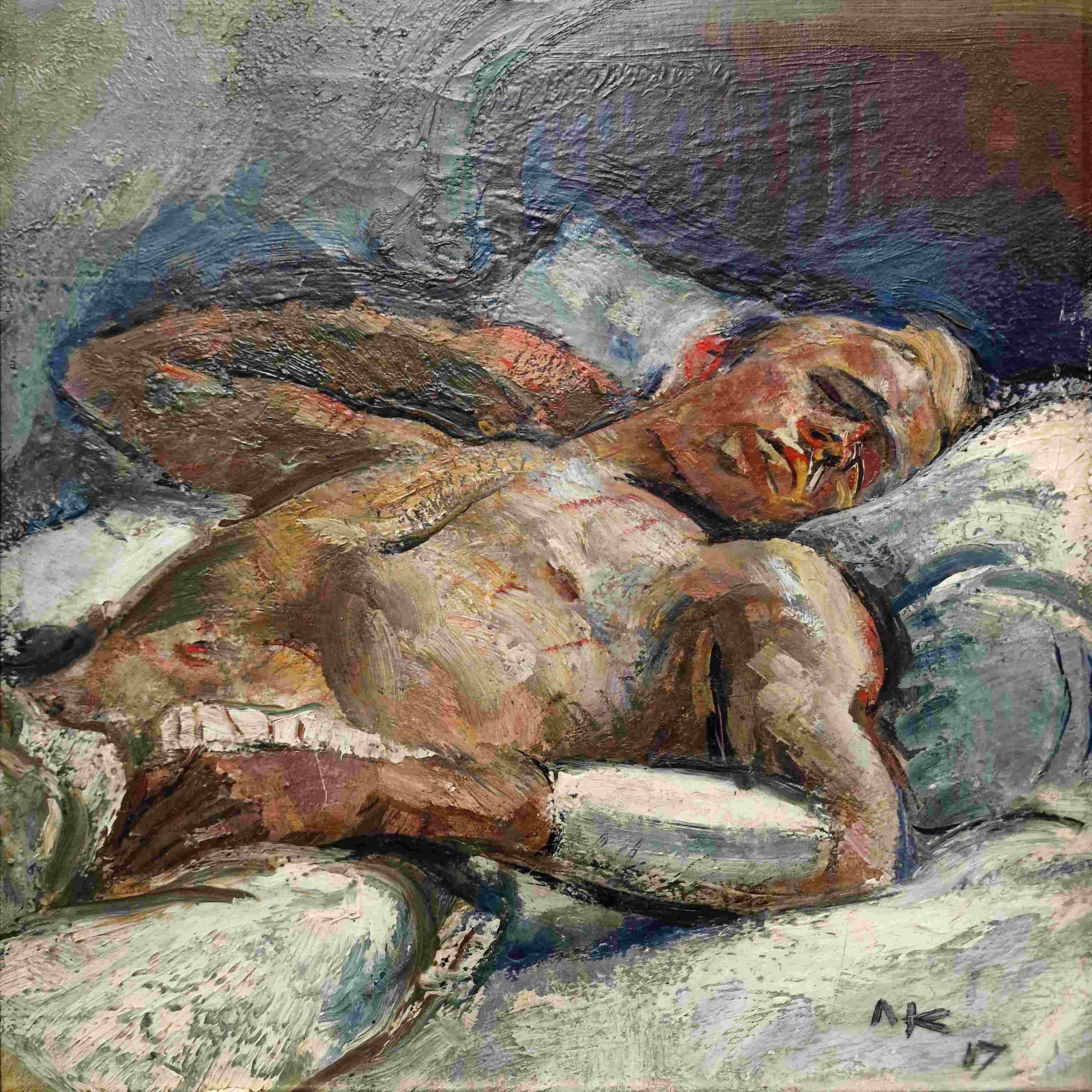
Die Neukunstgruppe and Friends of Schiele: Anton Kolig
Verwundeter (Wounded Man), 1917
Oil on canvas
42 x 36 cm
©National Gallery Prague, Czechia
Anton Kolig’s painting “Verwundeter” (Wounded Man) from 1917 shows a wounded soldier, making clear the pain and trauma of World War I. Kolig uses strong colors and expressive brush strokes to capture the soldier’s suffering. The man’s pained expression and vulnerable pose emphasize the harsh reality of war. This raw depiction of human suffering stands in stark contrast to the heroic propaganda expected from official wartime art. With its distorted posture and deep psychological focus, “Verwundeter” draws a powerful stylistic parallel to Egon Schiele’s own tortured figure drawings from the same period, showing how both artists used the human canvas to mirror the heavy psychological trauma of their generation.
Anton Kolig (1886-1950) was an Austrian artist who played an important role in Austrian Expressionism. He was a founding member of the Neukunstgruppe (New Art Group) in 1909, which was established by Egon Schiele, Anton Peschka, Albert Paris von Gütersloh, and Anton Faistauer. This group was formed out of dissatisfaction with the conservative and outdated teaching methods at the Vienna Academy of Fine Arts. Kolig’s involvement in this group marked his commitment to innovative and progressive art. While the group revolted against the Academy, they found a spiritual mentor in Gustav Klimt, who championed the young rebels and opened doors for them within the broader Viennese art scene, fostering a creative bridge between Art Nouveau and the emerging Expressionism.
Kolig’s connection to Egon Schiele was both personal and professional. They maintained a correspondence, and Schiele even helped Kolig by trying to find buyers for his works. In one letter from 1918, Kolig expressed his gratitude to Schiele for his support and assistance. This mutual respect culminated in early 1918. Following the tragic and unexpected death of Gustav Klimt in February 1918, Schiele suddenly became the leading figure of the Viennese avant-garde. He was invited to organize the historic 49th Vienna Secession exhibition in March 1918, where he included Kolig’s work alongside his own. It was a bittersweet breakthrough; Schiele’s famous poster for the exhibition featured an empty chair—a poignant tribute to their late mentor, Klimt, whose sudden absence reshaped their entire artistic circle.
Throughout his career, Kolig created many male nudes, still lifes, and portraits. He preferred monumental paintings and admired the works of Michelangelo and Lovis Corinth. His use of intense colors and expressive techniques distinguished his work within the Expressionist movement.
Kolig’s personal career was marked by several significant events. During World War I, he served as a war painter for the Austro-Hungarian Army Press Bureau. After the war, he attempted to realize his vision of a private art school in Nötsch, where he taught some of his first students, including Gerhart Frankl, Theodor Herzmansky, and Wolfgang von Schaukal. He also held a professorship at the Württemberg Academy of Art in Stuttgart from 1928 until his retirement in 1943 due to the political climate under National Socialism.
Unfortunately, during a bombardment in 1944, two-thirds of Kolig’s works were destroyed. Despite this loss, some of his surviving works can be seen at the Leopold Museum in Vienna.
Leave a Reply