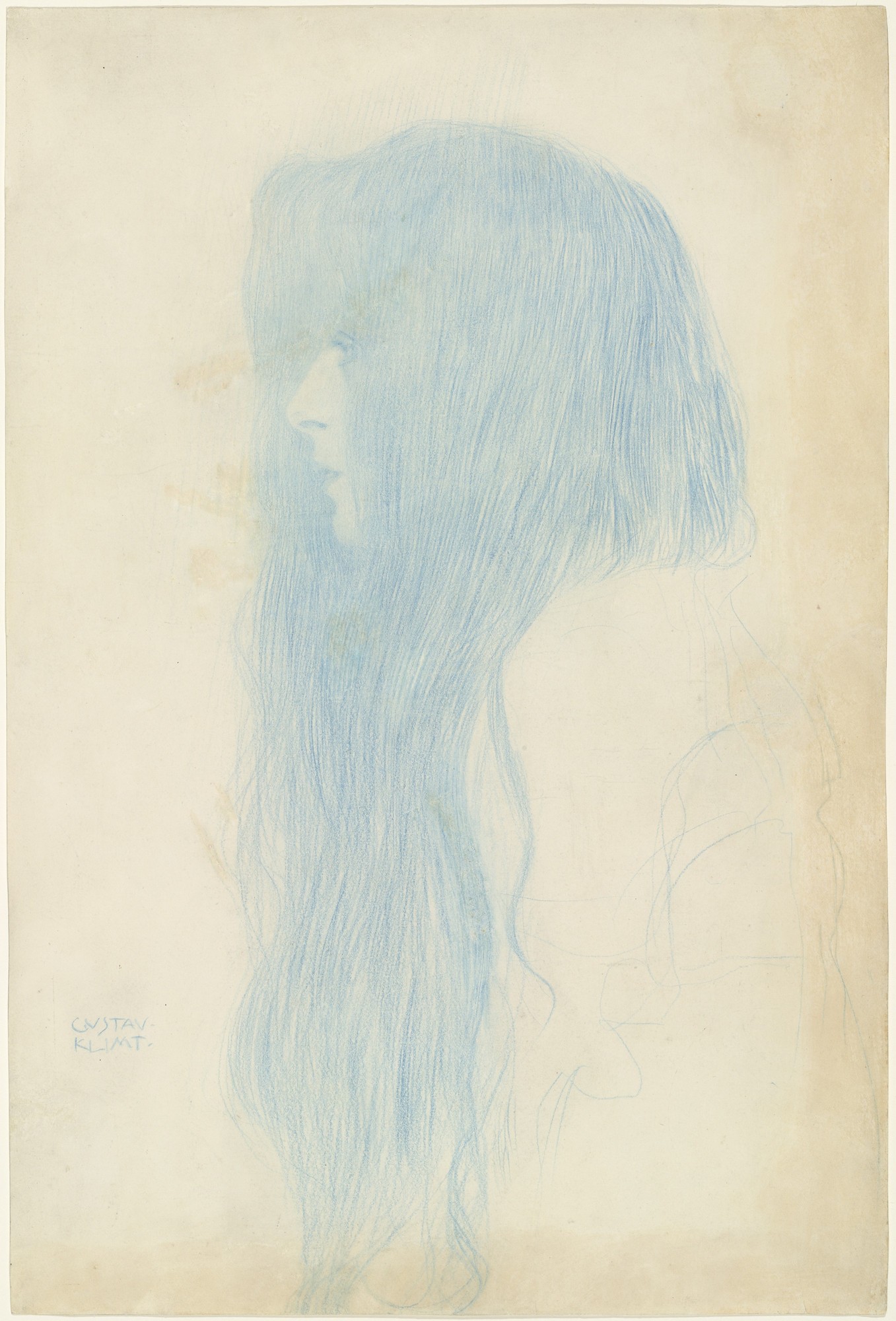
Gustav Klimt:
Bust of a Girl with Long Hair, Profile to the Left (Brustbild eines Mädchens mit langem Haar im Profil nach links), 1898–1899
Blue pencil on paper
42.6 × 28.9 cm
©The Museum of Modern Art, New York
(Strobl 432)
The drawing shows a young girl in profile, her long hair falling softly along the contour of her face. Klimt traces the profile with a calm, deliberate line, giving the sitter a quiet presence that feels attentive yet slightly withdrawn. The blue pencil lends the sheet a cool, restrained tone, allowing the features to emerge gently from the paper without strong contrasts. The signature at the lower margin places the drawing within Klimt’s portrait studies from the late 1890s, when he was refining a more intimate, linear approach to the female head.
The sheet belongs to a group of youthful portraits in which Klimt explored subtle variations of profile, gesture, and expression. These studies are closely related to his broader figural research for Thalia und Melpomene, an allegorical drawing created in 1898 for the Secessionist magazine Ver Sacrum. In this work, Klimt examined the clarity of contour and the expressive potential of the female profile. The modelling is concentrated on the face, while the hair and shoulders remain lightly indicated, creating a balance between precision and suggestion that is characteristic of his drawings from these years. The verso inscription, partly erased and written by an unknown hand, offers no further information about the sitter.
The Allegorical Context: Thalia and Melpomene
In Greek mythology, Thalia and Melpomene personify the fundamental balance of dramatic art: the interplay between comedy and tragedy. For the definitive 1898 composition—now preserved in the Albertina Museum in Vienna—Klimt juxtaposed the two muses through contrasting perspectives. He presented Thalia in a soft, smiling frontal view and Melpomene as a stern, mask-like profile. This specific study (Strobl 432) captures Klimt’s preparation for that female profile. By focusing on the pure contour of the girl’s face, Klimt transitions from classical portraiture to the symbolic style that defined the early years of the Vienna Secession.

The model is not identified in surviving documentation. Klimt frequently drew young women from his surroundings without recording their names, and no archival material links a specific person to Strobl 432. The drawing is therefore regarded as a self-contained study of an unnamed girl, representative of the quiet, observational character of Klimt’s portrait work around 1898–1899.
Leave a Reply